

Hyperfine and Electroweak Interactions in Heavy Finite Fermi Systems …
71
basis of the many-body PT. A minimization of the functional ImδE leads to integraldifferential Dirac-Kohn-Sham-like density functional equations. The magnetic interelectron interaction is accounted for in the lowest order on α
2 (α is the fine structure
constant) parameter.
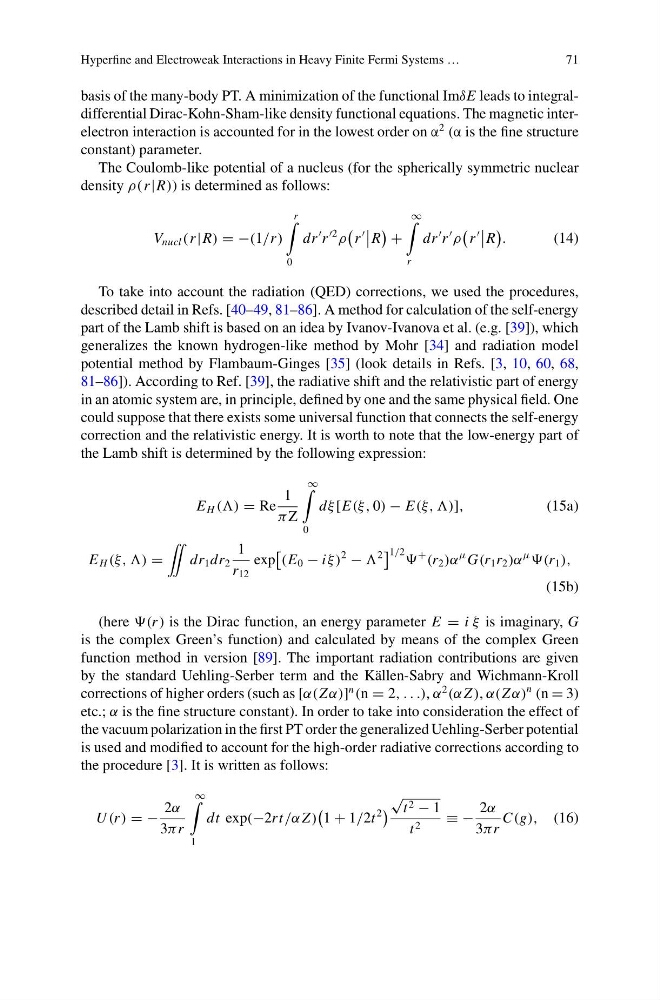
The Coulomb-like potential of a nucleus (for the spherically symmetric nuclear
density ρ(r |R)) is determined as follows:
V nucl (r |R) = −(1/r )
r
0
dr
r
2
ρ
r
R
+
∞
r
dr
r
ρ
r
R
.
(14)
To take into account the radiation (QED) corrections, we used the procedures,
described detail in Refs. [40–49, 81–86]. A method for calculation of the self-energy
part of the Lamb shift is based on an idea by Ivanov-Ivanova et al. (e.g. [39]), which
generalizes the known hydrogen-like method by Mohr [34] and radiation model
potential method by Flambaum-Ginges [35] (look details in Refs. [3, 10, 60, 68,
81–86]). According to Ref. [39], the radiative shift and the relativistic part of energy
in an atomic system are, in principle, defined by one and the same physical field. One
could suppose that there exists some universal function that connects the self-energy
correction and the relativistic energy. It is worth to note that the low-energy part of
the Lamb shift is determined by the following expression:
E H (() = Re
1
π Z
∞
0
dξ [E(ξ, 0) − E(ξ, ,)],
(15a)
E H (ξ, ,) =
¨
dr 1 dr 2
1
r 12
exp
(E 0 − iξ )
2
−
2
1/2
+
(r 2 )α
μ G(r 1 r 2 )α
μ
(r 1 ),
(15b)
(here (r ) is the Dirac function, an energy parameter E = i ξ is imaginary, G
is the complex Green’s function) and calculated by means of the complex Green
function method in version [89]. The important radiation contributions are given
by the standard Uehling-Serber term and the Källen-Sabry and Wichmann-Kroll
corrections of higher orders (such as [α(Z α)]
n
(n = 2, . . .), α
2
(α Z ), α(Z α)
n (n = 3)
etc.; α is the fine structure constant). In order to take into consideration the effect of
the vacuum polarization in the first PT order the generalized Uehling-Serber potential
is used and modified to account for the high-order radiative corrections according to
the procedure [3]. It is written as follows:
U (r ) = −
2α
3πr
∞
1
dt exp(−2rt/α Z )
1 + 1/2t
2
√
t 2 − 1
t 2
≡ −
2α
3πr
C(g), (16)
71
basis of the many-body PT. A minimization of the functional ImδE leads to integraldifferential Dirac-Kohn-Sham-like density functional equations. The magnetic interelectron interaction is accounted for in the lowest order on α
2 (α is the fine structure
constant) parameter.
The Coulomb-like potential of a nucleus (for the spherically symmetric nuclear
density ρ(r |R)) is determined as follows:
V nucl (r |R) = −(1/r )
r
0
dr
r
2
ρ
r
R
+
∞
r
dr
r
ρ
r
R
.
(14)
To take into account the radiation (QED) corrections, we used the procedures,
described detail in Refs. [40–49, 81–86]. A method for calculation of the self-energy
part of the Lamb shift is based on an idea by Ivanov-Ivanova et al. (e.g. [39]), which
generalizes the known hydrogen-like method by Mohr [34] and radiation model
potential method by Flambaum-Ginges [35] (look details in Refs. [3, 10, 60, 68,
81–86]). According to Ref. [39], the radiative shift and the relativistic part of energy
in an atomic system are, in principle, defined by one and the same physical field. One
could suppose that there exists some universal function that connects the self-energy
correction and the relativistic energy. It is worth to note that the low-energy part of
the Lamb shift is determined by the following expression:
E H (() = Re
1
π Z
∞
0
dξ [E(ξ, 0) − E(ξ, ,)],
(15a)
E H (ξ, ,) =
¨
dr 1 dr 2
1
r 12
exp
(E 0 − iξ )
2
−
2
1/2
+
(r 2 )α
μ G(r 1 r 2 )α
μ
(r 1 ),
(15b)
(here (r ) is the Dirac function, an energy parameter E = i ξ is imaginary, G
is the complex Green’s function) and calculated by means of the complex Green
function method in version [89]. The important radiation contributions are given
by the standard Uehling-Serber term and the Källen-Sabry and Wichmann-Kroll
corrections of higher orders (such as [α(Z α)]
n
(n = 2, . . .), α
2
(α Z ), α(Z α)
n (n = 3)
etc.; α is the fine structure constant). In order to take into consideration the effect of
the vacuum polarization in the first PT order the generalized Uehling-Serber potential
is used and modified to account for the high-order radiative corrections according to
the procedure [3]. It is written as follows:
U (r ) = −
2α
3πr
∞
1
dt exp(−2rt/α Z )
1 + 1/2t
2
√
t 2 − 1
t 2
≡ −
2α
3πr
C(g), (16)