

70
O. Yu. Khetselius et al.
description of the corresponding matrix elements and other details of the general
method and PC code are presented in Refs. [3, 4, 10, 50, 63–98].
The fundamentals of the RMBPT formalism are presented previously in details
in Refs. [40–49] and here we mention only the key points. The RMBPT formalism
includes the optimized Dirac-Kohn-Sham (DKS) zeroth approximation and allows
to provide an effective taking the relativistic, exchange-correlation, nuclear, radiative effects into account. The relativistic electron wave functions are determined
from solution of the relativistic Dirac equation with a general potential. The latter
includes ab initio mean-field potential, electric, polarization potentials of a nucleus.
There have been considered all correlation corrections of the second order and dominated classes of the higher orders diagrams (electrons screening, mass operator
iterations etc.).
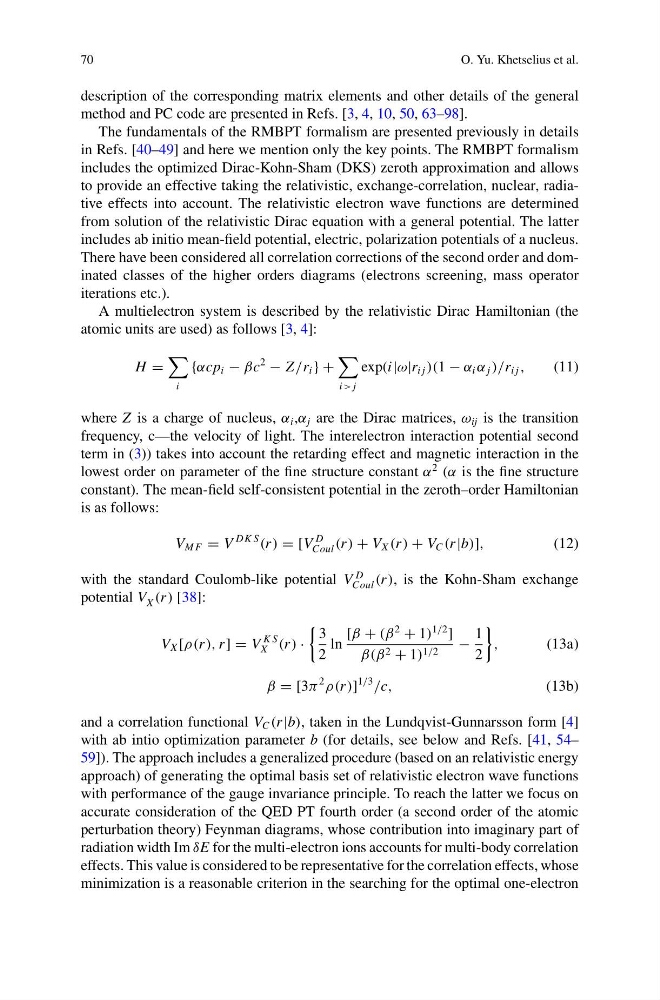
A multielectron system is described by the relativistic Dirac Hamiltonian (the
atomic units are used) as follows [3, 4]:
H =
i
{αcp i − βc
2
− Z /r i } +
i> j
exp(i|ω|r i j )(1 − α i α j )/r i j ,
(11)
where Z is a charge of nucleus, α i ,α j are the Dirac matrices, ω ij is the transition
frequency, c—the velocity of light. The interelectron interaction potential second
term in (3)) takes into account the retarding effect and magnetic interaction in the
lowest order on parameter of the fine structure constant α
2 (α is the fine structure
constant). The mean-field self-consistent potential in the zeroth–order Hamiltonian
is as follows:
V M F = V
DK S
(r ) = [V
D
Coul (r ) + V X (r ) + V C (r |b)],
(12)
with the standard Coulomb-like potential V
D
Coul (r ), is the Kohn-Sham exchange
potential V X (r ) [38]:
V X [ρ(r ), r ] = V
K S
X (r ) ·
3
2
ln
[β + (β
2
+ 1)
1/2
]
β(β 2 + 1) 1/2 −
1
2
,
(13a)
β = [3π
2
ρ(r )]
1/3
/c,
(13b)
and a correlation functional V C (r |b), taken in the Lundqvist-Gunnarsson form [4]
with ab intio optimization parameter b (for details, see below and Refs. [41, 54–
59]). The approach includes a generalized procedure (based on an relativistic energy
approach) of generating the optimal basis set of relativistic electron wave functions
with performance of the gauge invariance principle. To reach the latter we focus on
accurate consideration of the QED PT fourth order (a second order of the atomic
perturbation theory) Feynman diagrams, whose contribution into imaginary part of
radiation width Im δE for the multi-electron ions accounts for multi-body correlation
effects. This value is considered to be representative for the correlation effects, whose
minimization is a reasonable criterion in the searching for the optimal one-electron
O. Yu. Khetselius et al.
description of the corresponding matrix elements and other details of the general
method and PC code are presented in Refs. [3, 4, 10, 50, 63–98].
The fundamentals of the RMBPT formalism are presented previously in details
in Refs. [40–49] and here we mention only the key points. The RMBPT formalism
includes the optimized Dirac-Kohn-Sham (DKS) zeroth approximation and allows
to provide an effective taking the relativistic, exchange-correlation, nuclear, radiative effects into account. The relativistic electron wave functions are determined
from solution of the relativistic Dirac equation with a general potential. The latter
includes ab initio mean-field potential, electric, polarization potentials of a nucleus.
There have been considered all correlation corrections of the second order and dominated classes of the higher orders diagrams (electrons screening, mass operator
iterations etc.).
A multielectron system is described by the relativistic Dirac Hamiltonian (the
atomic units are used) as follows [3, 4]:
H =
i
{αcp i − βc
2
− Z /r i } +
i> j
exp(i|ω|r i j )(1 − α i α j )/r i j ,
(11)
where Z is a charge of nucleus, α i ,α j are the Dirac matrices, ω ij is the transition
frequency, c—the velocity of light. The interelectron interaction potential second
term in (3)) takes into account the retarding effect and magnetic interaction in the
lowest order on parameter of the fine structure constant α
2 (α is the fine structure
constant). The mean-field self-consistent potential in the zeroth–order Hamiltonian
is as follows:
V M F = V
DK S
(r ) = [V
D
Coul (r ) + V X (r ) + V C (r |b)],
(12)
with the standard Coulomb-like potential V
D
Coul (r ), is the Kohn-Sham exchange
potential V X (r ) [38]:
V X [ρ(r ), r ] = V
K S
X (r ) ·
3
2
ln
[β + (β
2
+ 1)
1/2
]
β(β 2 + 1) 1/2 −
1
2
,
(13a)
β = [3π
2
ρ(r )]
1/3
/c,
(13b)
and a correlation functional V C (r |b), taken in the Lundqvist-Gunnarsson form [4]
with ab intio optimization parameter b (for details, see below and Refs. [41, 54–
59]). The approach includes a generalized procedure (based on an relativistic energy
approach) of generating the optimal basis set of relativistic electron wave functions
with performance of the gauge invariance principle. To reach the latter we focus on
accurate consideration of the QED PT fourth order (a second order of the atomic
perturbation theory) Feynman diagrams, whose contribution into imaginary part of
radiation width Im δE for the multi-electron ions accounts for multi-body correlation
effects. This value is considered to be representative for the correlation effects, whose
minimization is a reasonable criterion in the searching for the optimal one-electron