

68
O. Yu. Khetselius et al.
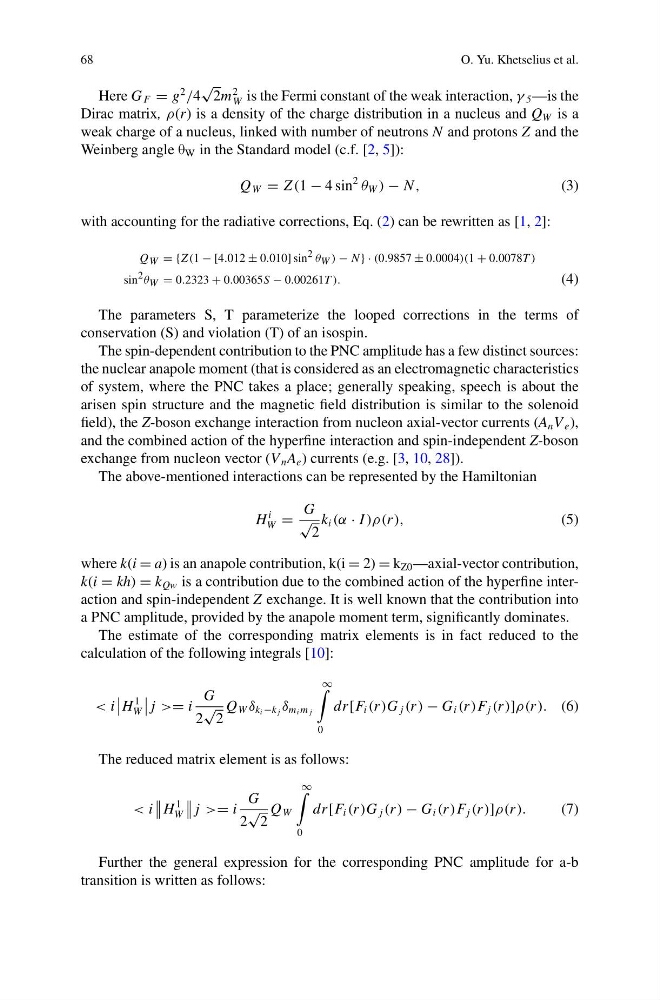
Here G F = g
2
/4
√
2m
2
W is the Fermi constant of the weak interaction, γ 5 —is the
Dirac matrix, ρ(r) is a density of the charge distribution in a nucleus and Q W is a
weak charge of a nucleus, linked with number of neutrons N and protons Z and the
Weinberg angle θ W in the Standard model (c.f. [2, 5]):
Q W = Z (1 − 4 sin
2
θ W ) − N ,
(3)
with accounting for the radiative corrections, Eq. (2) can be rewritten as [1, 2]:
Q W = {Z (1 − [4.012 ± 0.010] sin 2 θ W ) − N } · (0.9857 ± 0.0004)(1 + 0.0078T )
sin 2 θ W = 0.2323 + 0.00365S − 0.00261T ).
(4)
The parameters S, T parameterize the looped corrections in the terms of
conservation (S) and violation (T) of an isospin.
The spin-dependent contribution to the PNC amplitude has a few distinct sources:
the nuclear anapole moment (that is considered as an electromagnetic characteristics
of system, where the PNC takes a place; generally speaking, speech is about the
arisen spin structure and the magnetic field distribution is similar to the solenoid
field), the Z-boson exchange interaction from nucleon axial-vector currents (A n V e ),
and the combined action of the hyperfine interaction and spin-independent Z-boson
exchange from nucleon vector (V n A e ) currents (e.g. [3, 10, 28]).
The above-mentioned interactions can be represented by the Hamiltonian
H
i
W =
G
√
2
k i (α · I )ρ(r ),
(5)
where k(i = a) is an anapole contribution, k(i = 2) = k Z0 —axial-vector contribution,
k(i = kh) = k Qw is a contribution due to the combined action of the hyperfine interaction and spin-independent Z exchange. It is well known that the contribution into
a PNC amplitude, provided by the anapole moment term, significantly dominates.
The estimate of the corresponding matrix elements is in fact reduced to the
calculation of the following integrals [10]:
< i
H
1
W
j >= i
G
2
√
2
Q W δ k i −k j δ m i m j
∞
0
dr[F i (r )G j (r ) − G i (r )F j (r )]ρ(r ). (6)
The reduced matrix element is as follows:
< i
H
1
W
j >= i
G
2
√
2
Q W
∞
0
dr[F i (r )G j (r ) − G i (r )F j (r )]ρ(r ).
(7)
Further the general expression for the corresponding PNC amplitude for a-b
transition is written as follows:
O. Yu. Khetselius et al.
Here G F = g
2
/4
√
2m
2
W is the Fermi constant of the weak interaction, γ 5 —is the
Dirac matrix, ρ(r) is a density of the charge distribution in a nucleus and Q W is a
weak charge of a nucleus, linked with number of neutrons N and protons Z and the
Weinberg angle θ W in the Standard model (c.f. [2, 5]):
Q W = Z (1 − 4 sin
2
θ W ) − N ,
(3)
with accounting for the radiative corrections, Eq. (2) can be rewritten as [1, 2]:
Q W = {Z (1 − [4.012 ± 0.010] sin 2 θ W ) − N } · (0.9857 ± 0.0004)(1 + 0.0078T )
sin 2 θ W = 0.2323 + 0.00365S − 0.00261T ).
(4)
The parameters S, T parameterize the looped corrections in the terms of
conservation (S) and violation (T) of an isospin.
The spin-dependent contribution to the PNC amplitude has a few distinct sources:
the nuclear anapole moment (that is considered as an electromagnetic characteristics
of system, where the PNC takes a place; generally speaking, speech is about the
arisen spin structure and the magnetic field distribution is similar to the solenoid
field), the Z-boson exchange interaction from nucleon axial-vector currents (A n V e ),
and the combined action of the hyperfine interaction and spin-independent Z-boson
exchange from nucleon vector (V n A e ) currents (e.g. [3, 10, 28]).
The above-mentioned interactions can be represented by the Hamiltonian
H
i
W =
G
√
2
k i (α · I )ρ(r ),
(5)
where k(i = a) is an anapole contribution, k(i = 2) = k Z0 —axial-vector contribution,
k(i = kh) = k Qw is a contribution due to the combined action of the hyperfine interaction and spin-independent Z exchange. It is well known that the contribution into
a PNC amplitude, provided by the anapole moment term, significantly dominates.
The estimate of the corresponding matrix elements is in fact reduced to the
calculation of the following integrals [10]:
< i
H
1
W
j >= i
G
2
√
2
Q W δ k i −k j δ m i m j
∞
0
dr[F i (r )G j (r ) − G i (r )F j (r )]ρ(r ). (6)
The reduced matrix element is as follows:
< i
H
1
W
j >= i
G
2
√
2
Q W
∞
0
dr[F i (r )G j (r ) − G i (r )F j (r )]ρ(r ).
(7)
Further the general expression for the corresponding PNC amplitude for a-b
transition is written as follows: