

Hyperfine and Electroweak Interactions in Heavy Finite Fermi Systems …
67
nuclear, Breit and QED radiative corrections. All correlation corrections of the second order and dominated classes of the higher orders diagrams are taken into account.
The results of calculation of the hyperfine structure parameters, the PNC amplitudes,
the nuclear spin dependent corrections to the PNC, a weak charge Q W for different
atomic systems are presented and compared with available data in the literature.
2 Relativistic Nuclear-RMBPT Formalism in Theory
of Heavy Finite Fermi Systems
Here we present a brief description of the key moments of our approach (more details
can be found in Refs. [3, 4, 10, 50, 63–96]). The wave electron functions zeroth
basis is found from the Dirac equation solution with potential, which includes the
self-consistent ab initio potential (in the Dirac-Kohn-Sham approximation), electric,
polarization potentials of a nucleus. All correlation corrections of the second and
high orders of PT (electrons screening, particle-hole interaction etc.) are accounted
for.
The concrete model for nuclear subsystem is based on the relativistic mean-field
model for the ground-state calculation of the nucleus, which was developed as a
renormalizable meson-field theory for nuclear matter and finite nuclei. The realization of nonlinear self-interactions of the scalar meson led to a quantitative description
of nuclear ground states. As a self-consistent mean-field model (for a comprehensive
review see Ref. [36, 99]), its ansatz is a Lagrangian or Hamiltonian that incorporates
the effective, in-medium nucleon-nucleon interaction. As a Kohn-Sham scheme, the
relativistic mean-field model can incorporate certain ground-state correlations and
yields a ground-state description beyond the literal mean-field picture. As indicated
in Refs. [36, 37] the strong attractive scalar (S: −400 MeV) and repulsive vector (V:
+350 MeV) fields provide both the binding mechanism (S + V: −50 MeV) and the
strong spin-orbit force (S–V: −750 MeV) of both right sign and magnitude. In our
opinion, the most preferable one for the class of problems under consideration is so
called NL3-NLC version (see details in Refs. [3, 60, 68]), which are among the most
successful parameterizations available.
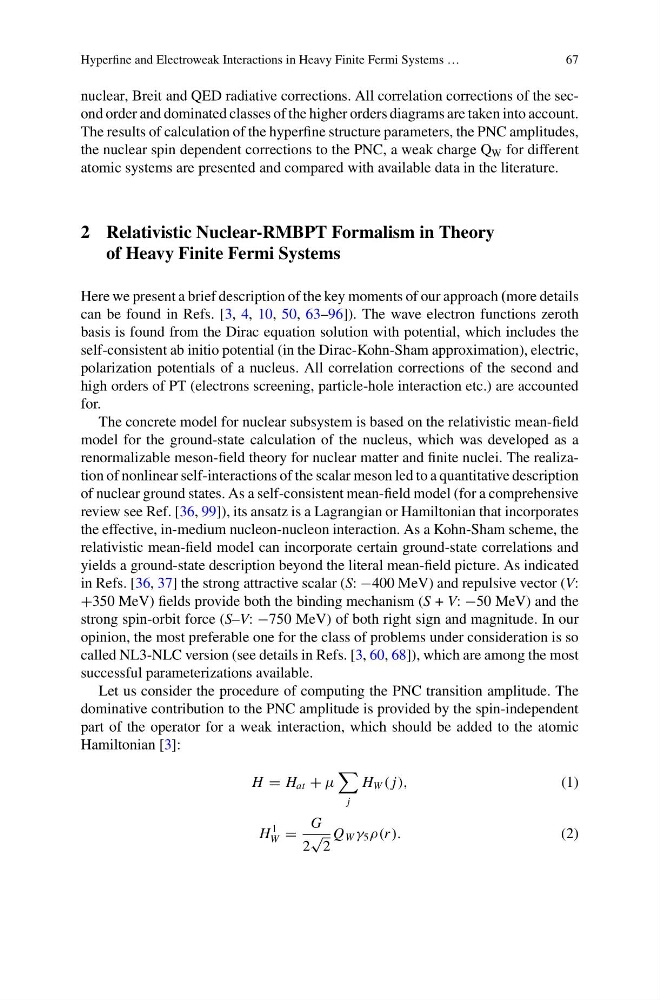
Let us consider the procedure of computing the PNC transition amplitude. The
dominative contribution to the PNC amplitude is provided by the spin-independent
part of the operator for a weak interaction, which should be added to the atomic
Hamiltonian [3]:
H = H at + μ
j
H W ( j),
(1)
H
1
W =
G
2
√
2
Q W γ 5 ρ(r ).
(2)
67
nuclear, Breit and QED radiative corrections. All correlation corrections of the second order and dominated classes of the higher orders diagrams are taken into account.
The results of calculation of the hyperfine structure parameters, the PNC amplitudes,
the nuclear spin dependent corrections to the PNC, a weak charge Q W for different
atomic systems are presented and compared with available data in the literature.
2 Relativistic Nuclear-RMBPT Formalism in Theory
of Heavy Finite Fermi Systems
Here we present a brief description of the key moments of our approach (more details
can be found in Refs. [3, 4, 10, 50, 63–96]). The wave electron functions zeroth
basis is found from the Dirac equation solution with potential, which includes the
self-consistent ab initio potential (in the Dirac-Kohn-Sham approximation), electric,
polarization potentials of a nucleus. All correlation corrections of the second and
high orders of PT (electrons screening, particle-hole interaction etc.) are accounted
for.
The concrete model for nuclear subsystem is based on the relativistic mean-field
model for the ground-state calculation of the nucleus, which was developed as a
renormalizable meson-field theory for nuclear matter and finite nuclei. The realization of nonlinear self-interactions of the scalar meson led to a quantitative description
of nuclear ground states. As a self-consistent mean-field model (for a comprehensive
review see Ref. [36, 99]), its ansatz is a Lagrangian or Hamiltonian that incorporates
the effective, in-medium nucleon-nucleon interaction. As a Kohn-Sham scheme, the
relativistic mean-field model can incorporate certain ground-state correlations and
yields a ground-state description beyond the literal mean-field picture. As indicated
in Refs. [36, 37] the strong attractive scalar (S: −400 MeV) and repulsive vector (V:
+350 MeV) fields provide both the binding mechanism (S + V: −50 MeV) and the
strong spin-orbit force (S–V: −750 MeV) of both right sign and magnitude. In our
opinion, the most preferable one for the class of problems under consideration is so
called NL3-NLC version (see details in Refs. [3, 60, 68]), which are among the most
successful parameterizations available.
Let us consider the procedure of computing the PNC transition amplitude. The
dominative contribution to the PNC amplitude is provided by the spin-independent
part of the operator for a weak interaction, which should be added to the atomic
Hamiltonian [3]:
H = H at + μ
j
H W ( j),
(1)
H
1
W =
G
2
√
2
Q W γ 5 ρ(r ).
(2)