

Spectroscopy of Rydberg Atomic Systems in a Black-Body Radiation Field
55
The key idea to take the polarization interelectron interaction into consideration is
to include an effective ab initio two-quasiparticle polarization interaction functional
to operator (2). The correct non-relativistic expression for this functional is obtained
in Ref. [52]. In this work we use more consistent relativistic expression, which is
derived in Ref. [81] and applied in this work.
An account for the screening interelectron effects is fulfilled by modification of
the RMBPT zeroth approximation mean-field potential (see details in Refs. [58, 62,
93]). Simultaneously we use the optimized one-quasiparticle representation in the
RMBPT zeroth perturbation theory order. Under its construction we use an effective,
ab initio relativistic optimization procedure [68] (see also [58–61]). This procedure is
directly related to the condition of fulfilling the principle of gauge invariance and, in
particular, reduced to minimization of the gauge-noninvariant contributions into the
imaginary part of electron energy ImE for the certain class of the electromagnetic
field potentials (see also [56–61]).
The procedure works within a relativistic energy formalism [49–53, 56–61], where
the radiation decay (transition, excitation, ionization) probability is determined
through an imaginary part of the electron energy shift ImE, i.e. ∼ ImE and
the corresponding matrix elements of the imaginary part of the operator (2), which
contain the sum of the Coulomb and Breit terms. The detailed procedures of computing the radial and angular integrals in these matrix elements are described in Refs.
[45–59].
From physical viewpoint, the process of the BBR Rydberg atoms excitation and
ionization is sufficiently easily understandable [2–5]. Moreover, for the interested
interval of temperatures one could implement a single-electron approximation for
calculating the ionization rates (cross sections) within relativistic energy approach.
The important point is in appearance of a product with the Planck’s distribution for
the thermal photon number density. Corresponding decay (ionization) rate results in
the integral over the Blackbody radiation frequencies (see details in Refs. [1–19]).
The total ionization rate of the Rydberg atomic system in the BBR radiation
field is usually determined as the sum of direct BBR ionization rate of the initially
excited state, the ionization (field ionization) rate of highly excited states, which are
populated from the initial Rydberg state via absorption of the BBR photons, the rate
of direct BBR-induced ionization of atoms from the neighbouring Rydberg states
and the rate of field ionization of high-lying Rydberg states (with populating through
so called two-step process via the BBR photons absorption).
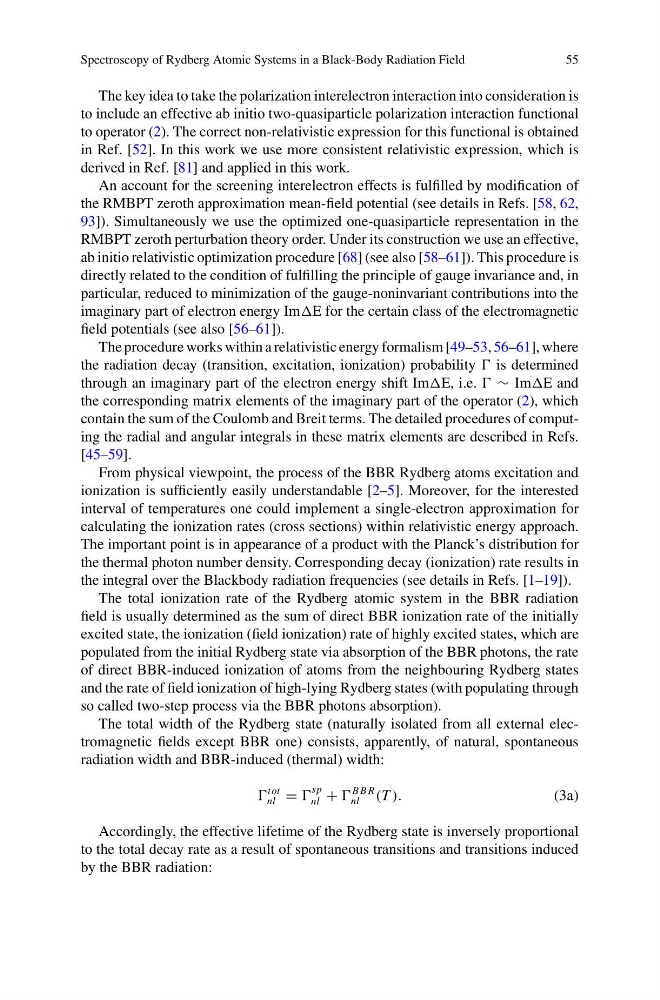
The total width of the Rydberg state (naturally isolated from all external electromagnetic fields except BBR one) consists, apparently, of natural, spontaneous
radiation width and BBR-induced (thermal) width:
tot
nl =
sp
nl +
B B R
nl
(T ).
(3a)
Accordingly, the effective lifetime of the Rydberg state is inversely proportional
to the total decay rate as a result of spontaneous transitions and transitions induced
by the BBR radiation:
55
The key idea to take the polarization interelectron interaction into consideration is
to include an effective ab initio two-quasiparticle polarization interaction functional
to operator (2). The correct non-relativistic expression for this functional is obtained
in Ref. [52]. In this work we use more consistent relativistic expression, which is
derived in Ref. [81] and applied in this work.
An account for the screening interelectron effects is fulfilled by modification of
the RMBPT zeroth approximation mean-field potential (see details in Refs. [58, 62,
93]). Simultaneously we use the optimized one-quasiparticle representation in the
RMBPT zeroth perturbation theory order. Under its construction we use an effective,
ab initio relativistic optimization procedure [68] (see also [58–61]). This procedure is
directly related to the condition of fulfilling the principle of gauge invariance and, in
particular, reduced to minimization of the gauge-noninvariant contributions into the
imaginary part of electron energy ImE for the certain class of the electromagnetic
field potentials (see also [56–61]).
The procedure works within a relativistic energy formalism [49–53, 56–61], where
the radiation decay (transition, excitation, ionization) probability is determined
through an imaginary part of the electron energy shift ImE, i.e. ∼ ImE and
the corresponding matrix elements of the imaginary part of the operator (2), which
contain the sum of the Coulomb and Breit terms. The detailed procedures of computing the radial and angular integrals in these matrix elements are described in Refs.
[45–59].
From physical viewpoint, the process of the BBR Rydberg atoms excitation and
ionization is sufficiently easily understandable [2–5]. Moreover, for the interested
interval of temperatures one could implement a single-electron approximation for
calculating the ionization rates (cross sections) within relativistic energy approach.
The important point is in appearance of a product with the Planck’s distribution for
the thermal photon number density. Corresponding decay (ionization) rate results in
the integral over the Blackbody radiation frequencies (see details in Refs. [1–19]).
The total ionization rate of the Rydberg atomic system in the BBR radiation
field is usually determined as the sum of direct BBR ionization rate of the initially
excited state, the ionization (field ionization) rate of highly excited states, which are
populated from the initial Rydberg state via absorption of the BBR photons, the rate
of direct BBR-induced ionization of atoms from the neighbouring Rydberg states
and the rate of field ionization of high-lying Rydberg states (with populating through
so called two-step process via the BBR photons absorption).
The total width of the Rydberg state (naturally isolated from all external electromagnetic fields except BBR one) consists, apparently, of natural, spontaneous
radiation width and BBR-induced (thermal) width:
tot
nl =
sp
nl +
B B R
nl
(T ).
(3a)
Accordingly, the effective lifetime of the Rydberg state is inversely proportional
to the total decay rate as a result of spontaneous transitions and transitions induced
by the BBR radiation: