

54
A. V. Glushkov et al.
In this chapter we present a consistent relativistic approach to computing the
energy, spectroscopic, radiation decay (excitation, ionization) characteristics of the
Rydberg atomic systems in a BBR radiation field. The approach is based on an
advanced relativistic energy formalism (in a single-electron approximation) and
the method of relativistic many-body perturbation theory (RMBPT) with the zeroth
density functional approximation [56–62, 86–95].
As illustration, we list some results of computing spectroscopic characteristics
(ionization rate, effective lifetime values etc.) of the Rydberg atoms (sodium) in a
Black-body radiation field for different electron states and temperatures.
2 Theoretical Method
The fundamentals of our theoretical approach to study of the Rydberg atoms in a
BBR radiation field are earlier presented in detail in Refs. [51–55, 90–95]. So, here
we are limited to presenting only the main blocks of the approach and some principal new elements, related to the Rydberg multielectron atoms. The approach represents the combination of an advanced relativistic energy approach and formalism
of the relativistic many-body perturbation theory with the zeroth density functional
approximation (see details in Refs. [40, 51–95, 96–100]).
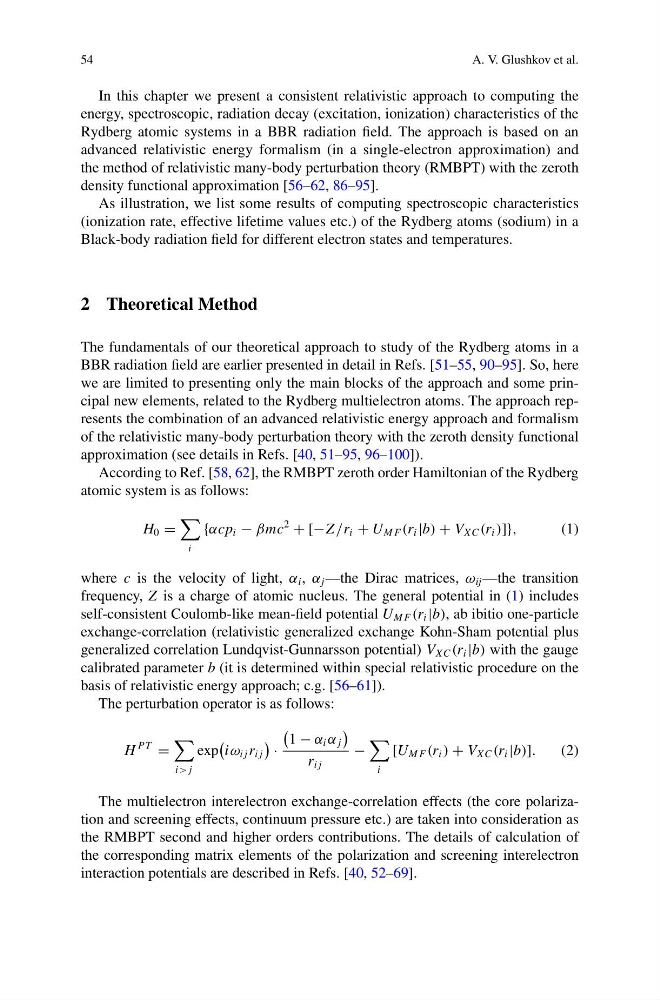
According to Ref. [58, 62], the RMBPT zeroth order Hamiltonian of the Rydberg
atomic system is as follows:
H 0 =
i
{αcp i − βmc
2
+ [−Z /r i + U M F (r i |b) + V XC (r i )]},
(1)
where c is the velocity of light, α i , α j —the Dirac matrices, ω ij —the transition
frequency, Z is a charge of atomic nucleus. The general potential in (1) includes
self-consistent Coulomb-like mean-field potential U M F (r i |b), ab ibitio one-particle
exchange-correlation (relativistic generalized exchange Kohn-Sham potential plus
generalized correlation Lundqvist-Gunnarsson potential) V XC (r i |b) with the gauge
calibrated parameter b (it is determined within special relativistic procedure on the
basis of relativistic energy approach; c.g. [56–61]).
The perturbation operator is as follows:
H
PT
=
i> j
exp
iω i j r i j
·
1 − α i α j
r i j
−
i
[U M F (r i ) + V XC (r i |b)].
(2)
The multielectron interelectron exchange-correlation effects (the core polarization and screening effects, continuum pressure etc.) are taken into consideration as
the RMBPT second and higher orders contributions. The details of calculation of
the corresponding matrix elements of the polarization and screening interelectron
interaction potentials are described in Refs. [40, 52–69].
A. V. Glushkov et al.
In this chapter we present a consistent relativistic approach to computing the
energy, spectroscopic, radiation decay (excitation, ionization) characteristics of the
Rydberg atomic systems in a BBR radiation field. The approach is based on an
advanced relativistic energy formalism (in a single-electron approximation) and
the method of relativistic many-body perturbation theory (RMBPT) with the zeroth
density functional approximation [56–62, 86–95].
As illustration, we list some results of computing spectroscopic characteristics
(ionization rate, effective lifetime values etc.) of the Rydberg atoms (sodium) in a
Black-body radiation field for different electron states and temperatures.
2 Theoretical Method
The fundamentals of our theoretical approach to study of the Rydberg atoms in a
BBR radiation field are earlier presented in detail in Refs. [51–55, 90–95]. So, here
we are limited to presenting only the main blocks of the approach and some principal new elements, related to the Rydberg multielectron atoms. The approach represents the combination of an advanced relativistic energy approach and formalism
of the relativistic many-body perturbation theory with the zeroth density functional
approximation (see details in Refs. [40, 51–95, 96–100]).
According to Ref. [58, 62], the RMBPT zeroth order Hamiltonian of the Rydberg
atomic system is as follows:
H 0 =
i
{αcp i − βmc
2
+ [−Z /r i + U M F (r i |b) + V XC (r i )]},
(1)
where c is the velocity of light, α i , α j —the Dirac matrices, ω ij —the transition
frequency, Z is a charge of atomic nucleus. The general potential in (1) includes
self-consistent Coulomb-like mean-field potential U M F (r i |b), ab ibitio one-particle
exchange-correlation (relativistic generalized exchange Kohn-Sham potential plus
generalized correlation Lundqvist-Gunnarsson potential) V XC (r i |b) with the gauge
calibrated parameter b (it is determined within special relativistic procedure on the
basis of relativistic energy approach; c.g. [56–61]).
The perturbation operator is as follows:
H
PT
=
i> j
exp
iω i j r i j
·
1 − α i α j
r i j
−
i
[U M F (r i ) + V XC (r i |b)].
(2)
The multielectron interelectron exchange-correlation effects (the core polarization and screening effects, continuum pressure etc.) are taken into consideration as
the RMBPT second and higher orders contributions. The details of calculation of
the corresponding matrix elements of the polarization and screening interelectron
interaction potentials are described in Refs. [40, 52–69].