

Relativistic Quantum Chemistry and Spectroscopy of Kaonic Atomic Systems …
37
radiation (vacuum polarization), nuclear (finite size of a nucleus) and the strong
kaon-nuclear interaction corrections into account. An analysis of different physical
contributions to the transition energies in the X-ray spectra of the kaonic atoms
and kaonic helium puzzle is given. The available experimental results (DAFNE
EAR, Frascatti, Italy, 2004; E570-KEK, RIKEN, Nishina Centre, JAPAN etc.) and
alternative theoretical data are listed too.
2 Relativistic Theory of Kaonic Atoms with Accounting
for Nuclear, Radiative and Strong Interaction Effects
2.1 Electromagnetic Interactions and Quantum
Electrodynamics Effects in Kaonic Atoms
The fundamentals of our theoretical approach to study of the exotic atomic systems
are presented in detail in Refs. [51–55, 91–96]. So, here we are limited to presenting
only the main elements of a general approach and some new elements, related to
kaonic atoms. Let us remind that a kaon is the Boson with spin 0 and here we use
the following values for its mass and radius:
m K − = 493.667 ± 0.013 MeV,
r K
− = 0.560 ± 0.031 fm.
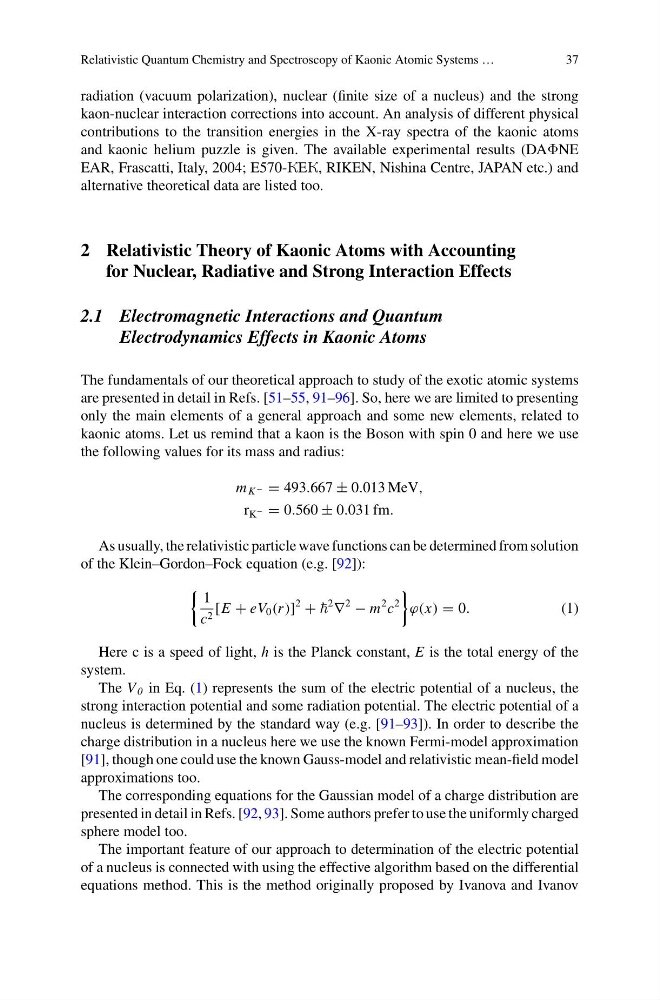
As usually, the relativistic particle wave functions can be determined from solution
of the Klein–Gordon–Fock equation (e.g. [92]):
1
c 2 [E + eV 0 (r )]
2
+
2
∇
2
− m
2 c
2
ϕ(x) = 0.
(1)
Here c is a speed of light, h is the Planck constant, E is the total energy of the
system.
The V 0 in Eq. (1) represents the sum of the electric potential of a nucleus, the
strong interaction potential and some radiation potential. The electric potential of a
nucleus is determined by the standard way (e.g. [91–93]). In order to describe the
charge distribution in a nucleus here we use the known Fermi-model approximation
[91], though one could use the known Gauss-model and relativistic mean-field model
approximations too.
The corresponding equations for the Gaussian model of a charge distribution are
presented in detail in Refs. [92, 93]. Some authors prefer to use the uniformly charged
sphere model too.
The important feature of our approach to determination of the electric potential
of a nucleus is connected with using the effective algorithm based on the differential
equations method. This is the method originally proposed by Ivanova and Ivanov
37
radiation (vacuum polarization), nuclear (finite size of a nucleus) and the strong
kaon-nuclear interaction corrections into account. An analysis of different physical
contributions to the transition energies in the X-ray spectra of the kaonic atoms
and kaonic helium puzzle is given. The available experimental results (DAFNE
EAR, Frascatti, Italy, 2004; E570-KEK, RIKEN, Nishina Centre, JAPAN etc.) and
alternative theoretical data are listed too.
2 Relativistic Theory of Kaonic Atoms with Accounting
for Nuclear, Radiative and Strong Interaction Effects
2.1 Electromagnetic Interactions and Quantum
Electrodynamics Effects in Kaonic Atoms
The fundamentals of our theoretical approach to study of the exotic atomic systems
are presented in detail in Refs. [51–55, 91–96]. So, here we are limited to presenting
only the main elements of a general approach and some new elements, related to
kaonic atoms. Let us remind that a kaon is the Boson with spin 0 and here we use
the following values for its mass and radius:
m K − = 493.667 ± 0.013 MeV,
r K
− = 0.560 ± 0.031 fm.
As usually, the relativistic particle wave functions can be determined from solution
of the Klein–Gordon–Fock equation (e.g. [92]):
1
c 2 [E + eV 0 (r )]
2
+
2
∇
2
− m
2 c
2
ϕ(x) = 0.
(1)
Here c is a speed of light, h is the Planck constant, E is the total energy of the
system.
The V 0 in Eq. (1) represents the sum of the electric potential of a nucleus, the
strong interaction potential and some radiation potential. The electric potential of a
nucleus is determined by the standard way (e.g. [91–93]). In order to describe the
charge distribution in a nucleus here we use the known Fermi-model approximation
[91], though one could use the known Gauss-model and relativistic mean-field model
approximations too.
The corresponding equations for the Gaussian model of a charge distribution are
presented in detail in Refs. [92, 93]. Some authors prefer to use the uniformly charged
sphere model too.
The important feature of our approach to determination of the electric potential
of a nucleus is connected with using the effective algorithm based on the differential
equations method. This is the method originally proposed by Ivanova and Ivanov