

36
O. Yu. Khetselius et al.
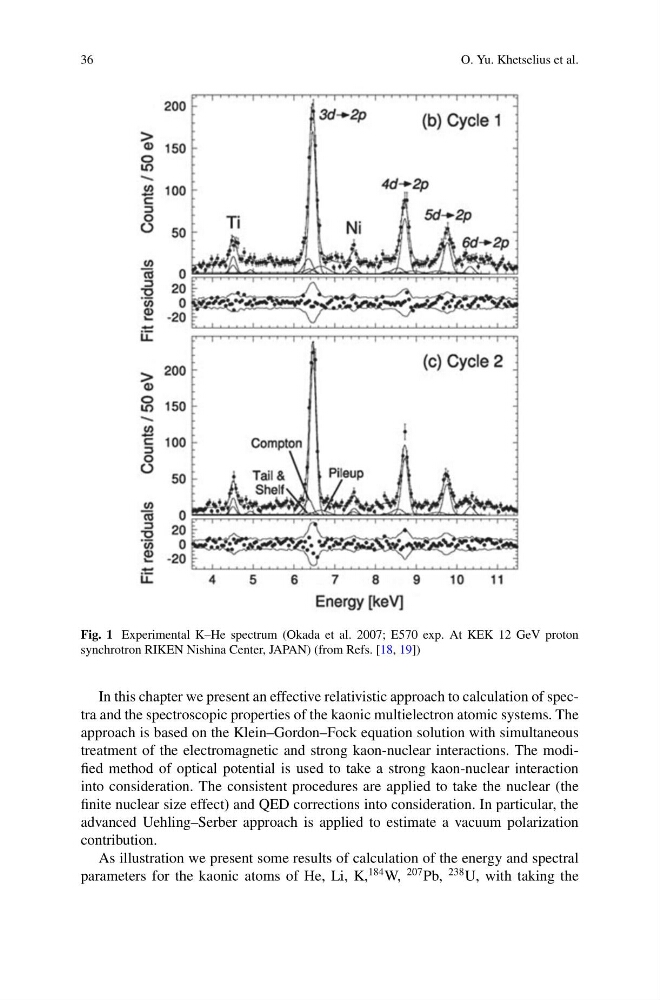
Fig. 1 Experimental K–He spectrum (Okada et al. 2007; E570 exp. At KEK 12 GeV proton
synchrotron RIKEN Nishina Center, JAPAN) (from Refs. [18, 19])
In this chapter we present an effective relativistic approach to calculation of spectra and the spectroscopic properties of the kaonic multielectron atomic systems. The
approach is based on the Klein–Gordon–Fock equation solution with simultaneous
treatment of the electromagnetic and strong kaon-nuclear interactions. The modified method of optical potential is used to take a strong kaon-nuclear interaction
into consideration. The consistent procedures are applied to take the nuclear (the
finite nuclear size effect) and QED corrections into consideration. In particular, the
advanced Uehling–Serber approach is applied to estimate a vacuum polarization
contribution.
As illustration we present some results of calculation of the energy and spectral
parameters for the kaonic atoms of He, Li, K,
184 W,
207 Pb,
238 U, with taking the
O. Yu. Khetselius et al.
Fig. 1 Experimental K–He spectrum (Okada et al. 2007; E570 exp. At KEK 12 GeV proton
synchrotron RIKEN Nishina Center, JAPAN) (from Refs. [18, 19])
In this chapter we present an effective relativistic approach to calculation of spectra and the spectroscopic properties of the kaonic multielectron atomic systems. The
approach is based on the Klein–Gordon–Fock equation solution with simultaneous
treatment of the electromagnetic and strong kaon-nuclear interactions. The modified method of optical potential is used to take a strong kaon-nuclear interaction
into consideration. The consistent procedures are applied to take the nuclear (the
finite nuclear size effect) and QED corrections into consideration. In particular, the
advanced Uehling–Serber approach is applied to estimate a vacuum polarization
contribution.
As illustration we present some results of calculation of the energy and spectral
parameters for the kaonic atoms of He, Li, K,
184 W,
207 Pb,
238 U, with taking the