

Can Quantum Theory Concepts Shed Light on Biological Evolution Processes?
459
complexity [48] that may help specify the ‘biological Lagrangian operator’ G in
Eq. (16).
In Feynman’s formalism [26], the Hamilton principle can be derived from constructive/destructive interferences of quantum waves associated with particle trajectories, as the interference of Huygens wavelets associated with light rays were shown
to yield the Fermat principle. We shall proceed by analogy in our search for a biological extremum principle, using the pitch waves built on the sequences of nucleotides
A, T (U), G, and C, carrying the genetic information in the DNA (RNA) molecules,
with which the thousands of genes embedded in chromosomes are built. A genome
would then be translated into a complex superposition of pitch waves, from which
Fourier analysis could extract fundamentals and harmonics.
Feynman’s proof [26] relies on Dirac’s remark (earlier surmised by de Broglie)
on the relation of quantum phase to classical action. One of Feynman’s postulates is
that ‘the (component) paths contribute equally in magnitude, but the phase of their
contribution is the classical action in units of è’. For a small (virtual) classical path
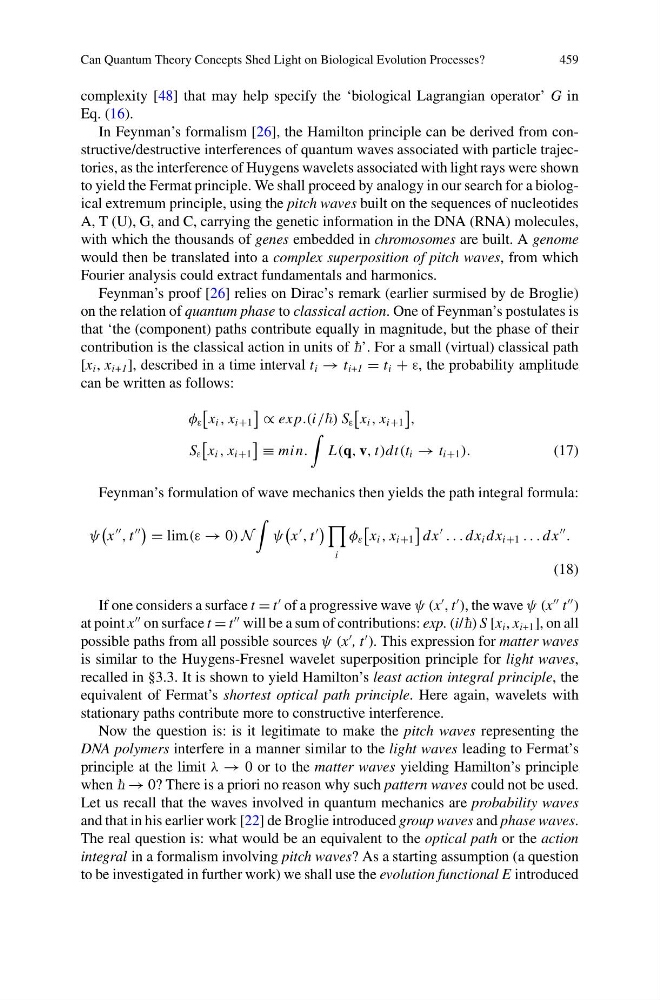
[x i , x i+1 ], described in a time interval t i → t i+1 = t i + ε, the probability amplitude
can be written as follows:
φ ε
x i , x i+1
∝ ex p.(i/) S ε
x i , x i+1
,
S ε
x i , x i+1
≡ min.
L(q, v, t)dt(t i → t i+1 ).
(17)
Feynman’s formulation of wave mechanics then yields the path integral formula:
ψ
x
, t
= lim.(ε → 0) N
ψ
x
, t
i
φ ε
x i , x i+1
dx
. . . dx i dx i+1 . . . dx
.
(18)
If one considers a surface t = t
of a progressive wave ψ (x
, t
), the wave ψ (x
t
)
at point x
on surface t = t
will be a sum of contributions: exp. (i/è) S [x i , x i+1 ], on all
possible paths from all possible sources ψ (x
, t
). This expression for matter waves
is similar to the Huygens-Fresnel wavelet superposition principle for light waves,
recalled in §3.3. It is shown to yield Hamilton’s least action integral principle, the
equivalent of Fermat’s shortest optical path principle. Here again, wavelets with
stationary paths contribute more to constructive interference.
Now the question is: is it legitimate to make the pitch waves representing the
DNA polymers interfere in a manner similar to the light waves leading to Fermat’s
principle at the limit λ → 0 or to the matter waves yielding Hamilton’s principle
when è → 0? There is a priori no reason why such pattern waves could not be used.
Let us recall that the waves involved in quantum mechanics are probability waves
and that in his earlier work [22] de Broglie introduced group waves and phase waves.
The real question is: what would be an equivalent to the optical path or the action
integral in a formalism involving pitch waves? As a starting assumption (a question
to be investigated in further work) we shall use the evolution functional E introduced
459
complexity [48] that may help specify the ‘biological Lagrangian operator’ G in
Eq. (16).
In Feynman’s formalism [26], the Hamilton principle can be derived from constructive/destructive interferences of quantum waves associated with particle trajectories, as the interference of Huygens wavelets associated with light rays were shown
to yield the Fermat principle. We shall proceed by analogy in our search for a biological extremum principle, using the pitch waves built on the sequences of nucleotides
A, T (U), G, and C, carrying the genetic information in the DNA (RNA) molecules,
with which the thousands of genes embedded in chromosomes are built. A genome
would then be translated into a complex superposition of pitch waves, from which
Fourier analysis could extract fundamentals and harmonics.
Feynman’s proof [26] relies on Dirac’s remark (earlier surmised by de Broglie)
on the relation of quantum phase to classical action. One of Feynman’s postulates is
that ‘the (component) paths contribute equally in magnitude, but the phase of their
contribution is the classical action in units of è’. For a small (virtual) classical path
[x i , x i+1 ], described in a time interval t i → t i+1 = t i + ε, the probability amplitude
can be written as follows:
φ ε
x i , x i+1
∝ ex p.(i/) S ε
x i , x i+1
,
S ε
x i , x i+1
≡ min.
L(q, v, t)dt(t i → t i+1 ).
(17)
Feynman’s formulation of wave mechanics then yields the path integral formula:
ψ
x
, t
= lim.(ε → 0) N
ψ
x
, t
i
φ ε
x i , x i+1
dx
. . . dx i dx i+1 . . . dx
.
(18)
If one considers a surface t = t
of a progressive wave ψ (x
, t
), the wave ψ (x
t
)
at point x
on surface t = t
will be a sum of contributions: exp. (i/è) S [x i , x i+1 ], on all
possible paths from all possible sources ψ (x
, t
). This expression for matter waves
is similar to the Huygens-Fresnel wavelet superposition principle for light waves,
recalled in §3.3. It is shown to yield Hamilton’s least action integral principle, the
equivalent of Fermat’s shortest optical path principle. Here again, wavelets with
stationary paths contribute more to constructive interference.
Now the question is: is it legitimate to make the pitch waves representing the
DNA polymers interfere in a manner similar to the light waves leading to Fermat’s
principle at the limit λ → 0 or to the matter waves yielding Hamilton’s principle
when è → 0? There is a priori no reason why such pattern waves could not be used.
Let us recall that the waves involved in quantum mechanics are probability waves
and that in his earlier work [22] de Broglie introduced group waves and phase waves.
The real question is: what would be an equivalent to the optical path or the action
integral in a formalism involving pitch waves? As a starting assumption (a question
to be investigated in further work) we shall use the evolution functional E introduced