

458
J. Maruani
For instance, let us consider the 4 DNA nucleotide bases: A (135.13), T (126.11),
G (151.13), C (111.10), the molecular masses given in parentheses not including
that of the double-helix backbone desoxyribophosphate. At body temperature (T ~
310 K), their thermal energy is (half) mv
2
= 3kT (k = 1.38065 × 10
−23 J.K
−1 ). The
respective de Broglie wavelengths (Eq. 9a, with h = 6.62607 × 10
−34 J.s) can be
written in the form: λ = h /
√
3mkT = (58.475/
√
m) × 10
−25 (in meters), yielding
(omitting the common factor 10
−25 m): A (5.03), T (5.21), G (4.76), C (5.55).
The ratios of these wavelengths to their smallest one (or, equivalently, the ratios
of the largest frequency to the other respective ones) are: ρ i = 1.058 (A), 1.095 (T),
1.0 (G), 1.166 (C), and their relative increments are: δ i ≡ 10
3 (ρ i − 1) = 58 ~ 1l b
(A), 95 ~ 2l b (T), 00 ~ 0l b (G), 166 ~ 3l b (C), where l b ~ 53 stands for the average
increment (these relations hold within 4–12%). Symbolically, one can write: A (1),
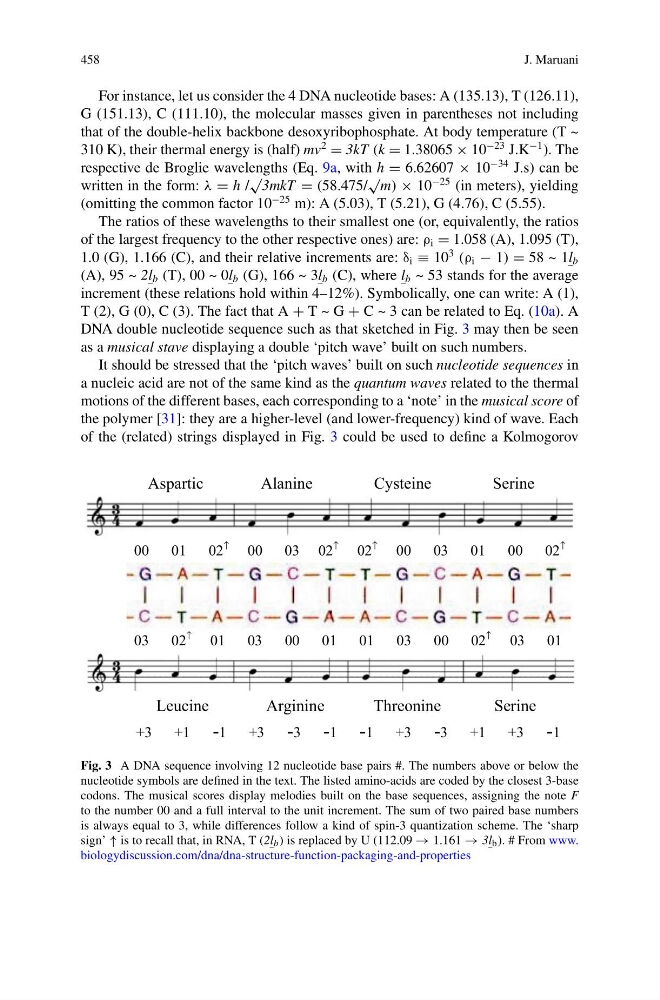
T (2), G (0), C (3). The fact that A + T ~ G + C ~ 3 can be related to Eq. (10a). A
DNA double nucleotide sequence such as that sketched in Fig. 3 may then be seen
as a musical stave displaying a double ‘pitch wave’ built on such numbers.
It should be stressed that the ‘pitch waves’ built on such nucleotide sequences in
a nucleic acid are not of the same kind as the quantum waves related to the thermal
motions of the different bases, each corresponding to a ‘note’ in the musical score of
the polymer [31]: they are a higher-level (and lower-frequency) kind of wave. Each
of the (related) strings displayed in Fig. 3 could be used to define a Kolmogorov
Aspartic
Alanine
Cysteine
Serine
00 01 02
↑
00 03 02
↑
02
↑
00 03 01 00 02
↑
03 02
↑
01 03 00 01 01 03 00 02
↑
03 01
Leucine
Arginine
Threonine
Serine
+3 +1
-1 +3 -3 -1 -1 +3 -3 +1 +3 -1
Fig. 3 A DNA sequence involving 12 nucleotide base pairs #. The numbers above or below the
nucleotide symbols are defined in the text. The listed amino-acids are coded by the closest 3-base
codons. The musical scores display melodies built on the base sequences, assigning the note F
to the number 00 and a full interval to the unit increment. The sum of two paired base numbers
is always equal to 3, while differences follow a kind of spin-3 quantization scheme. The ‘sharp
sign’ ↑ is to recall that, in RNA, T (2l b ) is replaced by U (112.09 → 1.161 → 3l b ). # From www.
biologydiscussion.com/dna/dna-structure-function-packaging-and-properties
J. Maruani
For instance, let us consider the 4 DNA nucleotide bases: A (135.13), T (126.11),
G (151.13), C (111.10), the molecular masses given in parentheses not including
that of the double-helix backbone desoxyribophosphate. At body temperature (T ~
310 K), their thermal energy is (half) mv
2
= 3kT (k = 1.38065 × 10
−23 J.K
−1 ). The
respective de Broglie wavelengths (Eq. 9a, with h = 6.62607 × 10
−34 J.s) can be
written in the form: λ = h /
√
3mkT = (58.475/
√
m) × 10
−25 (in meters), yielding
(omitting the common factor 10
−25 m): A (5.03), T (5.21), G (4.76), C (5.55).
The ratios of these wavelengths to their smallest one (or, equivalently, the ratios
of the largest frequency to the other respective ones) are: ρ i = 1.058 (A), 1.095 (T),
1.0 (G), 1.166 (C), and their relative increments are: δ i ≡ 10
3 (ρ i − 1) = 58 ~ 1l b
(A), 95 ~ 2l b (T), 00 ~ 0l b (G), 166 ~ 3l b (C), where l b ~ 53 stands for the average
increment (these relations hold within 4–12%). Symbolically, one can write: A (1),
T (2), G (0), C (3). The fact that A + T ~ G + C ~ 3 can be related to Eq. (10a). A
DNA double nucleotide sequence such as that sketched in Fig. 3 may then be seen
as a musical stave displaying a double ‘pitch wave’ built on such numbers.
It should be stressed that the ‘pitch waves’ built on such nucleotide sequences in
a nucleic acid are not of the same kind as the quantum waves related to the thermal
motions of the different bases, each corresponding to a ‘note’ in the musical score of
the polymer [31]: they are a higher-level (and lower-frequency) kind of wave. Each
of the (related) strings displayed in Fig. 3 could be used to define a Kolmogorov
Aspartic
Alanine
Cysteine
Serine
00 01 02
↑
00 03 02
↑
02
↑
00 03 01 00 02
↑
03 02
↑
01 03 00 01 01 03 00 02
↑
03 01
Leucine
Arginine
Threonine
Serine
+3 +1
-1 +3 -3 -1 -1 +3 -3 +1 +3 -1
Fig. 3 A DNA sequence involving 12 nucleotide base pairs #. The numbers above or below the
nucleotide symbols are defined in the text. The listed amino-acids are coded by the closest 3-base
codons. The musical scores display melodies built on the base sequences, assigning the note F
to the number 00 and a full interval to the unit increment. The sum of two paired base numbers
is always equal to 3, while differences follow a kind of spin-3 quantization scheme. The ‘sharp
sign’ ↑ is to recall that, in RNA, T (2l b ) is replaced by U (112.09 → 1.161 → 3l b ). # From www.
biologydiscussion.com/dna/dna-structure-function-packaging-and-properties