

454
J. Maruani
(2) Differential heredity: an important number of the small variations are transmissible. Darwin included among the transmissible variations those resulting from ‘direct
effects’ (through a mechanism which he called pangenesis).
(3) Fight for survival and for procreation. The first idea, independently discovered by
Alfred Wallace [4], was inspired by the famous Essay on the Principle of Population
(1796) by Thomas Malthus, who conjectured that for a given species on a given
territory more individuals are born than can survive until getting able to procreate,
limited subsistence setting a limit to population increase. The second idea was also
proposed by Ernst Haeckel [5] (the founder of Ecology) in order to explain the
differentiation of sexes and races: there is ‘competition between individuals of a
same sex, usually males, to insure possession of the other sex’, through seduction or
fighting.
(4) Natural selection and sexual selection, the second often prevailing over the first:
since all individuals of a given species cannot survive and procreate, only do so those
whose transmissible variations allow better adaptation to their environment: weather
conditions, food supply, resistance to predation, reproduction. To insure procreation
all means are good, even those that make their user less apt to find subsistence and/or
more vulnerable to predation (as the woods of male deers or the tail of peacocks).
Darwin also believed in the role of neutral variations in the explanation of the
polymorphism of species, and in ‘laws of increase and reciprocal action of the parts’
to account for ‘coordinated changes’. The neutral hypothesis was later developed
by Kimura [13]. The combination of these factors suggests that randomly occurring
neutral mutations may remain ‘silent’ until their number reaches a threeshold, above
which a consistent macromutation becomes possible.
Gould [12] proposed to complete Darwin’s scheme by two more points. (5) Single
genes do not fully control the capacity of interaction with the environment: organisms
are not ‘the product of additive effects of individually optimized genes’ but, through
development, an emerging product of nonlinear interactions between genes. (6) In
addition to the selection of individual organisms within species, there is an overall
selection of whole species, which can be viewed as ‘collective organisms’. This
helped him understand recorded punctuated equilibria.
Point 1 simply expresses the variability of living structures under effects of the
environment. Point 2 does not differ much from Point 4 in Lamarck’s theory. Points 3
and 4 propose mechanisms by which living organisms adapt to their environment. It
can be noticed that the concept of survival of the fittest is an extremum principle. One
may then consider choosing as a ‘biological Hamilton principle’ the maximization of
a ‘fitness’ F to be defined, both in internal (homeostasis) and external (adaptability)
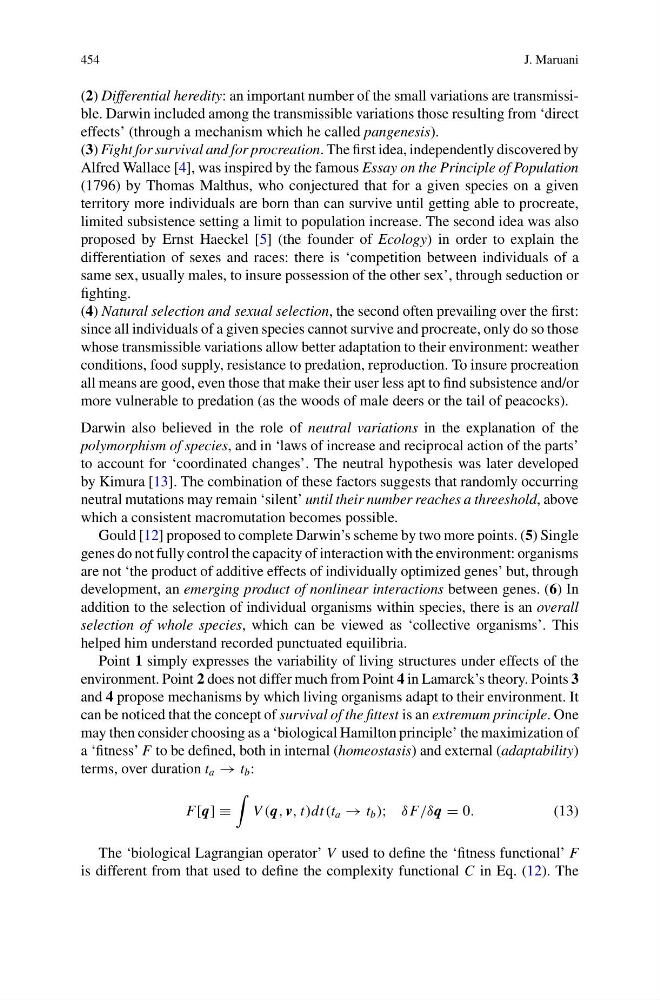
terms, over duration t a → t b :
F[q] ≡
V (q, v, t)dt(t a → t b ); δ F/δq = 0.
(13)
The ‘biological Lagrangian operator’ V used to define the ‘fitness functional’ F
is different from that used to define the complexity functional C in Eq. (12). The
J. Maruani
(2) Differential heredity: an important number of the small variations are transmissible. Darwin included among the transmissible variations those resulting from ‘direct
effects’ (through a mechanism which he called pangenesis).
(3) Fight for survival and for procreation. The first idea, independently discovered by
Alfred Wallace [4], was inspired by the famous Essay on the Principle of Population
(1796) by Thomas Malthus, who conjectured that for a given species on a given
territory more individuals are born than can survive until getting able to procreate,
limited subsistence setting a limit to population increase. The second idea was also
proposed by Ernst Haeckel [5] (the founder of Ecology) in order to explain the
differentiation of sexes and races: there is ‘competition between individuals of a
same sex, usually males, to insure possession of the other sex’, through seduction or
fighting.
(4) Natural selection and sexual selection, the second often prevailing over the first:
since all individuals of a given species cannot survive and procreate, only do so those
whose transmissible variations allow better adaptation to their environment: weather
conditions, food supply, resistance to predation, reproduction. To insure procreation
all means are good, even those that make their user less apt to find subsistence and/or
more vulnerable to predation (as the woods of male deers or the tail of peacocks).
Darwin also believed in the role of neutral variations in the explanation of the
polymorphism of species, and in ‘laws of increase and reciprocal action of the parts’
to account for ‘coordinated changes’. The neutral hypothesis was later developed
by Kimura [13]. The combination of these factors suggests that randomly occurring
neutral mutations may remain ‘silent’ until their number reaches a threeshold, above
which a consistent macromutation becomes possible.
Gould [12] proposed to complete Darwin’s scheme by two more points. (5) Single
genes do not fully control the capacity of interaction with the environment: organisms
are not ‘the product of additive effects of individually optimized genes’ but, through
development, an emerging product of nonlinear interactions between genes. (6) In
addition to the selection of individual organisms within species, there is an overall
selection of whole species, which can be viewed as ‘collective organisms’. This
helped him understand recorded punctuated equilibria.
Point 1 simply expresses the variability of living structures under effects of the
environment. Point 2 does not differ much from Point 4 in Lamarck’s theory. Points 3
and 4 propose mechanisms by which living organisms adapt to their environment. It
can be noticed that the concept of survival of the fittest is an extremum principle. One
may then consider choosing as a ‘biological Hamilton principle’ the maximization of
a ‘fitness’ F to be defined, both in internal (homeostasis) and external (adaptability)
terms, over duration t a → t b :
F[q] ≡
V (q, v, t)dt(t a → t b ); δ F/δq = 0.
(13)
The ‘biological Lagrangian operator’ V used to define the ‘fitness functional’ F
is different from that used to define the complexity functional C in Eq. (12). The