

424
E. J. Brändas
“communication” time scale τ com = (m − 1)τ rel or mτ rel adding the decay time.
We will denote the super propagator a Correlated Dissipative Ensemble, CDE, i.e.
a statistical ensemble associated with a perturbation out of equilibrium representing
assembled stochastic features adapted for Complex Enough Systems, CES’s, with
evolved size- and time scales at precisely given temperatures.
The formulation suggests “molecular communication”, i.e. the transmission of
crucial molecular traits providing cells with their functional duties to be extended
from the microscopic level to generating significant cellular information. Obviously,
there might be focal relations between the primal factorization properties of n and
m. It is also interesting to realize the importance of the transformation B
† , bringing
the CDS, or the CDE, to classical canonical form, and B documenting the ODLRO
information via transforming the steady state flow back to its localized binding sets
of points.
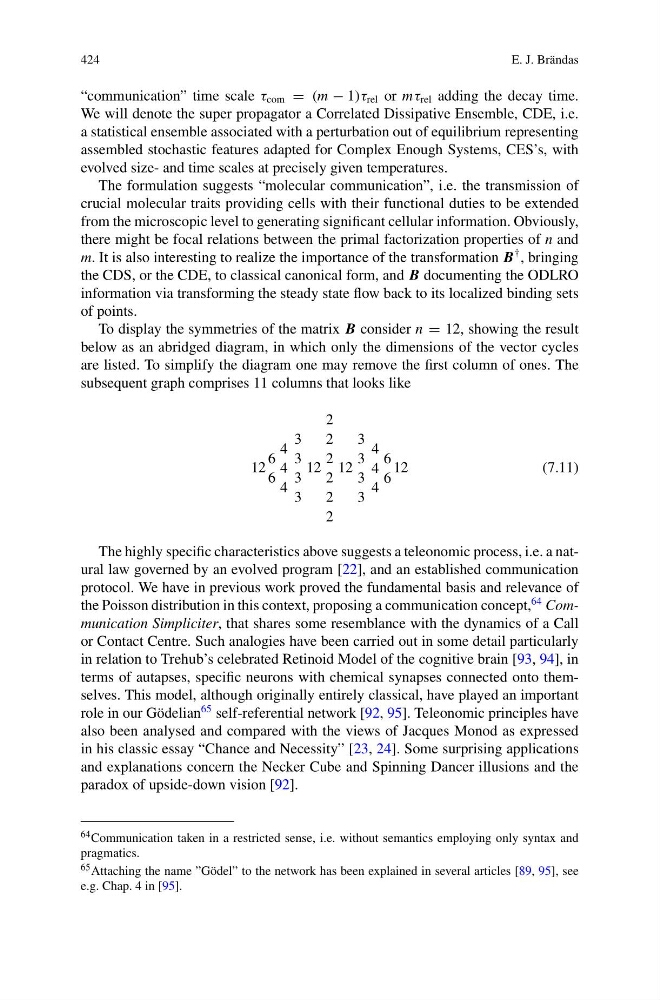
To display the symmetries of the matrix B consider n = 12, showing the result
below as an abridged diagram, in which only the dimensions of the vector cycles
are listed. To simplify the diagram one may remove the first column of ones. The
subsequent graph comprises 11 columns that looks like
12
6
6
4
4
4
3
3
3
3
12
2
2
2
2
2
2
12
3
3
3
3
4
4
4
6
6
12
(7.11)
The highly specific characteristics above suggests a teleonomic process, i.e. a natural law governed by an evolved program [22], and an established communication
protocol. We have in previous work proved the fundamental basis and relevance of
the Poisson distribution in this context, proposing a communication concept,
64 Communication Simpliciter, that shares some resemblance with the dynamics of a Call
or Contact Centre. Such analogies have been carried out in some detail particularly
in relation to Trehub’s celebrated Retinoid Model of the cognitive brain [93, 94], in
terms of autapses, specific neurons with chemical synapses connected onto themselves. This model, although originally entirely classical, have played an important
role in our Gödelian
65 self-referential network [92, 95]. Teleonomic principles have
also been analysed and compared with the views of Jacques Monod as expressed
in his classic essay “Chance and Necessity” [23, 24]. Some surprising applications
and explanations concern the Necker Cube and Spinning Dancer illusions and the
paradox of upside-down vision [92].
64 Communication taken in a restricted sense, i.e. without semantics employing only syntax and
pragmatics.
65 Attaching the name ”Gödel” to the network has been explained in several articles [89, 95], see
e.g. Chap. 4 in [95].
E. J. Brändas
“communication” time scale τ com = (m − 1)τ rel or mτ rel adding the decay time.
We will denote the super propagator a Correlated Dissipative Ensemble, CDE, i.e.
a statistical ensemble associated with a perturbation out of equilibrium representing
assembled stochastic features adapted for Complex Enough Systems, CES’s, with
evolved size- and time scales at precisely given temperatures.
The formulation suggests “molecular communication”, i.e. the transmission of
crucial molecular traits providing cells with their functional duties to be extended
from the microscopic level to generating significant cellular information. Obviously,
there might be focal relations between the primal factorization properties of n and
m. It is also interesting to realize the importance of the transformation B
† , bringing
the CDS, or the CDE, to classical canonical form, and B documenting the ODLRO
information via transforming the steady state flow back to its localized binding sets
of points.
To display the symmetries of the matrix B consider n = 12, showing the result
below as an abridged diagram, in which only the dimensions of the vector cycles
are listed. To simplify the diagram one may remove the first column of ones. The
subsequent graph comprises 11 columns that looks like
12
6
6
4
4
4
3
3
3
3
12
2
2
2
2
2
2
12
3
3
3
3
4
4
4
6
6
12
(7.11)
The highly specific characteristics above suggests a teleonomic process, i.e. a natural law governed by an evolved program [22], and an established communication
protocol. We have in previous work proved the fundamental basis and relevance of
the Poisson distribution in this context, proposing a communication concept,
64 Communication Simpliciter, that shares some resemblance with the dynamics of a Call
or Contact Centre. Such analogies have been carried out in some detail particularly
in relation to Trehub’s celebrated Retinoid Model of the cognitive brain [93, 94], in
terms of autapses, specific neurons with chemical synapses connected onto themselves. This model, although originally entirely classical, have played an important
role in our Gödelian
65 self-referential network [92, 95]. Teleonomic principles have
also been analysed and compared with the views of Jacques Monod as expressed
in his classic essay “Chance and Necessity” [23, 24]. Some surprising applications
and explanations concern the Necker Cube and Spinning Dancer illusions and the
paradox of upside-down vision [92].
64 Communication taken in a restricted sense, i.e. without semantics employing only syntax and
pragmatics.
65 Attaching the name ”Gödel” to the network has been explained in several articles [89, 95], see
e.g. Chap. 4 in [95].