

Abiogenesis and the Second Law of Thermodynamics
415
wavefunction at singularities in the potential and the general requirement of square
integrability, avoid any arbitrariness or subsequent additional criteria in the formulation. This understanding prevails also in the extension to resonances and unstable
states in the continuous spectra, such as Gamow waves and the Stark effect [21,
76]. Generalizing the question to include the Universe and the Universal Device it
becomes a daunting problem as it must include at least a realistic idea of what characterizes a Quantum Black Hole, QBH. Some suggestions will be offered in the last
section, but here we will be content with a picture commensurate with Eqs. (4.5),
(4.6) and Fig. 1.
Obviously, it is reasonable to assume that the device is brought into some kind
of equilibrium with its environment, i.e. subsisting in a steady state configuration
as it carries out its functionality. In principle the prehistory, i.e. the making of the
device, might be part of the incident flux. However, since the steady state exhibits
stochastic traits
45 there appears no restriction or loss of generality to formulate the
initial condition as carried out previously for U D(n).
The present formulation holds in principle for both the Schrödinger-, the Liouvilleand the Bloch equation
46 with Ψ, ρ, , being the wavefunction, the evolving- and the
thermalized density matrices.
47
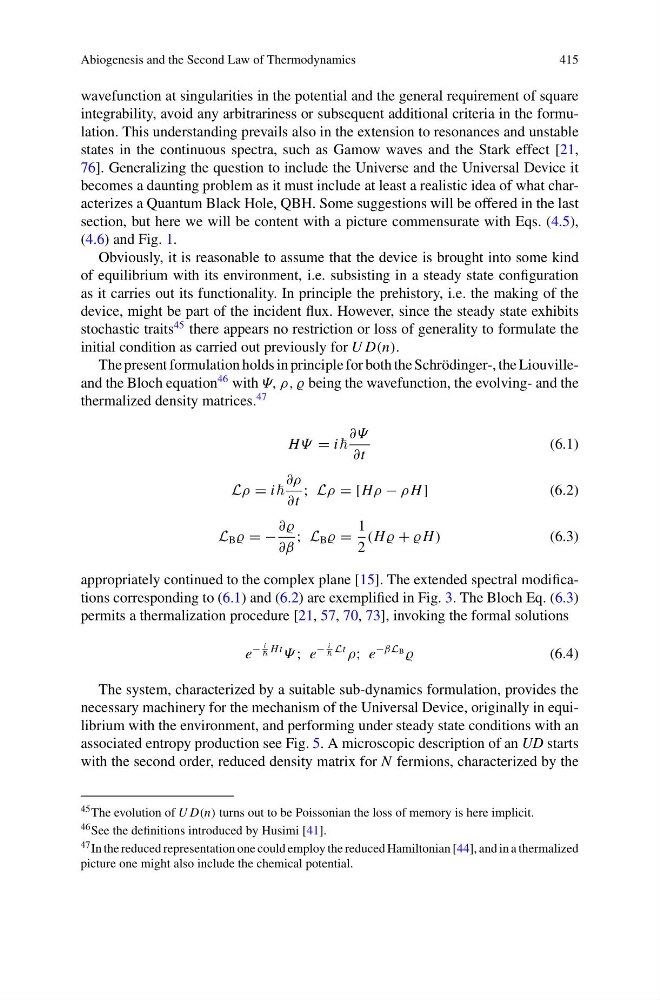
H Ψ = i
∂Ψ
∂t
(6.1)
Lρ = i
∂ρ
∂t
; Lρ = [Hρ − ρ H ]
(6.2)
L B = −
∂∂
∂β
; L B =
1
2
(H + H )
(6.3)
appropriately continued to the complex plane [15]. The extended spectral modifications corresponding to (6.1) and (6.2) are exemplified in Fig. 3. The Bloch Eq. (6.3)
permits a thermalization procedure [21, 57, 70, 73], invoking the formal solutions
e
−
i
Ht
Ψ ; e
−
i
Lt
ρ; e
−βL B
(6.4)
The system, characterized by a suitable sub-dynamics formulation, provides the
necessary machinery for the mechanism of the Universal Device, originally in equilibrium with the environment, and performing under steady state conditions with an
associated entropy production see Fig. 5. A microscopic description of an UD starts
with the second order, reduced density matrix for N fermions, characterized by the
45 The evolution of U D(n) turns out to be Poissonian the loss of memory is here implicit.
46 See the definitions introduced by Husimi [41].
47 In the reduced representation one could employ the reduced Hamiltonian [44], and in a thermalized
picture one might also include the chemical potential.
415
wavefunction at singularities in the potential and the general requirement of square
integrability, avoid any arbitrariness or subsequent additional criteria in the formulation. This understanding prevails also in the extension to resonances and unstable
states in the continuous spectra, such as Gamow waves and the Stark effect [21,
76]. Generalizing the question to include the Universe and the Universal Device it
becomes a daunting problem as it must include at least a realistic idea of what characterizes a Quantum Black Hole, QBH. Some suggestions will be offered in the last
section, but here we will be content with a picture commensurate with Eqs. (4.5),
(4.6) and Fig. 1.
Obviously, it is reasonable to assume that the device is brought into some kind
of equilibrium with its environment, i.e. subsisting in a steady state configuration
as it carries out its functionality. In principle the prehistory, i.e. the making of the
device, might be part of the incident flux. However, since the steady state exhibits
stochastic traits
45 there appears no restriction or loss of generality to formulate the
initial condition as carried out previously for U D(n).
The present formulation holds in principle for both the Schrödinger-, the Liouvilleand the Bloch equation
46 with Ψ, ρ, , being the wavefunction, the evolving- and the
thermalized density matrices.
47
H Ψ = i
∂Ψ
∂t
(6.1)
Lρ = i
∂ρ
∂t
; Lρ = [Hρ − ρ H ]
(6.2)
L B = −
∂∂
∂β
; L B =
1
2
(H + H )
(6.3)
appropriately continued to the complex plane [15]. The extended spectral modifications corresponding to (6.1) and (6.2) are exemplified in Fig. 3. The Bloch Eq. (6.3)
permits a thermalization procedure [21, 57, 70, 73], invoking the formal solutions
e
−
i
Ht
Ψ ; e
−
i
Lt
ρ; e
−βL B
(6.4)
The system, characterized by a suitable sub-dynamics formulation, provides the
necessary machinery for the mechanism of the Universal Device, originally in equilibrium with the environment, and performing under steady state conditions with an
associated entropy production see Fig. 5. A microscopic description of an UD starts
with the second order, reduced density matrix for N fermions, characterized by the
45 The evolution of U D(n) turns out to be Poissonian the loss of memory is here implicit.
46 See the definitions introduced by Husimi [41].
47 In the reduced representation one could employ the reduced Hamiltonian [44], and in a thermalized
picture one might also include the chemical potential.