

Megascopic Quantum Phenomena
337
ε P =
r
˜
ω r
⎛
⎝
A =P
|u
r
P A |
2
(ε
0
P −ε
0
A ) 2 −(ω r ) 2 −
I =P
|u
r
P I |
2
(ε
0
P −ε
0
I ) 2 −(ω r ) 2
⎞
⎠
(11.53)
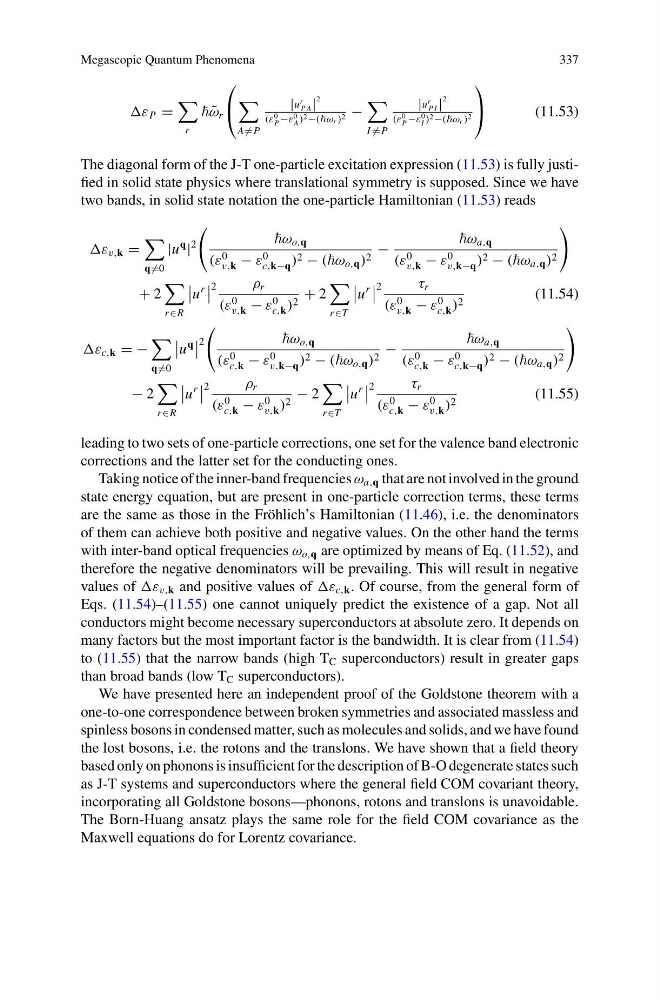
The diagonal form of the J-T one-particle excitation expression (11.53) is fully justified in solid state physics where translational symmetry is supposed. Since we have
two bands, in solid state notation the one-particle Hamiltonian (11.53) reads
ε v,k =
q =0
|u
q
|
2
ω o,q
(ε
0
v,k − ε
0
c,k−q ) 2 − (ω o,q ) 2 −
ω a,q
(ε
0
v,k − ε
0
v,k−q ) 2 − (ω a,q ) 2
+ 2
r ∈R
u
r
2
ρ r
(ε
0
v,k − ε
0
c,k ) 2 + 2
r ∈T
u
r
2
τ r
(ε
0
v,k − ε
0
c,k ) 2
(11.54)
ε c,k = −
q =0
u
q
2
ω o,q
(ε
0
c,k − ε
0
v,k−q ) 2 − (ω o,q ) 2 −
ω a,q
(ε
0
c,k − ε
0
c,k−q ) 2 − (ω a,q ) 2
− 2
r ∈R
u
r
2
ρ r
(ε
0
c,k − ε
0
v,k ) 2 − 2
r ∈T
u
r
2
τ r
(ε
0
c,k − ε
0
v,k ) 2
(11.55)
leading to two sets of one-particle corrections, one set for the valence band electronic
corrections and the latter set for the conducting ones.
Taking notice of the inner-band frequencies ω a,q that are not involved in the ground
state energy equation, but are present in one-particle correction terms, these terms
are the same as those in the Fröhlich’s Hamiltonian (11.46), i.e. the denominators
of them can achieve both positive and negative values. On the other hand the terms
with inter-band optical frequencies ω o,q are optimized by means of Eq. (11.52), and
therefore the negative denominators will be prevailing. This will result in negative
values of ε v,k and positive values of ε c,k . Of course, from the general form of
Eqs. (11.54)–(11.55) one cannot uniquely predict the existence of a gap. Not all
conductors might become necessary superconductors at absolute zero. It depends on
many factors but the most important factor is the bandwidth. It is clear from (11.54)
to (11.55) that the narrow bands (high T C superconductors) result in greater gaps
than broad bands (low T C superconductors).
We have presented here an independent proof of the Goldstone theorem with a
one-to-one correspondence between broken symmetries and associated massless and
spinless bosons in condensed matter, such as molecules and solids, and we have found
the lost bosons, i.e. the rotons and the translons. We have shown that a field theory
based only on phonons is insufficient for the description of B-O degenerate states such
as J-T systems and superconductors where the general field COM covariant theory,
incorporating all Goldstone bosons—phonons, rotons and translons is unavoidable.
The Born-Huang ansatz plays the same role for the field COM covariance as the
Maxwell equations do for Lorentz covariance.
337
ε P =
r
˜
ω r
⎛
⎝
A =P
|u
r
P A |
2
(ε
0
P −ε
0
A ) 2 −(ω r ) 2 −
I =P
|u
r
P I |
2
(ε
0
P −ε
0
I ) 2 −(ω r ) 2
⎞
⎠
(11.53)
The diagonal form of the J-T one-particle excitation expression (11.53) is fully justified in solid state physics where translational symmetry is supposed. Since we have
two bands, in solid state notation the one-particle Hamiltonian (11.53) reads
ε v,k =
q =0
|u
q
|
2
ω o,q
(ε
0
v,k − ε
0
c,k−q ) 2 − (ω o,q ) 2 −
ω a,q
(ε
0
v,k − ε
0
v,k−q ) 2 − (ω a,q ) 2
+ 2
r ∈R
u
r
2
ρ r
(ε
0
v,k − ε
0
c,k ) 2 + 2
r ∈T
u
r
2
τ r
(ε
0
v,k − ε
0
c,k ) 2
(11.54)
ε c,k = −
q =0
u
q
2
ω o,q
(ε
0
c,k − ε
0
v,k−q ) 2 − (ω o,q ) 2 −
ω a,q
(ε
0
c,k − ε
0
c,k−q ) 2 − (ω a,q ) 2
− 2
r ∈R
u
r
2
ρ r
(ε
0
c,k − ε
0
v,k ) 2 − 2
r ∈T
u
r
2
τ r
(ε
0
c,k − ε
0
v,k ) 2
(11.55)
leading to two sets of one-particle corrections, one set for the valence band electronic
corrections and the latter set for the conducting ones.
Taking notice of the inner-band frequencies ω a,q that are not involved in the ground
state energy equation, but are present in one-particle correction terms, these terms
are the same as those in the Fröhlich’s Hamiltonian (11.46), i.e. the denominators
of them can achieve both positive and negative values. On the other hand the terms
with inter-band optical frequencies ω o,q are optimized by means of Eq. (11.52), and
therefore the negative denominators will be prevailing. This will result in negative
values of ε v,k and positive values of ε c,k . Of course, from the general form of
Eqs. (11.54)–(11.55) one cannot uniquely predict the existence of a gap. Not all
conductors might become necessary superconductors at absolute zero. It depends on
many factors but the most important factor is the bandwidth. It is clear from (11.54)
to (11.55) that the narrow bands (high T C superconductors) result in greater gaps
than broad bands (low T C superconductors).
We have presented here an independent proof of the Goldstone theorem with a
one-to-one correspondence between broken symmetries and associated massless and
spinless bosons in condensed matter, such as molecules and solids, and we have found
the lost bosons, i.e. the rotons and the translons. We have shown that a field theory
based only on phonons is insufficient for the description of B-O degenerate states such
as J-T systems and superconductors where the general field COM covariant theory,
incorporating all Goldstone bosons—phonons, rotons and translons is unavoidable.
The Born-Huang ansatz plays the same role for the field COM covariance as the
Maxwell equations do for Lorentz covariance.