

336
M. Svrˇ cek
quanta occurs even if the molecule or crystal is completely in rest and does not rotate
or move.
(6) The ground state energy of the B-O degenerate systems:
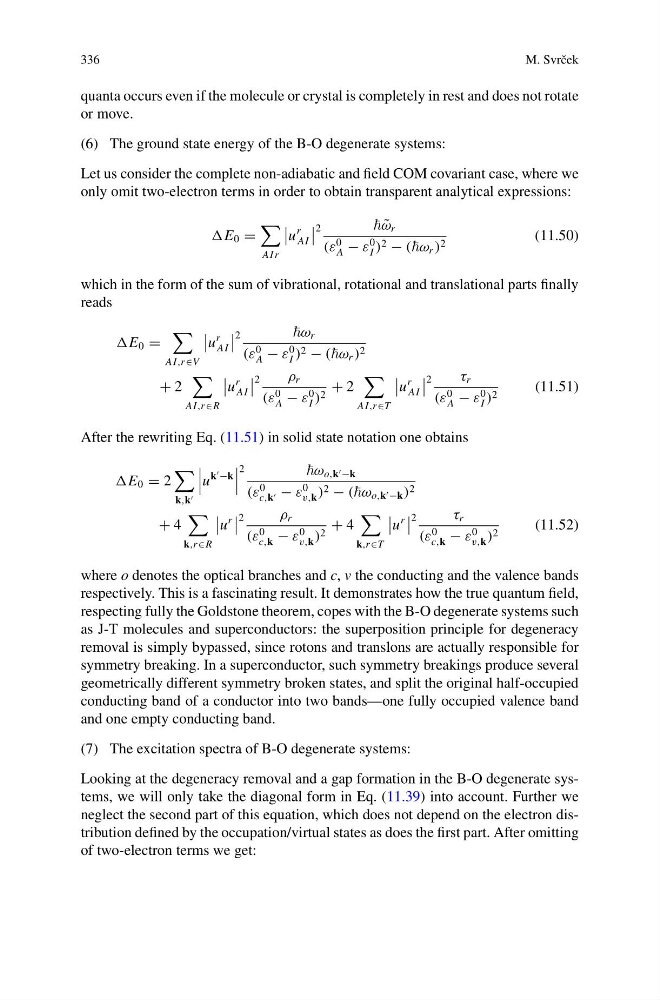
Let us consider the complete non-adiabatic and field COM covariant case, where we
only omit two-electron terms in order to obtain transparent analytical expressions:
E 0 =
AIr
u
r
AI
2
˜
ω r
(ε
0
A − ε
0
I ) 2 − (ω r ) 2
(11.50)
which in the form of the sum of vibrational, rotational and translational parts finally
reads
E 0 =
AI,r ∈V
u
r
AI
2
ω r
(ε
0
A − ε
0
I ) 2 − (ω r ) 2
+ 2
AI,r ∈R
u
r
AI
2
ρ r
(ε
0
A − ε
0
I ) 2 + 2
AI,r ∈T
u
r
AI
2
τ r
(ε
0
A − ε
0
I ) 2
(11.51)
After the rewriting Eq. (11.51) in solid state notation one obtains
E 0 = 2
k,k
u
k
−k
2
ω o,k −k
(ε
0
c,k − ε
0
v,k ) 2 − (ω o,k −k ) 2
+ 4
k,r ∈R
u
r
2
ρ r
(ε
0
c,k − ε
0
v,k ) 2 + 4
k,r ∈T
u
r
2
τ r
(ε
0
c,k − ε
0
v,k ) 2
(11.52)
where o denotes the optical branches and c, v the conducting and the valence bands
respectively. This is a fascinating result. It demonstrates how the true quantum field,
respecting fully the Goldstone theorem, copes with the B-O degenerate systems such
as J-T molecules and superconductors: the superposition principle for degeneracy
removal is simply bypassed, since rotons and translons are actually responsible for
symmetry breaking. In a superconductor, such symmetry breakings produce several
geometrically different symmetry broken states, and split the original half-occupied
conducting band of a conductor into two bands—one fully occupied valence band
and one empty conducting band.
(7) The excitation spectra of B-O degenerate systems:
Looking at the degeneracy removal and a gap formation in the B-O degenerate systems, we will only take the diagonal form in Eq. (11.39) into account. Further we
neglect the second part of this equation, which does not depend on the electron distribution defined by the occupation/virtual states as does the first part. After omitting
of two-electron terms we get:
M. Svrˇ cek
quanta occurs even if the molecule or crystal is completely in rest and does not rotate
or move.
(6) The ground state energy of the B-O degenerate systems:
Let us consider the complete non-adiabatic and field COM covariant case, where we
only omit two-electron terms in order to obtain transparent analytical expressions:
E 0 =
AIr
u
r
AI
2
˜
ω r
(ε
0
A − ε
0
I ) 2 − (ω r ) 2
(11.50)
which in the form of the sum of vibrational, rotational and translational parts finally
reads
E 0 =
AI,r ∈V
u
r
AI
2
ω r
(ε
0
A − ε
0
I ) 2 − (ω r ) 2
+ 2
AI,r ∈R
u
r
AI
2
ρ r
(ε
0
A − ε
0
I ) 2 + 2
AI,r ∈T
u
r
AI
2
τ r
(ε
0
A − ε
0
I ) 2
(11.51)
After the rewriting Eq. (11.51) in solid state notation one obtains
E 0 = 2
k,k
u
k
−k
2
ω o,k −k
(ε
0
c,k − ε
0
v,k ) 2 − (ω o,k −k ) 2
+ 4
k,r ∈R
u
r
2
ρ r
(ε
0
c,k − ε
0
v,k ) 2 + 4
k,r ∈T
u
r
2
τ r
(ε
0
c,k − ε
0
v,k ) 2
(11.52)
where o denotes the optical branches and c, v the conducting and the valence bands
respectively. This is a fascinating result. It demonstrates how the true quantum field,
respecting fully the Goldstone theorem, copes with the B-O degenerate systems such
as J-T molecules and superconductors: the superposition principle for degeneracy
removal is simply bypassed, since rotons and translons are actually responsible for
symmetry breaking. In a superconductor, such symmetry breakings produce several
geometrically different symmetry broken states, and split the original half-occupied
conducting band of a conductor into two bands—one fully occupied valence band
and one empty conducting band.
(7) The excitation spectra of B-O degenerate systems:
Looking at the degeneracy removal and a gap formation in the B-O degenerate systems, we will only take the diagonal form in Eq. (11.39) into account. Further we
neglect the second part of this equation, which does not depend on the electron distribution defined by the occupation/virtual states as does the first part. After omitting
of two-electron terms we get: