

Megascopic Quantum Phenomena
315
materials that are generally believed to be ‘unconventional’, i.e. not described by BCS
theory… And certainly there is no single ‘unconventional mechanism’ proposed to
describe all unconventional superconductors: new mechanisms are being proposed
that apply specifically to one family only, e.g. the cuprates, or the iron pnictides, or
the heavy fermion superconductors. However all superconductors, whether conventional or not, exhibit the Meissner effect. I argue that BCS theory cannot explain the
Meissner effect, so it cannot explain any superconductor. Furthermore, none of the
unconventional mechanisms proposed to explain ‘unconventional’ superconductivity has addressed the question of how to explain the Meissner effect. I argue that
none of these mechanisms describe any superconductor because they cannot explain
the Meissner effect.”
The problem of the transition into the superconducting state after cooling is not
the only one. For instance, what goes on when, beyond the critical temperature, a
superconductor becomes conductor again. What happens with the momentum of the
supercurrent? Hirsch, in his paper “The disappearing momentum of the supercurrent
in the superconductor to normal phase transformation” [82] writes: “A conundrum
that didn’t exist before was thus created by Meissner’s discovery: if there are no collision processes that dissipate Joule heat in the superconductor-to-normal transition
in the presence of a magnetic field, what happens to the mechanical momentum of
the disappearing current? The kinetic energy of the current is ‘stored’ in the normal
state electronic state, but its momentum is not. Of course the only possible answer is
that the momentum of the current is transmitted to the body as a whole. But what is
the physical mechanism by which this transfer of momentum happens with no energy
transfer and no energy dissipation? Surprisingly this basic and fundamental question
has never been asked (nor answered) in the extensive literature on superconductivity
since 1933 (213,616 papers according to the Web of Science).”
In the author’s opinion, Hirsch is absolutely right, as far as the two statements
given above. Does it mean that the Meissner effect and superconductivity have no
quantum physical solutions? Hirsch thinks that they have, and revives in his work
“The Bohr superconductor” [80] some old ideas from the pre-BCS era. He shows
that any superconductor, described classically, is equivalent to a system of charge
carriers rotating in the whole bulk in orbits of radius 2λ. He presents several ways
of solution; the simplest and most transparent is the following: The total angular
momentum of the Meissner current in a long cylinder of radius R and height d with
applied magnetic field parallel to the cylinder axis can be written in the two equivalent
forms
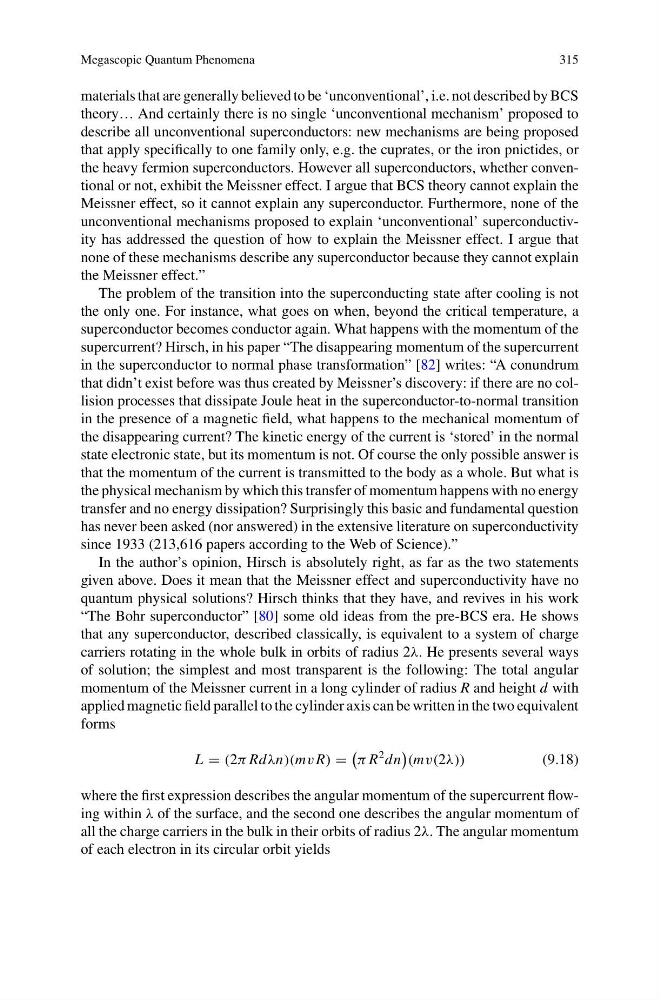
L = (2π Rdλn)(mv R) =
π R
2 dn
(mv(2λ))
(9.18)
where the first expression describes the angular momentum of the supercurrent flowing within λ of the surface, and the second one describes the angular momentum of
all the charge carriers in the bulk in their orbits of radius 2λ. The angular momentum
of each electron in its circular orbit yields
315
materials that are generally believed to be ‘unconventional’, i.e. not described by BCS
theory… And certainly there is no single ‘unconventional mechanism’ proposed to
describe all unconventional superconductors: new mechanisms are being proposed
that apply specifically to one family only, e.g. the cuprates, or the iron pnictides, or
the heavy fermion superconductors. However all superconductors, whether conventional or not, exhibit the Meissner effect. I argue that BCS theory cannot explain the
Meissner effect, so it cannot explain any superconductor. Furthermore, none of the
unconventional mechanisms proposed to explain ‘unconventional’ superconductivity has addressed the question of how to explain the Meissner effect. I argue that
none of these mechanisms describe any superconductor because they cannot explain
the Meissner effect.”
The problem of the transition into the superconducting state after cooling is not
the only one. For instance, what goes on when, beyond the critical temperature, a
superconductor becomes conductor again. What happens with the momentum of the
supercurrent? Hirsch, in his paper “The disappearing momentum of the supercurrent
in the superconductor to normal phase transformation” [82] writes: “A conundrum
that didn’t exist before was thus created by Meissner’s discovery: if there are no collision processes that dissipate Joule heat in the superconductor-to-normal transition
in the presence of a magnetic field, what happens to the mechanical momentum of
the disappearing current? The kinetic energy of the current is ‘stored’ in the normal
state electronic state, but its momentum is not. Of course the only possible answer is
that the momentum of the current is transmitted to the body as a whole. But what is
the physical mechanism by which this transfer of momentum happens with no energy
transfer and no energy dissipation? Surprisingly this basic and fundamental question
has never been asked (nor answered) in the extensive literature on superconductivity
since 1933 (213,616 papers according to the Web of Science).”
In the author’s opinion, Hirsch is absolutely right, as far as the two statements
given above. Does it mean that the Meissner effect and superconductivity have no
quantum physical solutions? Hirsch thinks that they have, and revives in his work
“The Bohr superconductor” [80] some old ideas from the pre-BCS era. He shows
that any superconductor, described classically, is equivalent to a system of charge
carriers rotating in the whole bulk in orbits of radius 2λ. He presents several ways
of solution; the simplest and most transparent is the following: The total angular
momentum of the Meissner current in a long cylinder of radius R and height d with
applied magnetic field parallel to the cylinder axis can be written in the two equivalent
forms
L = (2π Rdλn)(mv R) =
π R
2 dn
(mv(2λ))
(9.18)
where the first expression describes the angular momentum of the supercurrent flowing within λ of the surface, and the second one describes the angular momentum of
all the charge carriers in the bulk in their orbits of radius 2λ. The angular momentum
of each electron in its circular orbit yields