

272
X. Liu et al.
e
−βφ
(dia) (R 1 ,...,R P )
= Tr e
P
i=1
e
−βV diag (R i )/P
.
(56)
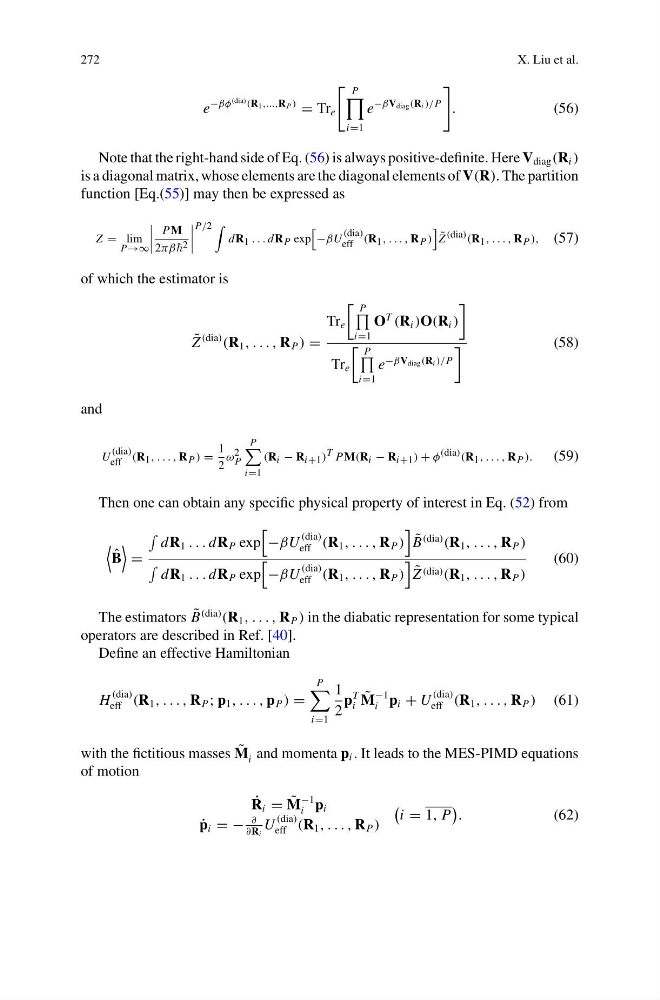
Note that the right-hand side of Eq. (56) is always positive-definite. Here V diag (R i )
is a diagonal matrix, whose elements are the diagonal elements of V(R). The partition
function [Eq.(55)] may then be expressed as
Z = lim
P→∞
PM
2πβ 2
P/2
dR 1 . . . dR P exp
−βU
(dia)
eff (R 1 , . . . , R P )
˜
Z (dia) (R 1 , . . . , R P ), (57)
of which the estimator is
˜
Z
(dia)
(R 1 , . . . , R P ) =
Tr e
P
i=1
O
T
(R i )O(R i )
Tr e
P
i=1
e −βV diag (R i )/P
(58)
and
U
(dia)
eff (R 1 , . . . , R P ) =
1
2
ω 2
P
P
i=1
(R i − R i+1 ) T PM(R i − R i+1 ) + φ (dia) (R 1 , . . . , R P ).
(59)
Then one can obtain any specific physical property of interest in Eq. (52) from
ˆ
B
=
dR 1 . . . dR P exp
−βU
(dia)
eff (R 1 , . . . , R P )
˜
B
(dia)
(R 1 , . . . , R P )
dR 1 . . . dR P exp
−βU
(dia)
eff (R 1 , . . . , R P )
˜
Z (dia) (R 1 , . . . , R P )
(60)
The estimators ˜
B
(dia)
(R 1 , . . . , R P ) in the diabatic representation for some typical
operators are described in Ref. [40].
Define an effective Hamiltonian
H
(dia)
eff (R 1 , . . . , R P ; p 1 , . . . , p P ) =
P
i=1
1
2
p
T
i
˜
M
−1
i p i + U
(dia)
eff (R 1 , . . . , R P ) (61)
with the fictitious masses ˜
M i and momenta p i . It leads to the MES-PIMD equations
of motion
˙
R i = ˜
M
−1
i p i
˙
p i = −
∂
∂R i
U
(dia)
eff (R 1 , . . . , R P )
i = 1, P
.
(62)
X. Liu et al.
e
−βφ
(dia) (R 1 ,...,R P )
= Tr e
P
i=1
e
−βV diag (R i )/P
.
(56)
Note that the right-hand side of Eq. (56) is always positive-definite. Here V diag (R i )
is a diagonal matrix, whose elements are the diagonal elements of V(R). The partition
function [Eq.(55)] may then be expressed as
Z = lim
P→∞
PM
2πβ 2
P/2
dR 1 . . . dR P exp
−βU
(dia)
eff (R 1 , . . . , R P )
˜
Z (dia) (R 1 , . . . , R P ), (57)
of which the estimator is
˜
Z
(dia)
(R 1 , . . . , R P ) =
Tr e
P
i=1
O
T
(R i )O(R i )
Tr e
P
i=1
e −βV diag (R i )/P
(58)
and
U
(dia)
eff (R 1 , . . . , R P ) =
1
2
ω 2
P
P
i=1
(R i − R i+1 ) T PM(R i − R i+1 ) + φ (dia) (R 1 , . . . , R P ).
(59)
Then one can obtain any specific physical property of interest in Eq. (52) from
ˆ
B
=
dR 1 . . . dR P exp
−βU
(dia)
eff (R 1 , . . . , R P )
˜
B
(dia)
(R 1 , . . . , R P )
dR 1 . . . dR P exp
−βU
(dia)
eff (R 1 , . . . , R P )
˜
Z (dia) (R 1 , . . . , R P )
(60)
The estimators ˜
B
(dia)
(R 1 , . . . , R P ) in the diabatic representation for some typical
operators are described in Ref. [40].
Define an effective Hamiltonian
H
(dia)
eff (R 1 , . . . , R P ; p 1 , . . . , p P ) =
P
i=1
1
2
p
T
i
˜
M
−1
i p i + U
(dia)
eff (R 1 , . . . , R P ) (61)
with the fictitious masses ˜
M i and momenta p i . It leads to the MES-PIMD equations
of motion
˙
R i = ˜
M
−1
i p i
˙
p i = −
∂
∂R i
U
(dia)
eff (R 1 , . . . , R P )
i = 1, P
.
(62)