

Current Problems in Computer Simulation of Variability …
245
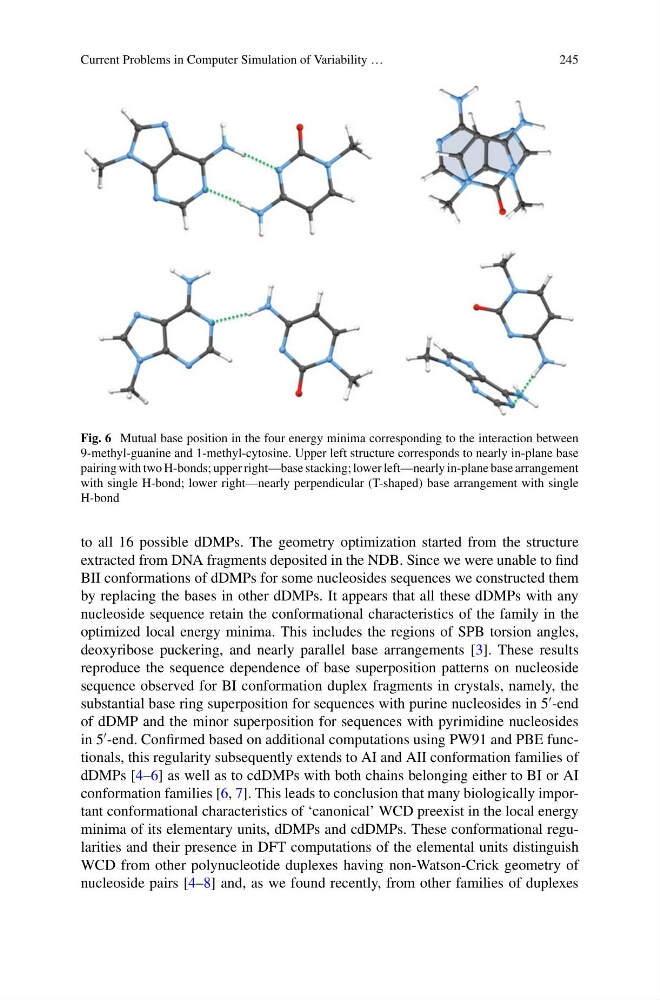
Fig. 6 Mutual base position in the four energy minima corresponding to the interaction between
9-methyl-guanine and 1-methyl-cytosine. Upper left structure corresponds to nearly in-plane base
pairing with two H-bonds; upper right—base stacking; lower left—nearly in-plane base arrangement
with single H-bond; lower right—nearly perpendicular (T-shaped) base arrangement with single
H-bond
to all 16 possible dDMPs. The geometry optimization started from the structure
extracted from DNA fragments deposited in the NDB. Since we were unable to find
BII conformations of dDMPs for some nucleosides sequences we constructed them
by replacing the bases in other dDMPs. It appears that all these dDMPs with any
nucleoside sequence retain the conformational characteristics of the family in the
optimized local energy minima. This includes the regions of SPB torsion angles,
deoxyribose puckering, and nearly parallel base arrangements [3]. These results
reproduce the sequence dependence of base superposition patterns on nucleoside
sequence observed for BI conformation duplex fragments in crystals, namely, the
substantial base ring superposition for sequences with purine nucleosides in 5
-end
of dDMP and the minor superposition for sequences with pyrimidine nucleosides
in 5
-end. Confirmed based on additional computations using PW91 and PBE functionals, this regularity subsequently extends to AI and AII conformation families of
dDMPs [4–6] as well as to cdDMPs with both chains belonging either to BI or AI
conformation families [6, 7]. This leads to conclusion that many biologically important conformational characteristics of ‘canonical’ WCD preexist in the local energy
minima of its elementary units, dDMPs and cdDMPs. These conformational regularities and their presence in DFT computations of the elemental units distinguish
WCD from other polynucleotide duplexes having non-Watson-Crick geometry of
nucleoside pairs [4–8] and, as we found recently, from other families of duplexes
245
Fig. 6 Mutual base position in the four energy minima corresponding to the interaction between
9-methyl-guanine and 1-methyl-cytosine. Upper left structure corresponds to nearly in-plane base
pairing with two H-bonds; upper right—base stacking; lower left—nearly in-plane base arrangement
with single H-bond; lower right—nearly perpendicular (T-shaped) base arrangement with single
H-bond
to all 16 possible dDMPs. The geometry optimization started from the structure
extracted from DNA fragments deposited in the NDB. Since we were unable to find
BII conformations of dDMPs for some nucleosides sequences we constructed them
by replacing the bases in other dDMPs. It appears that all these dDMPs with any
nucleoside sequence retain the conformational characteristics of the family in the
optimized local energy minima. This includes the regions of SPB torsion angles,
deoxyribose puckering, and nearly parallel base arrangements [3]. These results
reproduce the sequence dependence of base superposition patterns on nucleoside
sequence observed for BI conformation duplex fragments in crystals, namely, the
substantial base ring superposition for sequences with purine nucleosides in 5
-end
of dDMP and the minor superposition for sequences with pyrimidine nucleosides
in 5
-end. Confirmed based on additional computations using PW91 and PBE functionals, this regularity subsequently extends to AI and AII conformation families of
dDMPs [4–6] as well as to cdDMPs with both chains belonging either to BI or AI
conformation families [6, 7]. This leads to conclusion that many biologically important conformational characteristics of ‘canonical’ WCD preexist in the local energy
minima of its elementary units, dDMPs and cdDMPs. These conformational regularities and their presence in DFT computations of the elemental units distinguish
WCD from other polynucleotide duplexes having non-Watson-Crick geometry of
nucleoside pairs [4–8] and, as we found recently, from other families of duplexes