

226
N. Tshilande and L. Mammino
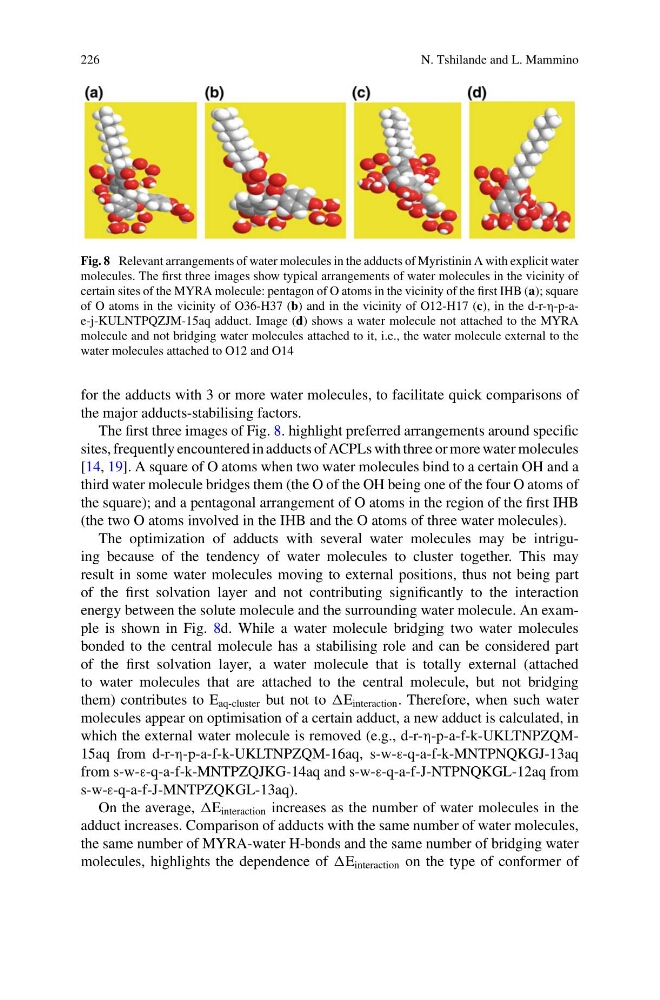
Fig. 8 Relevant arrangements of water molecules in the adducts of Myristinin A with explicit water
molecules. The first three images show typical arrangements of water molecules in the vicinity of
certain sites of the MYRA molecule: pentagon of O atoms in the vicinity of the first IHB (a); square
of O atoms in the vicinity of O36-H37 (b) and in the vicinity of O12-H17 (c), in the d-r-η-p-ae-j-KULNTPQZJM-15aq adduct. Image (d) shows a water molecule not attached to the MYRA
molecule and not bridging water molecules attached to it, i.e., the water molecule external to the
water molecules attached to O12 and O14
for the adducts with 3 or more water molecules, to facilitate quick comparisons of
the major adducts-stabilising factors.
The first three images of Fig. 8. highlight preferred arrangements around specific
sites, frequently encountered in adducts of ACPLs with three or more water molecules
[14, 19]. A square of O atoms when two water molecules bind to a certain OH and a
third water molecule bridges them (the O of the OH being one of the four O atoms of
the square); and a pentagonal arrangement of O atoms in the region of the first IHB
(the two O atoms involved in the IHB and the O atoms of three water molecules).
The optimization of adducts with several water molecules may be intriguing because of the tendency of water molecules to cluster together. This may
result in some water molecules moving to external positions, thus not being part
of the first solvation layer and not contributing significantly to the interaction
energy between the solute molecule and the surrounding water molecule. An example is shown in Fig. 8d. While a water molecule bridging two water molecules
bonded to the central molecule has a stabilising role and can be considered part
of the first solvation layer, a water molecule that is totally external (attached
to water molecules that are attached to the central molecule, but not bridging
them) contributes to E aq-cluster but not to E interaction . Therefore, when such water
molecules appear on optimisation of a certain adduct, a new adduct is calculated, in
which the external water molecule is removed (e.g., d-r-η-p-a-f-k-UKLTNPZQM15aq from d-r-η-p-a-f-k-UKLTNPZQM-16aq, s-w-ε-q-a-f-k-MNTPNQKGJ-13aq
from s-w-ε-q-a-f-k-MNTPZQJKG-14aq and s-w-ε-q-a-f-J-NTPNQKGL-12aq from
s-w-ε-q-a-f-J-MNTPZQKGL-13aq).
On the average, E interaction increases as the number of water molecules in the
adduct increases. Comparison of adducts with the same number of water molecules,
the same number of MYRA-water H-bonds and the same number of bridging water
molecules, highlights the dependence of E interaction on the type of conformer of
N. Tshilande and L. Mammino
Fig. 8 Relevant arrangements of water molecules in the adducts of Myristinin A with explicit water
molecules. The first three images show typical arrangements of water molecules in the vicinity of
certain sites of the MYRA molecule: pentagon of O atoms in the vicinity of the first IHB (a); square
of O atoms in the vicinity of O36-H37 (b) and in the vicinity of O12-H17 (c), in the d-r-η-p-ae-j-KULNTPQZJM-15aq adduct. Image (d) shows a water molecule not attached to the MYRA
molecule and not bridging water molecules attached to it, i.e., the water molecule external to the
water molecules attached to O12 and O14
for the adducts with 3 or more water molecules, to facilitate quick comparisons of
the major adducts-stabilising factors.
The first three images of Fig. 8. highlight preferred arrangements around specific
sites, frequently encountered in adducts of ACPLs with three or more water molecules
[14, 19]. A square of O atoms when two water molecules bind to a certain OH and a
third water molecule bridges them (the O of the OH being one of the four O atoms of
the square); and a pentagonal arrangement of O atoms in the region of the first IHB
(the two O atoms involved in the IHB and the O atoms of three water molecules).
The optimization of adducts with several water molecules may be intriguing because of the tendency of water molecules to cluster together. This may
result in some water molecules moving to external positions, thus not being part
of the first solvation layer and not contributing significantly to the interaction
energy between the solute molecule and the surrounding water molecule. An example is shown in Fig. 8d. While a water molecule bridging two water molecules
bonded to the central molecule has a stabilising role and can be considered part
of the first solvation layer, a water molecule that is totally external (attached
to water molecules that are attached to the central molecule, but not bridging
them) contributes to E aq-cluster but not to E interaction . Therefore, when such water
molecules appear on optimisation of a certain adduct, a new adduct is calculated, in
which the external water molecule is removed (e.g., d-r-η-p-a-f-k-UKLTNPZQM15aq from d-r-η-p-a-f-k-UKLTNPZQM-16aq, s-w-ε-q-a-f-k-MNTPNQKGJ-13aq
from s-w-ε-q-a-f-k-MNTPZQJKG-14aq and s-w-ε-q-a-f-J-NTPNQKGL-12aq from
s-w-ε-q-a-f-J-MNTPZQKGL-13aq).
On the average, E interaction increases as the number of water molecules in the
adduct increases. Comparison of adducts with the same number of water molecules,
the same number of MYRA-water H-bonds and the same number of bridging water
molecules, highlights the dependence of E interaction on the type of conformer of