

Ab Initio and DFT Computational Study …
225
d-r-η-p-a-e-j-U-1aq d-r-η-p-a-e-j-L-1aq
d-r-η-p-a-e-j-T-1aq
d-r-η-p-a-e-j-KU-2aq d-r-η-p-a-e-j-LG-2aq
s-w-ε-q-a-f-kJ-NTPNQKGL-12aq MNTPNQKGJ-13aq
d-r-η-p-a-f-kUKLNTPZQM-14aq UKLTNPZQM-15aq KULNTPQZJM-15aq KGLQZPNTM-15aq KULNTPQZM-16aq
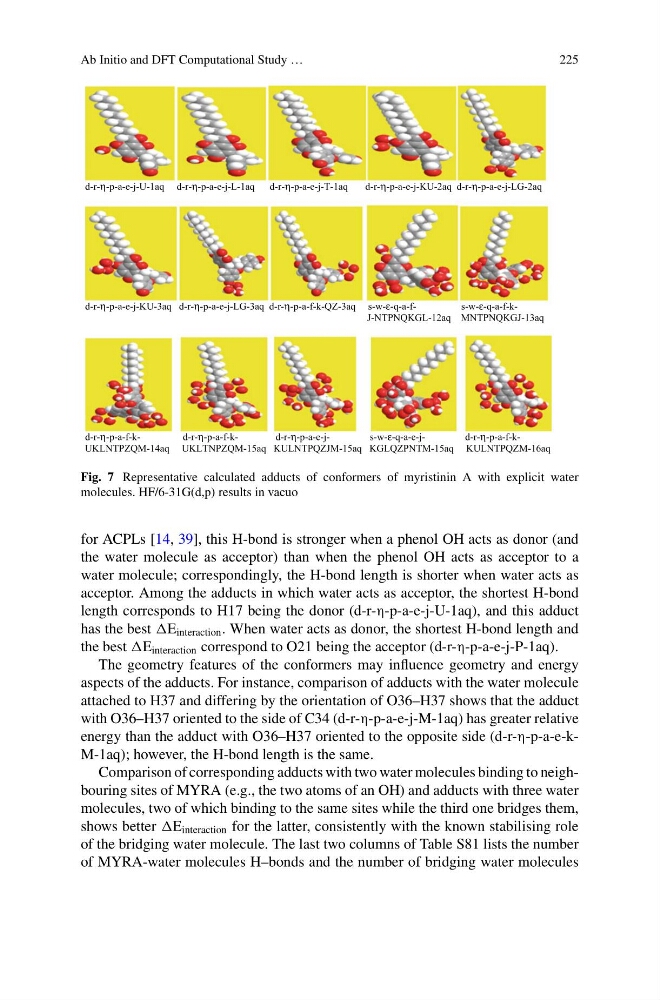
Fig. 7 Representative calculated adducts of conformers of myristinin A with explicit water
molecules. HF/6-31G(d,p) results in vacuo
for ACPLs [14, 39], this H-bond is stronger when a phenol OH acts as donor (and
the water molecule as acceptor) than when the phenol OH acts as acceptor to a
water molecule; correspondingly, the H-bond length is shorter when water acts as
acceptor. Among the adducts in which water acts as acceptor, the shortest H-bond
length corresponds to H17 being the donor (d-r-η-p-a-e-j-U-1aq), and this adduct
has the best interaction . When water acts as donor, the shortest H-bond length and
the best interaction correspond to O21 being the acceptor (d-r-η-p-a-e-j-P-1aq).
The geometry features of the conformers may influence geometry and energy
aspects of the adducts. For instance, comparison of adducts with the water molecule
attached to H37 and differing by the orientation of O36–H37 shows that the adduct
with O36–H37 oriented to the side of C34 (d-r-η-p-a-e-j-M-1aq) has greater relative
energy than the adduct with O36–H37 oriented to the opposite side (d-r-η-p-a-e-kM-1aq); however, the H-bond length is the same.
Comparison of corresponding adducts with two water molecules binding to neighbouring sites of MYRA (e.g., the two atoms of an OH) and adducts with three water
molecules, two of which binding to the same sites while the third one bridges them,
shows better interaction for the latter, consistently with the known stabilising role
of the bridging water molecule. The last two columns of Table S81 lists the number
of MYRA-water molecules H–bonds and the number of bridging water molecules
225
d-r-η-p-a-e-j-U-1aq d-r-η-p-a-e-j-L-1aq
d-r-η-p-a-e-j-T-1aq
d-r-η-p-a-e-j-KU-2aq d-r-η-p-a-e-j-LG-2aq
s-w-ε-q-a-f-kJ-NTPNQKGL-12aq MNTPNQKGJ-13aq
d-r-η-p-a-f-kUKLNTPZQM-14aq UKLTNPZQM-15aq KULNTPQZJM-15aq KGLQZPNTM-15aq KULNTPQZM-16aq
Fig. 7 Representative calculated adducts of conformers of myristinin A with explicit water
molecules. HF/6-31G(d,p) results in vacuo
for ACPLs [14, 39], this H-bond is stronger when a phenol OH acts as donor (and
the water molecule as acceptor) than when the phenol OH acts as acceptor to a
water molecule; correspondingly, the H-bond length is shorter when water acts as
acceptor. Among the adducts in which water acts as acceptor, the shortest H-bond
length corresponds to H17 being the donor (d-r-η-p-a-e-j-U-1aq), and this adduct
has the best interaction . When water acts as donor, the shortest H-bond length and
the best interaction correspond to O21 being the acceptor (d-r-η-p-a-e-j-P-1aq).
The geometry features of the conformers may influence geometry and energy
aspects of the adducts. For instance, comparison of adducts with the water molecule
attached to H37 and differing by the orientation of O36–H37 shows that the adduct
with O36–H37 oriented to the side of C34 (d-r-η-p-a-e-j-M-1aq) has greater relative
energy than the adduct with O36–H37 oriented to the opposite side (d-r-η-p-a-e-kM-1aq); however, the H-bond length is the same.
Comparison of corresponding adducts with two water molecules binding to neighbouring sites of MYRA (e.g., the two atoms of an OH) and adducts with three water
molecules, two of which binding to the same sites while the third one bridges them,
shows better interaction for the latter, consistently with the known stabilising role
of the bridging water molecule. The last two columns of Table S81 lists the number
of MYRA-water molecules H–bonds and the number of bridging water molecules