

Ab Initio and DFT Computational Study …
219
For all the three molecules, conformers with the same geometry of R and different
geometries of ABDE show conformational preferences corresponding to those of
MODL, and the preferences are influenced by the same factors; thus, the descriptions
provided for MODL (the d conformers have lower energy than the s conformers, etc.)
remain valid for MYRA, c-DBPO and t-DBPO. It can be inferred that the presence
of a considerably longer R than the ethyl mimicking it in MODL, or the different
nature of R in MYRA and DBPO, do not affect the influence of the major stabilising
factors such as the IHBs, the orientation of the rings and the orientation of the OH
groups.
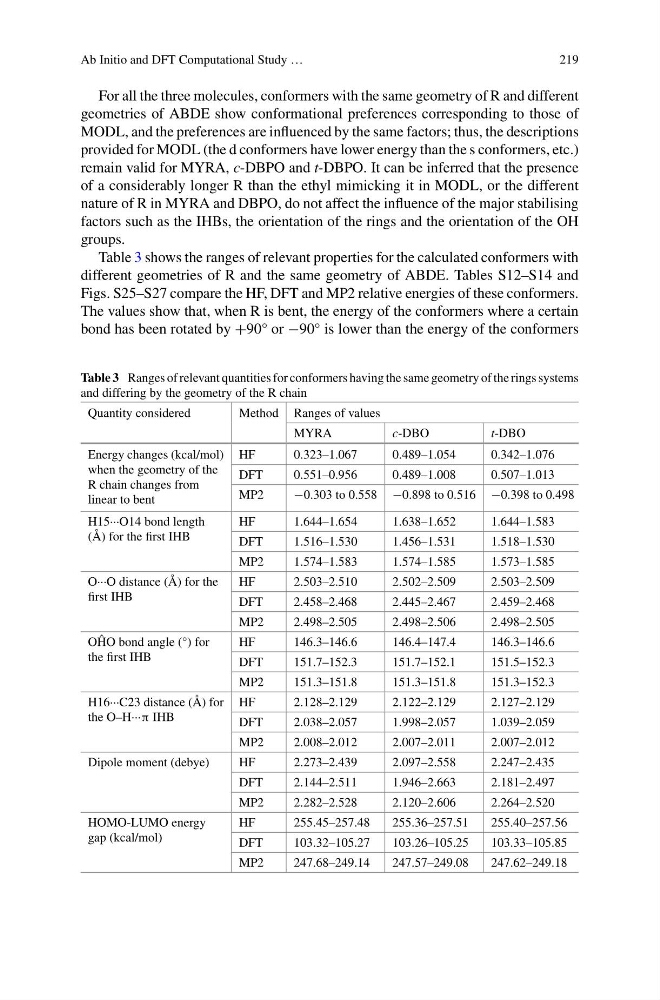
Table 3 shows the ranges of relevant properties for the calculated conformers with
different geometries of R and the same geometry of ABDE. Tables S12–S14 and
Figs. S25–S27 compare the HF, DFT and MP2 relative energies of these conformers.
The values show that, when R is bent, the energy of the conformers where a certain
bond has been rotated by +90° or −90° is lower than the energy of the conformers
Table 3 Ranges of relevant quantities for conformers having the same geometry of the rings systems
and differing by the geometry of the R chain
Quantity considered
Method Ranges of values
MYRA
c-DBO
t-DBO
Energy changes (kcal/mol)
when the geometry of the
R chain changes from
linear to bent
HF
0.323–1.067
0.489–1.054
0.342–1.076
DFT
0.551–0.956
0.489–1.008
0.507–1.013
MP2
−0.303 to 0.558 −0.898 to 0.516 −0.398 to 0.498
H15···O14 bond length
(Å) for the first IHB
HF
1.644–1.654
1.638–1.652
1.644–1.583
DFT
1.516–1.530
1.456–1.531
1.518–1.530
MP2
1.574–1.583
1.574–1.585
1.573–1.585
O···O distance (Å) for the
first IHB
HF
2.503–2.510
2.502–2.509
2.503–2.509
DFT
2.458–2.468
2.445–2.467
2.459–2.468
MP2
2.498–2.505
2.498–2.506
2.498–2.505
O ˆ
HO bond angle (°) for
the first IHB
HF
146.3–146.6
146.4–147.4
146.3–146.6
DFT
151.7–152.3
151.7–152.1
151.5–152.3
MP2
151.3–151.8
151.3–151.8
151.3–152.3
H16···C23 distance (Å) for
the O–H···π IHB
HF
2.128–2.129
2.122–2.129
2.127–2.129
DFT
2.038–2.057
1.998–2.057
1.039–2.059
MP2
2.008–2.012
2.007–2.011
2.007–2.012
Dipole moment (debye)
HF
2.273–2.439
2.097–2.558
2.247–2.435
DFT
2.144–2.511
1.946–2.663
2.181–2.497
MP2
2.282–2.528
2.120–2.606
2.264–2.520
HOMO-LUMO energy
gap (kcal/mol)
HF
255.45–257.48
255.36–257.51
255.40–257.56
DFT
103.32–105.27
103.26–105.25
103.33–105.85
MP2
247.68–249.14
247.57–249.08
247.62–249.18
219
For all the three molecules, conformers with the same geometry of R and different
geometries of ABDE show conformational preferences corresponding to those of
MODL, and the preferences are influenced by the same factors; thus, the descriptions
provided for MODL (the d conformers have lower energy than the s conformers, etc.)
remain valid for MYRA, c-DBPO and t-DBPO. It can be inferred that the presence
of a considerably longer R than the ethyl mimicking it in MODL, or the different
nature of R in MYRA and DBPO, do not affect the influence of the major stabilising
factors such as the IHBs, the orientation of the rings and the orientation of the OH
groups.
Table 3 shows the ranges of relevant properties for the calculated conformers with
different geometries of R and the same geometry of ABDE. Tables S12–S14 and
Figs. S25–S27 compare the HF, DFT and MP2 relative energies of these conformers.
The values show that, when R is bent, the energy of the conformers where a certain
bond has been rotated by +90° or −90° is lower than the energy of the conformers
Table 3 Ranges of relevant quantities for conformers having the same geometry of the rings systems
and differing by the geometry of the R chain
Quantity considered
Method Ranges of values
MYRA
c-DBO
t-DBO
Energy changes (kcal/mol)
when the geometry of the
R chain changes from
linear to bent
HF
0.323–1.067
0.489–1.054
0.342–1.076
DFT
0.551–0.956
0.489–1.008
0.507–1.013
MP2
−0.303 to 0.558 −0.898 to 0.516 −0.398 to 0.498
H15···O14 bond length
(Å) for the first IHB
HF
1.644–1.654
1.638–1.652
1.644–1.583
DFT
1.516–1.530
1.456–1.531
1.518–1.530
MP2
1.574–1.583
1.574–1.585
1.573–1.585
O···O distance (Å) for the
first IHB
HF
2.503–2.510
2.502–2.509
2.503–2.509
DFT
2.458–2.468
2.445–2.467
2.459–2.468
MP2
2.498–2.505
2.498–2.506
2.498–2.505
O ˆ
HO bond angle (°) for
the first IHB
HF
146.3–146.6
146.4–147.4
146.3–146.6
DFT
151.7–152.3
151.7–152.1
151.5–152.3
MP2
151.3–151.8
151.3–151.8
151.3–152.3
H16···C23 distance (Å) for
the O–H···π IHB
HF
2.128–2.129
2.122–2.129
2.127–2.129
DFT
2.038–2.057
1.998–2.057
1.039–2.059
MP2
2.008–2.012
2.007–2.011
2.007–2.012
Dipole moment (debye)
HF
2.273–2.439
2.097–2.558
2.247–2.435
DFT
2.144–2.511
1.946–2.663
2.181–2.497
MP2
2.282–2.528
2.120–2.606
2.264–2.520
HOMO-LUMO energy
gap (kcal/mol)
HF
255.45–257.48
255.36–257.51
255.40–257.56
DFT
103.32–105.27
103.26–105.25
103.33–105.85
MP2
247.68–249.14
247.57–249.08
247.62–249.18