

206
N. Tshilande and L. Mammino
1 Introduction
Anti-inflammatory drugs are drugs which are used for the relief of pain, fever and
inflammations [1]. Many of them are based on molecules isolated from plants,
in extracts used in traditional medicine in various continents. However, the antiinflammatory compounds that are currently in use have some undesirable side effects,
such as an increase in the risk of gastrointestinal disorders or an increase in the risk of
cardiovascular complications [2, 3]. Therefore, the search for new drugs with fewer
or milder side effects is important.
Since the biological activity of a compound depends on its molecular properties
[4–8], it is important to obtain detailed information about these properties to
better understand how it acts and for the design of modified molecules with more
potent activity or less undesirable side effects [7]. The current work considers
two anti-inflammatory compounds pertaining to the class of acylphloroglucinols
hydroxy-2-(4-hydroxyphenyl)-3,4-dihydro-2Hhromen-4-1yl]phenyl}dodecan-1one) and a structurally related molecule (2-(4-hydroxyphenyl)-4-[2,4,6rihydroxy-3(9etradecenoyl)phenyl]-3,4-dihydro-2H-benzopyran-7-ol); they are here concisely
denoted as MYRA and DBPO respectively. They were firstly isolated from Horsfieldia amygdaline and exhibit a variety of biological activities, including potent
anti-inflammatory activity, potent DNA-damaging activity and DNA-polymerase
ß inhibitions [9]. They are non-steroidal anti-inflammatories and their structures
(Fig. 2) are different from those of the anti-inflammatories currently in use or whose
use has been discontinued.
This work pertains to a broad computational study of biologically active
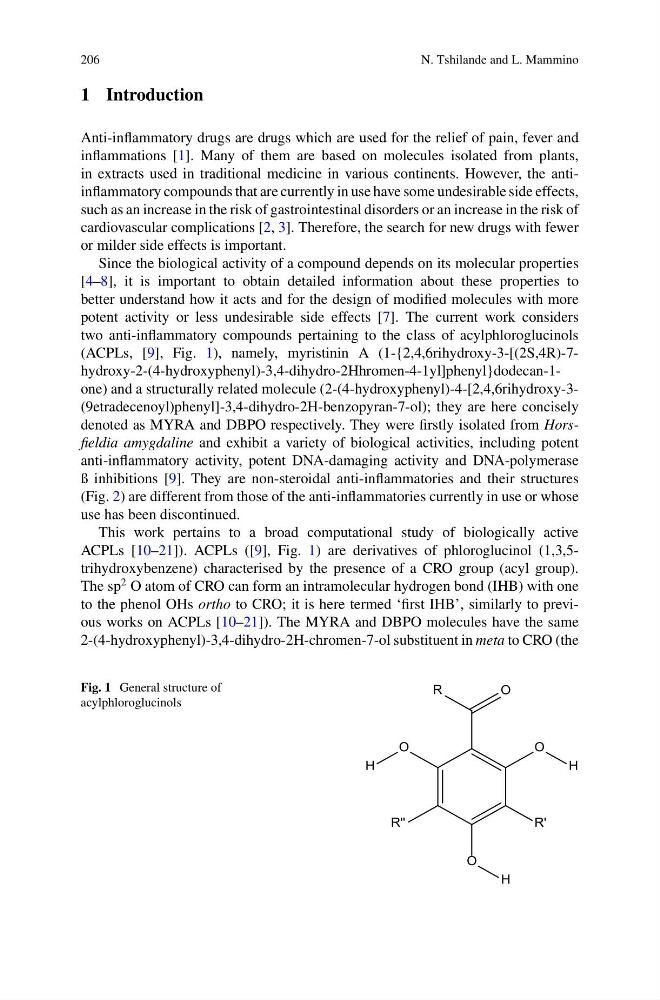
ACPLs [10–21]). ACPLs ([9], Fig. 1) are derivatives of phloroglucinol (1,3,5trihydroxybenzene) characterised by the presence of a CRO group (acyl group).
The sp
2 O atom of CRO can form an intramolecular hydrogen bond (IHB) with one
to the phenol OHs ortho to CRO; it is here termed ‘first IHB’, similarly to previous works on ACPLs [10–21]). The MYRA and DBPO molecules have the same
2-(4-hydroxyphenyl)-3,4-dihydro-2H-chromen-7-ol substituent in meta to CRO (the
Fig. 1 General structure of
acylphloroglucinols
O
R'
O
R''
O
R
O
H
H
H
N. Tshilande and L. Mammino
1 Introduction
Anti-inflammatory drugs are drugs which are used for the relief of pain, fever and
inflammations [1]. Many of them are based on molecules isolated from plants,
in extracts used in traditional medicine in various continents. However, the antiinflammatory compounds that are currently in use have some undesirable side effects,
such as an increase in the risk of gastrointestinal disorders or an increase in the risk of
cardiovascular complications [2, 3]. Therefore, the search for new drugs with fewer
or milder side effects is important.
Since the biological activity of a compound depends on its molecular properties
[4–8], it is important to obtain detailed information about these properties to
better understand how it acts and for the design of modified molecules with more
potent activity or less undesirable side effects [7]. The current work considers
two anti-inflammatory compounds pertaining to the class of acylphloroglucinols
hydroxy-2-(4-hydroxyphenyl)-3,4-dihydro-2Hhromen-4-1yl]phenyl}dodecan-1one) and a structurally related molecule (2-(4-hydroxyphenyl)-4-[2,4,6rihydroxy-3(9etradecenoyl)phenyl]-3,4-dihydro-2H-benzopyran-7-ol); they are here concisely
denoted as MYRA and DBPO respectively. They were firstly isolated from Horsfieldia amygdaline and exhibit a variety of biological activities, including potent
anti-inflammatory activity, potent DNA-damaging activity and DNA-polymerase
ß inhibitions [9]. They are non-steroidal anti-inflammatories and their structures
(Fig. 2) are different from those of the anti-inflammatories currently in use or whose
use has been discontinued.
This work pertains to a broad computational study of biologically active
ACPLs [10–21]). ACPLs ([9], Fig. 1) are derivatives of phloroglucinol (1,3,5trihydroxybenzene) characterised by the presence of a CRO group (acyl group).
The sp
2 O atom of CRO can form an intramolecular hydrogen bond (IHB) with one
to the phenol OHs ortho to CRO; it is here termed ‘first IHB’, similarly to previous works on ACPLs [10–21]). The MYRA and DBPO molecules have the same
2-(4-hydroxyphenyl)-3,4-dihydro-2H-chromen-7-ol substituent in meta to CRO (the
Fig. 1 General structure of
acylphloroglucinols
O
R'
O
R''
O
R
O
H
H
H