

196
M. K. Bilonda and L. Mammino
HOMO
1-a-b-g-h-i-u-q-v-x
2-a-b-g-h-i-u-q-t-y
3-a-b-g-h-i-u-p-v-y
4-a-b-g-h-i-u-q-t-x
8-b-c-g-h-i-u-q-v-x
9-a-d-g-h-i-u-q-v-x
15-c-d-g-h-i-u-q-v-x 16-c-d-g-h-i-u-p-v-y
LUMO
1-a-b-g-h-i-u-q-v-x
2-a-b-g-h-i-u-q-t-y
3-a-b-g-h-i-u-p-v-y
4-a-b-g-h-i-u-q-t-x
8-b-c-g-h-i-u-q-v-x
9-a-d-g-h-i-u-q-v-x
15-c-d-g-h-i-u-q-v-x
16-c-d-g-h-i-u-p-v-y
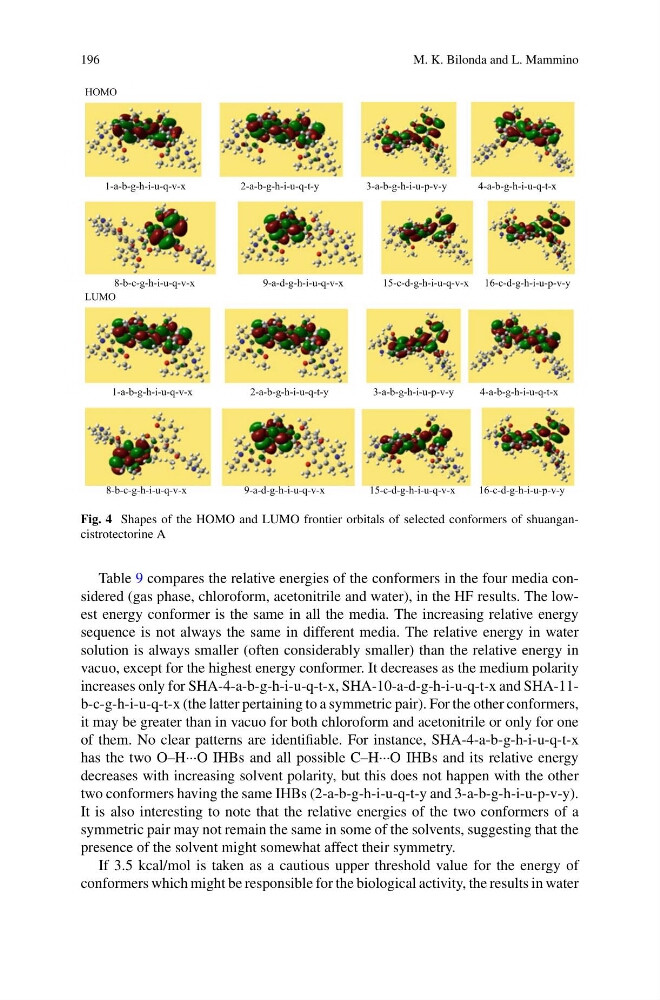
Fig. 4 Shapes of the HOMO and LUMO frontier orbitals of selected conformers of shuangancistrotectorine A
Table 9 compares the relative energies of the conformers in the four media considered (gas phase, chloroform, acetonitrile and water), in the HF results. The lowest energy conformer is the same in all the media. The increasing relative energy
sequence is not always the same in different media. The relative energy in water
solution is always smaller (often considerably smaller) than the relative energy in
vacuo, except for the highest energy conformer. It decreases as the medium polarity
increases only for SHA-4-a-b-g-h-i-u-q-t-x, SHA-10-a-d-g-h-i-u-q-t-x and SHA-11b-c-g-h-i-u-q-t-x (the latter pertaining to a symmetric pair). For the other conformers,
it may be greater than in vacuo for both chloroform and acetonitrile or only for one
of them. No clear patterns are identifiable. For instance, SHA-4-a-b-g-h-i-u-q-t-x
has the two O–H···O IHBs and all possible C–H···O IHBs and its relative energy
decreases with increasing solvent polarity, but this does not happen with the other
two conformers having the same IHBs (2-a-b-g-h-i-u-q-t-y and 3-a-b-g-h-i-u-p-v-y).
It is also interesting to note that the relative energies of the two conformers of a
symmetric pair may not remain the same in some of the solvents, suggesting that the
presence of the solvent might somewhat affect their symmetry.
If 3.5 kcal/mol is taken as a cautious upper threshold value for the energy of
conformers which might be responsible for the biological activity, the results in water
M. K. Bilonda and L. Mammino
HOMO
1-a-b-g-h-i-u-q-v-x
2-a-b-g-h-i-u-q-t-y
3-a-b-g-h-i-u-p-v-y
4-a-b-g-h-i-u-q-t-x
8-b-c-g-h-i-u-q-v-x
9-a-d-g-h-i-u-q-v-x
15-c-d-g-h-i-u-q-v-x 16-c-d-g-h-i-u-p-v-y
LUMO
1-a-b-g-h-i-u-q-v-x
2-a-b-g-h-i-u-q-t-y
3-a-b-g-h-i-u-p-v-y
4-a-b-g-h-i-u-q-t-x
8-b-c-g-h-i-u-q-v-x
9-a-d-g-h-i-u-q-v-x
15-c-d-g-h-i-u-q-v-x
16-c-d-g-h-i-u-p-v-y
Fig. 4 Shapes of the HOMO and LUMO frontier orbitals of selected conformers of shuangancistrotectorine A
Table 9 compares the relative energies of the conformers in the four media considered (gas phase, chloroform, acetonitrile and water), in the HF results. The lowest energy conformer is the same in all the media. The increasing relative energy
sequence is not always the same in different media. The relative energy in water
solution is always smaller (often considerably smaller) than the relative energy in
vacuo, except for the highest energy conformer. It decreases as the medium polarity
increases only for SHA-4-a-b-g-h-i-u-q-t-x, SHA-10-a-d-g-h-i-u-q-t-x and SHA-11b-c-g-h-i-u-q-t-x (the latter pertaining to a symmetric pair). For the other conformers,
it may be greater than in vacuo for both chloroform and acetonitrile or only for one
of them. No clear patterns are identifiable. For instance, SHA-4-a-b-g-h-i-u-q-t-x
has the two O–H···O IHBs and all possible C–H···O IHBs and its relative energy
decreases with increasing solvent polarity, but this does not happen with the other
two conformers having the same IHBs (2-a-b-g-h-i-u-q-t-y and 3-a-b-g-h-i-u-p-v-y).
It is also interesting to note that the relative energies of the two conformers of a
symmetric pair may not remain the same in some of the solvents, suggesting that the
presence of the solvent might somewhat affect their symmetry.
If 3.5 kcal/mol is taken as a cautious upper threshold value for the energy of
conformers which might be responsible for the biological activity, the results in water