

Computational Study of Shuangancistrotectorine A …
195
Table 8 HOMO-LUMO energy gap of the calculated conformers of shuangancistrotectorine A in
vacuo HF/6-31G(d,p) and (DFT/B3LYP/6-31+G(d,p) results, respectively denoted as HF and DFT
in the columns’ headings
Conformers
HOMO-LUMO
energy gap
(kcal/mol)
Conformers
HOMO-LUMO
energy gap (kcal/mol)
HF
DFT
HF
DFT
1-a-b-g-h-i-u-q-v-x
234.732
99.090
9-a-d-g-h-i-u-q-v-x
225.269
89.075
2-a-b-g-h-i-u-q-t-y
231.714
96.787
10-a-d-g-h-i-u-q-t-x
224.291
88.429
3-a-b-g-h-i-u-p-v-y
234.469
98.695
11-b-c-g-h-i-u-q-t-x
224.291
88.429
4-a-b-g-h-i-u-q-t-x
233.076
97.603
12-b-c-g-h-i-u-q-t-y
221.617
86.333
5-b-c-g-h-i-u-p-v-y
226.324
90.380
13-c-d-g-h-i-u-p-v-y
235.202
98.996
6-a-d-g-h-i-u-q-t-y
226.324
90.380
14-c-d-g-h-i-u-q-t-x
234.073
99.140
7-a-d-g-h-i-u-p-v-y
224.215
88.391
15-c-d-g-h-i-u-q-v-x
236.138
100.050
8-b-c-g-h-i-u-q-v-x
225.263
89.075
16-c-d-g-h-i-u-q-t-y
233.157
97.992
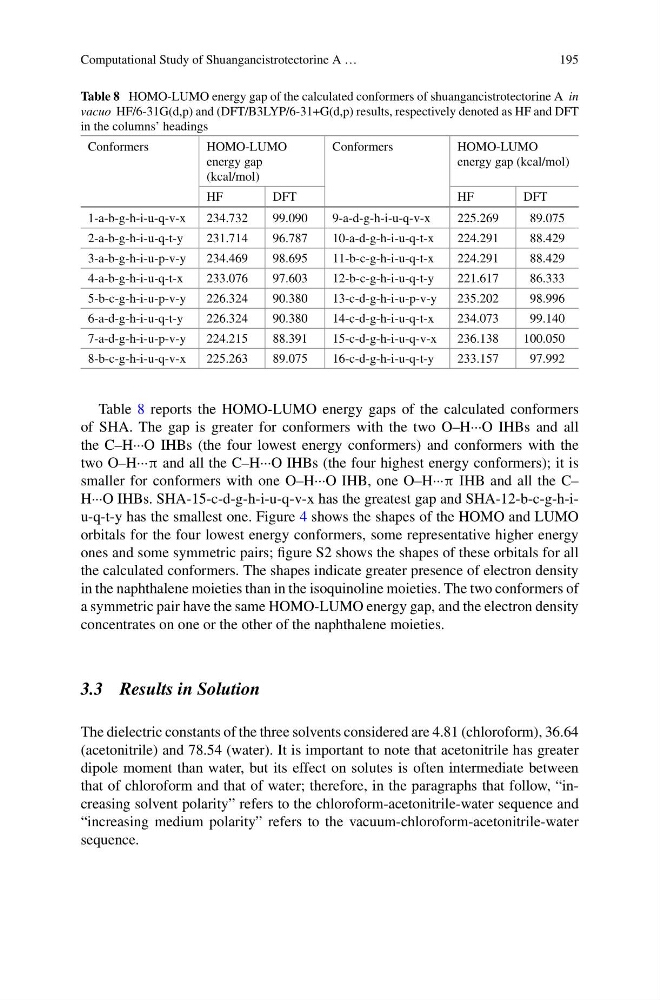
Table 8 reports the HOMO-LUMO energy gaps of the calculated conformers
of SHA. The gap is greater for conformers with the two O–H···O IHBs and all
the C–H···O IHBs (the four lowest energy conformers) and conformers with the
two O–H···π and all the C–H···O IHBs (the four highest energy conformers); it is
smaller for conformers with one O–H···O IHB, one O–H···π IHB and all the C–
H···O IHBs. SHA-15-c-d-g-h-i-u-q-v-x has the greatest gap and SHA-12-b-c-g-h-iu-q-t-y has the smallest one. Figure 4 shows the shapes of the HOMO and LUMO
orbitals for the four lowest energy conformers, some representative higher energy
ones and some symmetric pairs; figure S2 shows the shapes of these orbitals for all
the calculated conformers. The shapes indicate greater presence of electron density
in the naphthalene moieties than in the isoquinoline moieties. The two conformers of
a symmetric pair have the same HOMO-LUMO energy gap, and the electron density
concentrates on one or the other of the naphthalene moieties.
3.3 Results in Solution
The dielectric constants of the three solvents considered are 4.81 (chloroform), 36.64
(acetonitrile) and 78.54 (water). It is important to note that acetonitrile has greater
dipole moment than water, but its effect on solutes is often intermediate between
that of chloroform and that of water; therefore, in the paragraphs that follow, “increasing solvent polarity” refers to the chloroform-acetonitrile-water sequence and
“increasing medium polarity” refers to the vacuum-chloroform-acetonitrile-water
sequence.
195
Table 8 HOMO-LUMO energy gap of the calculated conformers of shuangancistrotectorine A in
vacuo HF/6-31G(d,p) and (DFT/B3LYP/6-31+G(d,p) results, respectively denoted as HF and DFT
in the columns’ headings
Conformers
HOMO-LUMO
energy gap
(kcal/mol)
Conformers
HOMO-LUMO
energy gap (kcal/mol)
HF
DFT
HF
DFT
1-a-b-g-h-i-u-q-v-x
234.732
99.090
9-a-d-g-h-i-u-q-v-x
225.269
89.075
2-a-b-g-h-i-u-q-t-y
231.714
96.787
10-a-d-g-h-i-u-q-t-x
224.291
88.429
3-a-b-g-h-i-u-p-v-y
234.469
98.695
11-b-c-g-h-i-u-q-t-x
224.291
88.429
4-a-b-g-h-i-u-q-t-x
233.076
97.603
12-b-c-g-h-i-u-q-t-y
221.617
86.333
5-b-c-g-h-i-u-p-v-y
226.324
90.380
13-c-d-g-h-i-u-p-v-y
235.202
98.996
6-a-d-g-h-i-u-q-t-y
226.324
90.380
14-c-d-g-h-i-u-q-t-x
234.073
99.140
7-a-d-g-h-i-u-p-v-y
224.215
88.391
15-c-d-g-h-i-u-q-v-x
236.138
100.050
8-b-c-g-h-i-u-q-v-x
225.263
89.075
16-c-d-g-h-i-u-q-t-y
233.157
97.992
Table 8 reports the HOMO-LUMO energy gaps of the calculated conformers
of SHA. The gap is greater for conformers with the two O–H···O IHBs and all
the C–H···O IHBs (the four lowest energy conformers) and conformers with the
two O–H···π and all the C–H···O IHBs (the four highest energy conformers); it is
smaller for conformers with one O–H···O IHB, one O–H···π IHB and all the C–
H···O IHBs. SHA-15-c-d-g-h-i-u-q-v-x has the greatest gap and SHA-12-b-c-g-h-iu-q-t-y has the smallest one. Figure 4 shows the shapes of the HOMO and LUMO
orbitals for the four lowest energy conformers, some representative higher energy
ones and some symmetric pairs; figure S2 shows the shapes of these orbitals for all
the calculated conformers. The shapes indicate greater presence of electron density
in the naphthalene moieties than in the isoquinoline moieties. The two conformers of
a symmetric pair have the same HOMO-LUMO energy gap, and the electron density
concentrates on one or the other of the naphthalene moieties.
3.3 Results in Solution
The dielectric constants of the three solvents considered are 4.81 (chloroform), 36.64
(acetonitrile) and 78.54 (water). It is important to note that acetonitrile has greater
dipole moment than water, but its effect on solutes is often intermediate between
that of chloroform and that of water; therefore, in the paragraphs that follow, “increasing solvent polarity” refers to the chloroform-acetonitrile-water sequence and
“increasing medium polarity” refers to the vacuum-chloroform-acetonitrile-water
sequence.