

176
L. Mammino
the spin density maps for representative complexes of FNGB, selected to portrait
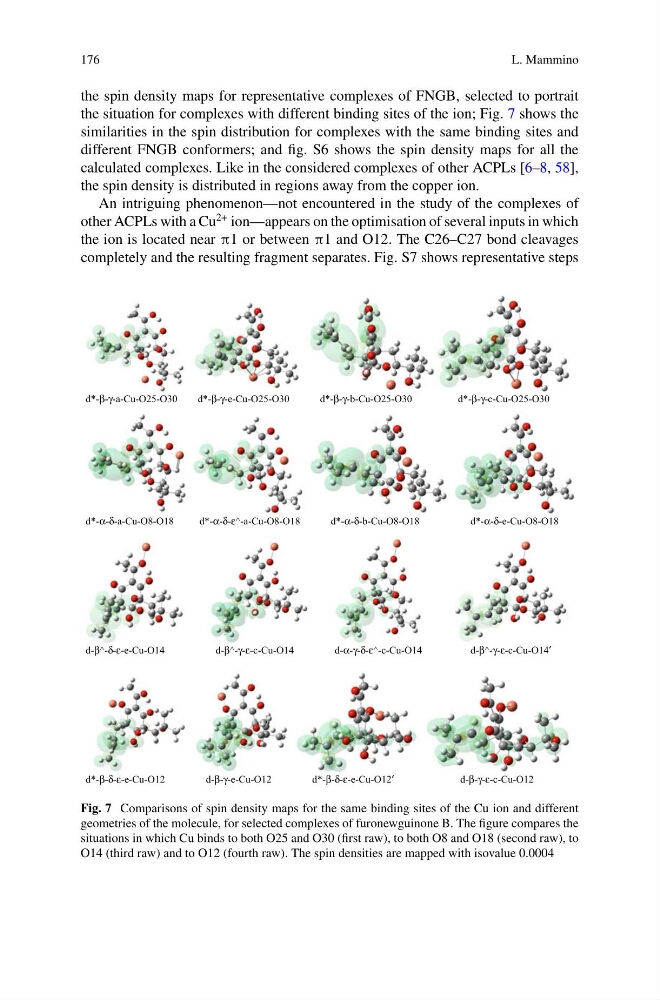
the situation for complexes with different binding sites of the ion; Fig. 7 shows the
similarities in the spin distribution for complexes with the same binding sites and
different FNGB conformers; and fig. S6 shows the spin density maps for all the
calculated complexes. Like in the considered complexes of other ACPLs [6–8, 58],
the spin density is distributed in regions away from the copper ion.
An intriguing phenomenon—not encountered in the study of the complexes of
other ACPLs with a Cu
2+ ion—appears on the optimisation of several inputs in which
the ion is located near π1 or between π1 and O12. The C26–C27 bond cleavages
completely and the resulting fragment separates. Fig. S7 shows representative steps
d*-β-γ-a-Cu-O25-O30
d*-β-γ-e-Cu-O25-O30
d*-β-γ-b-Cu-O25-O30
d*-β-γ-c-Cu-O25-O30
d*-α-δ-a-Cu-O8-O18
d*-α-δ-ε^-a-Cu-O8-O18
d*-α-δ-b-Cu-O8-O18
d*-α-δ-e-Cu-O8-O18
d-β^-δ-ε-e-Cu-O14
d-β^-γ-ε-c-Cu-O14
d-α-γ-δ-ε^-c-Cu-O14
d-β^-γ-ε-c-Cu-O14′
d*-β-δ-ε-e-Cu-O12
d-β-γ-e-Cu-O12
d*-β-δ-ε-e-Cu-O12′
d-β-γ-ε-c-Cu-O12
Fig. 7 Comparisons of spin density maps for the same binding sites of the Cu ion and different
geometries of the molecule, for selected complexes of furonewguinone B. The figure compares the
situations in which Cu binds to both O25 and O30 (first raw), to both O8 and O18 (second raw), to
O14 (third raw) and to O12 (fourth raw). The spin densities are mapped with isovalue 0.0004
L. Mammino
the spin density maps for representative complexes of FNGB, selected to portrait
the situation for complexes with different binding sites of the ion; Fig. 7 shows the
similarities in the spin distribution for complexes with the same binding sites and
different FNGB conformers; and fig. S6 shows the spin density maps for all the
calculated complexes. Like in the considered complexes of other ACPLs [6–8, 58],
the spin density is distributed in regions away from the copper ion.
An intriguing phenomenon—not encountered in the study of the complexes of
other ACPLs with a Cu
2+ ion—appears on the optimisation of several inputs in which
the ion is located near π1 or between π1 and O12. The C26–C27 bond cleavages
completely and the resulting fragment separates. Fig. S7 shows representative steps
d*-β-γ-a-Cu-O25-O30
d*-β-γ-e-Cu-O25-O30
d*-β-γ-b-Cu-O25-O30
d*-β-γ-c-Cu-O25-O30
d*-α-δ-a-Cu-O8-O18
d*-α-δ-ε^-a-Cu-O8-O18
d*-α-δ-b-Cu-O8-O18
d*-α-δ-e-Cu-O8-O18
d-β^-δ-ε-e-Cu-O14
d-β^-γ-ε-c-Cu-O14
d-α-γ-δ-ε^-c-Cu-O14
d-β^-γ-ε-c-Cu-O14′
d*-β-δ-ε-e-Cu-O12
d-β-γ-e-Cu-O12
d*-β-δ-ε-e-Cu-O12′
d-β-γ-ε-c-Cu-O12
Fig. 7 Comparisons of spin density maps for the same binding sites of the Cu ion and different
geometries of the molecule, for selected complexes of furonewguinone B. The figure compares the
situations in which Cu binds to both O25 and O30 (first raw), to both O8 and O18 (second raw), to
O14 (third raw) and to O12 (fourth raw). The spin densities are mapped with isovalue 0.0004