

Complexes of Furonewguinone B with a Cu 2+ Ion. A DFT Study
175
of the IHBs are related to the geometry changes occurring in the molecule on complexation. The lengths of the IHBs involving the terminal C28 and C29 methyls and
O30 do not change significantly, because both the methyls and the OH are attached
to the same atom (C27). In the other cases, the donor and the acceptor are sufficiently
distant that geometry changes can bring them significantly closer or farther away. In
few cases, an IHB that was present in the conformer disappears on complexation, or
a new IHB appears.
An electron transfer from the molecule to the ion reduces the charge on the ion
from +2 to +1; in this way, the molecule acquires a positive charge and one of
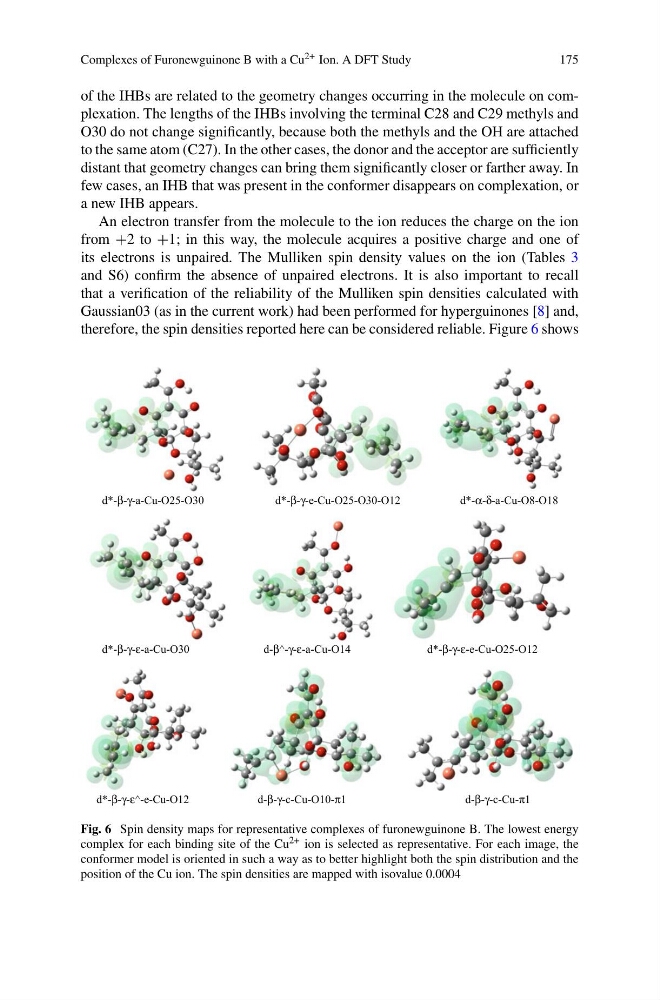
its electrons is unpaired. The Mulliken spin density values on the ion (Tables 3
and S6) confirm the absence of unpaired electrons. It is also important to recall
that a verification of the reliability of the Mulliken spin densities calculated with
Gaussian03 (as in the current work) had been performed for hyperguinones [8] and,
therefore, the spin densities reported here can be considered reliable. Figure 6 shows
d*-β-γ-a-Cu-O25-O30
d*-β-γ-e-Cu-O25-O30-O12
d*-α-δ-a-Cu-O8-O18
d*-β-γ-ε-a-Cu-O30
d-β^-γ-ε-a-Cu-O14
d*-β-γ-ε-e-Cu-O25-O12
d*-β-γ-ε^-e-Cu-O12
d-β-γ-c-Cu-O10-π1
d - β-γ-c-Cu-π1
Fig. 6 Spin density maps for representative complexes of furonewguinone B. The lowest energy
complex for each binding site of the Cu 2+ ion is selected as representative. For each image, the
conformer model is oriented in such a way as to better highlight both the spin distribution and the
position of the Cu ion. The spin densities are mapped with isovalue 0.0004
175
of the IHBs are related to the geometry changes occurring in the molecule on complexation. The lengths of the IHBs involving the terminal C28 and C29 methyls and
O30 do not change significantly, because both the methyls and the OH are attached
to the same atom (C27). In the other cases, the donor and the acceptor are sufficiently
distant that geometry changes can bring them significantly closer or farther away. In
few cases, an IHB that was present in the conformer disappears on complexation, or
a new IHB appears.
An electron transfer from the molecule to the ion reduces the charge on the ion
from +2 to +1; in this way, the molecule acquires a positive charge and one of
its electrons is unpaired. The Mulliken spin density values on the ion (Tables 3
and S6) confirm the absence of unpaired electrons. It is also important to recall
that a verification of the reliability of the Mulliken spin densities calculated with
Gaussian03 (as in the current work) had been performed for hyperguinones [8] and,
therefore, the spin densities reported here can be considered reliable. Figure 6 shows
d*-β-γ-a-Cu-O25-O30
d*-β-γ-e-Cu-O25-O30-O12
d*-α-δ-a-Cu-O8-O18
d*-β-γ-ε-a-Cu-O30
d-β^-γ-ε-a-Cu-O14
d*-β-γ-ε-e-Cu-O25-O12
d*-β-γ-ε^-e-Cu-O12
d-β-γ-c-Cu-O10-π1
d - β-γ-c-Cu-π1
Fig. 6 Spin density maps for representative complexes of furonewguinone B. The lowest energy
complex for each binding site of the Cu 2+ ion is selected as representative. For each image, the
conformer model is oriented in such a way as to better highlight both the spin distribution and the
position of the Cu ion. The spin densities are mapped with isovalue 0.0004