

96
D. Dell’Angelo
agreement between density distributions and chemical potentials has been found
up to the first solvatation shell, which for Li and Na occurs with n = 5, n = 6 for K
and n = 7 for Rb.
Except for Li, a shift of one helium atom between the supposed “classical” first
filled shells as shown in Fig. 3 and those obtained by IS-DMC computations is present.
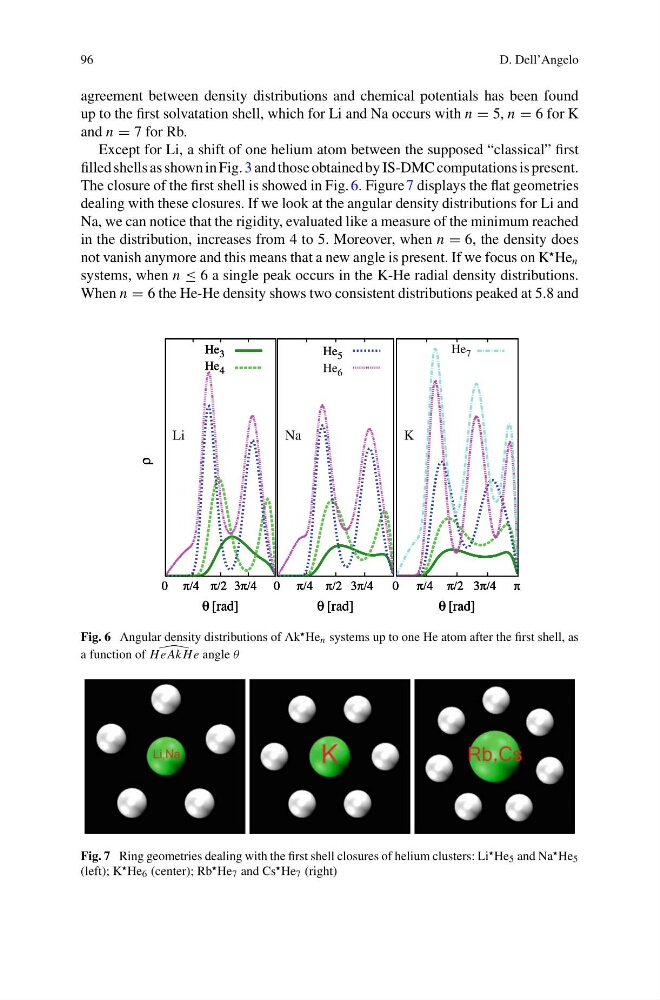
The closure of the first shell is showed in Fig. 6. Figure 7 displays the flat geometries
dealing with these closures. If we look at the angular density distributions for Li and
Na, we can notice that the rigidity, evaluated like a measure of the minimum reached
in the distribution, increases from 4 to 5. Moreover, when n = 6, the density does
not vanish anymore and this means that a new angle is present. If we focus on K
He n
systems, when n ≤ 6 a single peak occurs in the K-He radial density distributions.
When n = 6 the He-He density shows two consistent distributions peaked at 5.8 and
0 π/4 π/2 3π/4
ρ
θ [rad]
He 3
0 π/4 π/2 3π/4
ρ
θ [rad]
He 3
He 4
0 π/4 π/2 3π/4
ρ
θ [rad]
He 3
He 4
0 π/4 π/2 3π/4
ρ
θ [rad]
Li
He 3
He 4
0 π/4 π/2 3π/4
θ [rad]
0 π/4 π/2 3π/4
θ [rad]
0 π/4 π/2 3π/4
θ [rad]
He 5
0 π/4 π/2 3π/4
θ [rad]
Na
He 5
He 6
0 π/4 π/2 3π/4 π
θ [rad]
0 π/4 π/2 3π/4 π
θ [rad]
0 π/4 π/2 3π/4 π
θ [rad]
0 π/4 π/2 3π/4 π
θ [rad]
0 π/4 π/2 3π/4 π
θ [rad]
K
He 7
Fig. 6 Angular density distributions of Ak He n systems up to one He atom after the first shell, as
a function of
He Ak He angle θ
Fig. 7 Ring geometries dealing with the first shell closures of helium clusters: Li He 5 and Na He 5
(left); K He 6 (center); Rb He 7 and Cs He 7 (right)
D. Dell’Angelo
agreement between density distributions and chemical potentials has been found
up to the first solvatation shell, which for Li and Na occurs with n = 5, n = 6 for K
and n = 7 for Rb.
Except for Li, a shift of one helium atom between the supposed “classical” first
filled shells as shown in Fig. 3 and those obtained by IS-DMC computations is present.
The closure of the first shell is showed in Fig. 6. Figure 7 displays the flat geometries
dealing with these closures. If we look at the angular density distributions for Li and
Na, we can notice that the rigidity, evaluated like a measure of the minimum reached
in the distribution, increases from 4 to 5. Moreover, when n = 6, the density does
not vanish anymore and this means that a new angle is present. If we focus on K
He n
systems, when n ≤ 6 a single peak occurs in the K-He radial density distributions.
When n = 6 the He-He density shows two consistent distributions peaked at 5.8 and
0 π/4 π/2 3π/4
ρ
θ [rad]
He 3
0 π/4 π/2 3π/4
ρ
θ [rad]
He 3
He 4
0 π/4 π/2 3π/4
ρ
θ [rad]
He 3
He 4
0 π/4 π/2 3π/4
ρ
θ [rad]
Li
He 3
He 4
0 π/4 π/2 3π/4
θ [rad]
0 π/4 π/2 3π/4
θ [rad]
0 π/4 π/2 3π/4
θ [rad]
He 5
0 π/4 π/2 3π/4
θ [rad]
Na
He 5
He 6
0 π/4 π/2 3π/4 π
θ [rad]
0 π/4 π/2 3π/4 π
θ [rad]
0 π/4 π/2 3π/4 π
θ [rad]
0 π/4 π/2 3π/4 π
θ [rad]
0 π/4 π/2 3π/4 π
θ [rad]
K
He 7
Fig. 6 Angular density distributions of Ak He n systems up to one He atom after the first shell, as
a function of
He Ak He angle θ
Fig. 7 Ring geometries dealing with the first shell closures of helium clusters: Li He 5 and Na He 5
(left); K He 6 (center); Rb He 7 and Cs He 7 (right)