

48
In 1982, in his first book on cyclodextrins, Szejtli pursued and reformulated all
the interpretations made by Cramer, Saenger, and Bender on the mechanism of formation of inclusion complexes (Szejtli 1982a). The gain in enthalpy is then explained
by the spontaneous arrival of the guest, displacing active water molecules retained
in the non-polar cavity of the cyclodextrin in aqueous solution. Szejtli illustrated his
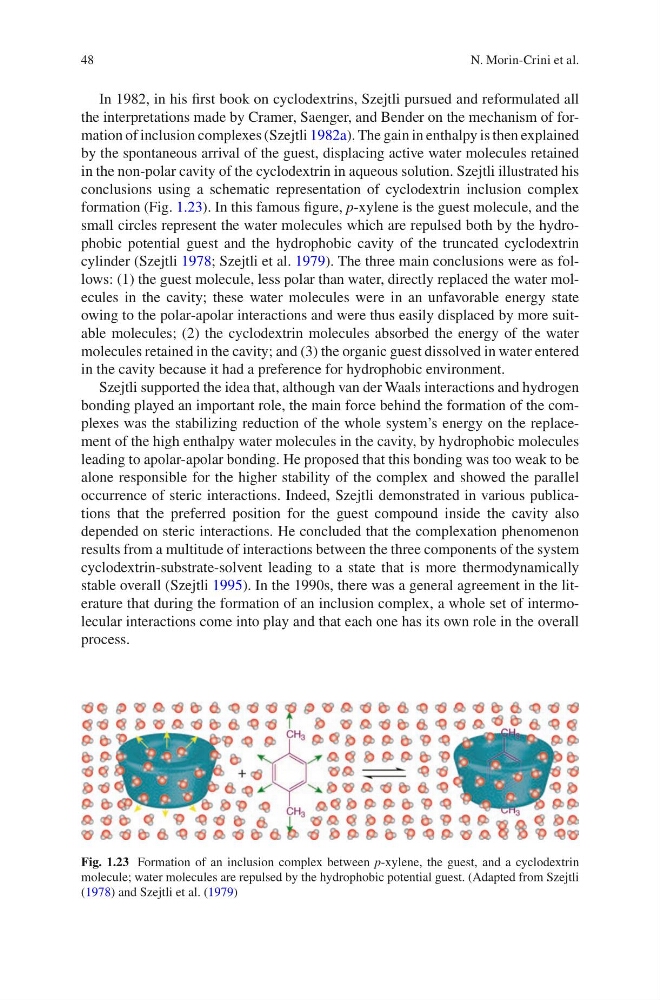
conclusions using a schematic representation of cyclodextrin inclusion complex
formation (Fig. 1.23). In this famous figure, p-xylene is the guest molecule, and the
small circles represent the water molecules which are repulsed both by the hydrophobic potential guest and the hydrophobic cavity of the truncated cyclodextrin
cylinder (Szejtli 1978; Szejtli et al. 1979). The three main conclusions were as follows: (1) the guest molecule, less polar than water, directly replaced the water molecules in the cavity; these water molecules were in an unfavorable energy state
owing to the polar-apolar interactions and were thus easily displaced by more suitable molecules; (2) the cyclodextrin molecules absorbed the energy of the water
molecules retained in the cavity; and (3) the organic guest dissolved in water entered
in the cavity because it had a preference for hydrophobic environment.
Szejtli supported the idea that, although van der Waals interactions and hydrogen
bonding played an important role, the main force behind the formation of the complexes was the stabilizing reduction of the whole system’s energy on the replacement of the high enthalpy water molecules in the cavity, by hydrophobic molecules
leading to apolar-apolar bonding. He proposed that this bonding was too weak to be
alone responsible for the higher stability of the complex and showed the parallel
occurrence of steric interactions. Indeed, Szejtli demonstrated in various publications that the preferred position for the guest compound inside the cavity also
depended on steric interactions. He concluded that the complexation phenomenon
results from a multitude of interactions between the three components of the system
cyclodextrin-substrate-solvent leading to a state that is more thermodynamically
stable overall (Szejtli 1995). In the 1990s, there was a general agreement in the literature that during the formation of an inclusion complex, a whole set of intermolecular interactions come into play and that each one has its own role in the overall
process.
Fig. 1.23 Formation of an inclusion complex between p-xylene, the guest, and a cyclodextrin
molecule; water molecules are repulsed by the hydrophobic potential guest. (Adapted from Szejtli
(1978) and Szejtli et al. (1979)
N. Morin-Crini et al.
In 1982, in his first book on cyclodextrins, Szejtli pursued and reformulated all
the interpretations made by Cramer, Saenger, and Bender on the mechanism of formation of inclusion complexes (Szejtli 1982a). The gain in enthalpy is then explained
by the spontaneous arrival of the guest, displacing active water molecules retained
in the non-polar cavity of the cyclodextrin in aqueous solution. Szejtli illustrated his
conclusions using a schematic representation of cyclodextrin inclusion complex
formation (Fig. 1.23). In this famous figure, p-xylene is the guest molecule, and the
small circles represent the water molecules which are repulsed both by the hydrophobic potential guest and the hydrophobic cavity of the truncated cyclodextrin
cylinder (Szejtli 1978; Szejtli et al. 1979). The three main conclusions were as follows: (1) the guest molecule, less polar than water, directly replaced the water molecules in the cavity; these water molecules were in an unfavorable energy state
owing to the polar-apolar interactions and were thus easily displaced by more suitable molecules; (2) the cyclodextrin molecules absorbed the energy of the water
molecules retained in the cavity; and (3) the organic guest dissolved in water entered
in the cavity because it had a preference for hydrophobic environment.
Szejtli supported the idea that, although van der Waals interactions and hydrogen
bonding played an important role, the main force behind the formation of the complexes was the stabilizing reduction of the whole system’s energy on the replacement of the high enthalpy water molecules in the cavity, by hydrophobic molecules
leading to apolar-apolar bonding. He proposed that this bonding was too weak to be
alone responsible for the higher stability of the complex and showed the parallel
occurrence of steric interactions. Indeed, Szejtli demonstrated in various publications that the preferred position for the guest compound inside the cavity also
depended on steric interactions. He concluded that the complexation phenomenon
results from a multitude of interactions between the three components of the system
cyclodextrin-substrate-solvent leading to a state that is more thermodynamically
stable overall (Szejtli 1995). In the 1990s, there was a general agreement in the literature that during the formation of an inclusion complex, a whole set of intermolecular interactions come into play and that each one has its own role in the overall
process.
Fig. 1.23 Formation of an inclusion complex between p-xylene, the guest, and a cyclodextrin
molecule; water molecules are repulsed by the hydrophobic potential guest. (Adapted from Szejtli
(1978) and Szejtli et al. (1979)
N. Morin-Crini et al.