

47
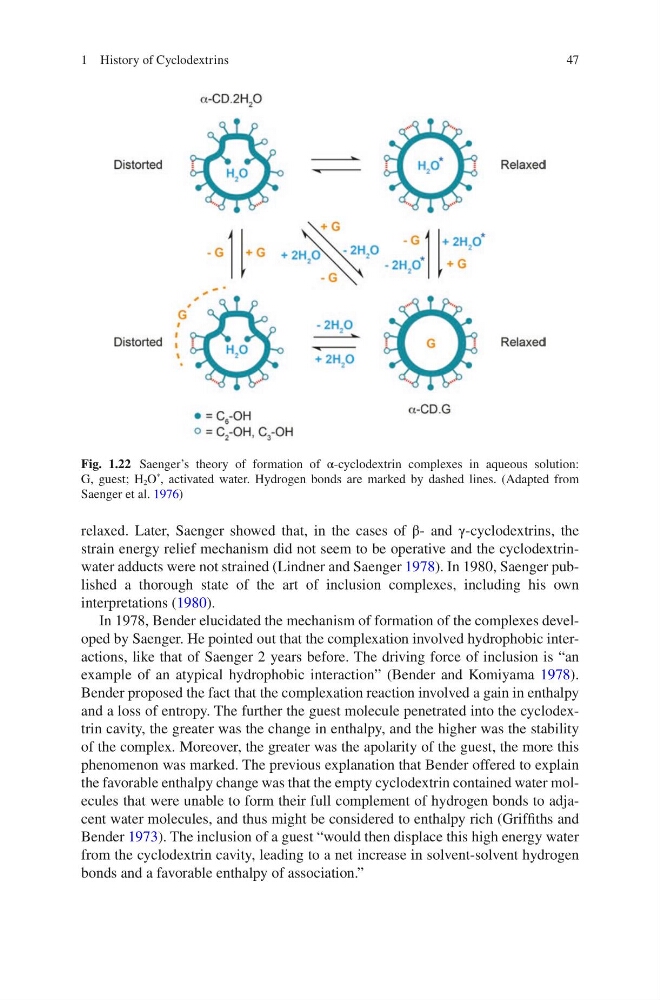
relaxed. Later, Saenger showed that, in the cases of β- and γ-cyclodextrins, the
strain energy relief mechanism did not seem to be operative and the cyclodextrinwater adducts were not strained (Lindner and Saenger 1978). In 1980, Saenger published a thorough state of the art of inclusion complexes, including his own
interpretations (1980).
In 1978, Bender elucidated the mechanism of formation of the complexes developed by Saenger. He pointed out that the complexation involved hydrophobic interactions, like that of Saenger 2 years before. The driving force of inclusion is “an
example of an atypical hydrophobic interaction” (Bender and Komiyama 1978).
Bender proposed the fact that the complexation reaction involved a gain in enthalpy
and a loss of entropy. The further the guest molecule penetrated into the cyclodextrin cavity, the greater was the change in enthalpy, and the higher was the stability
of the complex. Moreover, the greater was the apolarity of the guest, the more this
phenomenon was marked. The previous explanation that Bender offered to explain
the favorable enthalpy change was that the empty cyclodextrin contained water molecules that were unable to form their full complement of hydrogen bonds to adjacent water molecules, and thus might be considered to enthalpy rich (Griffiths and
Bender 1973). The inclusion of a guest “would then displace this high energy water
from the cyclodextrin cavity, leading to a net increase in solvent-solvent hydrogen
bonds and a favorable enthalpy of association.”
Fig. 1.22 Saenger’s theory of formation of α-cyclodextrin complexes in aqueous solution:
G, guest; H 2 O
*
, activated water. Hydrogen bonds are marked by dashed lines. (Adapted from
Saenger et al. 1976)
1 History of Cyclodextrins
relaxed. Later, Saenger showed that, in the cases of β- and γ-cyclodextrins, the
strain energy relief mechanism did not seem to be operative and the cyclodextrinwater adducts were not strained (Lindner and Saenger 1978). In 1980, Saenger published a thorough state of the art of inclusion complexes, including his own
interpretations (1980).
In 1978, Bender elucidated the mechanism of formation of the complexes developed by Saenger. He pointed out that the complexation involved hydrophobic interactions, like that of Saenger 2 years before. The driving force of inclusion is “an
example of an atypical hydrophobic interaction” (Bender and Komiyama 1978).
Bender proposed the fact that the complexation reaction involved a gain in enthalpy
and a loss of entropy. The further the guest molecule penetrated into the cyclodextrin cavity, the greater was the change in enthalpy, and the higher was the stability
of the complex. Moreover, the greater was the apolarity of the guest, the more this
phenomenon was marked. The previous explanation that Bender offered to explain
the favorable enthalpy change was that the empty cyclodextrin contained water molecules that were unable to form their full complement of hydrogen bonds to adjacent water molecules, and thus might be considered to enthalpy rich (Griffiths and
Bender 1973). The inclusion of a guest “would then displace this high energy water
from the cyclodextrin cavity, leading to a net increase in solvent-solvent hydrogen
bonds and a favorable enthalpy of association.”
Fig. 1.22 Saenger’s theory of formation of α-cyclodextrin complexes in aqueous solution:
G, guest; H 2 O
*
, activated water. Hydrogen bonds are marked by dashed lines. (Adapted from
Saenger et al. 1976)
1 History of Cyclodextrins