

32
covalent bond with some entering or leaving component, e.g., in the case of ester
hydrolysis. This process was called covalent catalysis. The model of non-covalent
catalysis was inclusion complex catalysis, introduced by Cramer (1953) and later
studied in detail by Bender (van Etten et al. 1967a, b; Griffiths and Bender 1973).
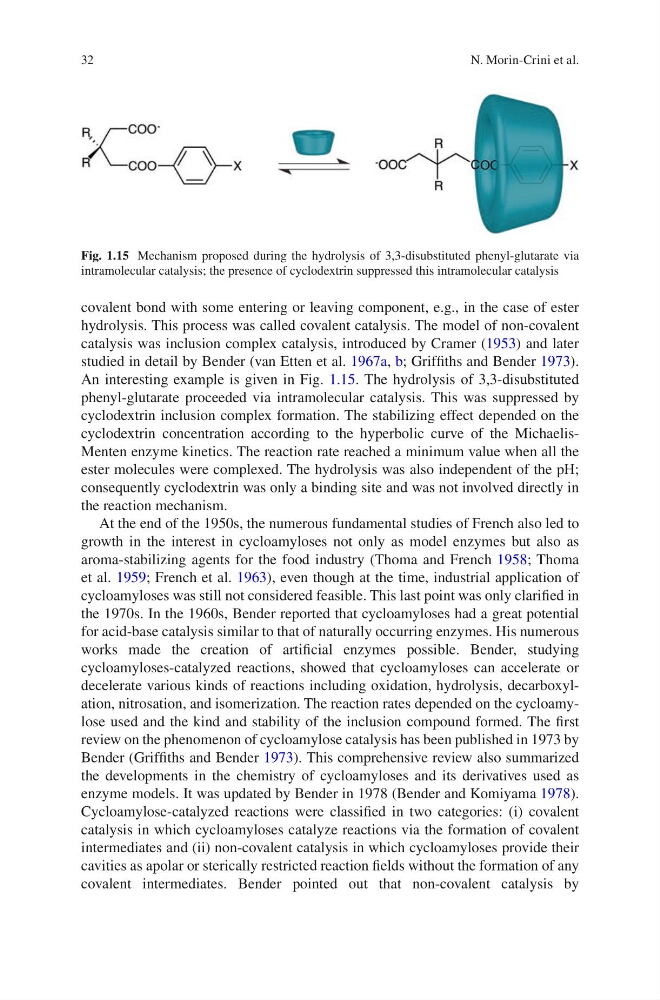
An interesting example is given in Fig. 1.15. The hydrolysis of 3,3-disubstituted
phenyl-glutarate proceeded via intramolecular catalysis. This was suppressed by
cyclodextrin inclusion complex formation. The stabilizing effect depended on the
cyclodextrin concentration according to the hyperbolic curve of the MichaelisMenten enzyme kinetics. The reaction rate reached a minimum value when all the
ester molecules were complexed. The hydrolysis was also independent of the pH;
consequently cyclodextrin was only a binding site and was not involved directly in
the reaction mechanism.
At the end of the 1950s, the numerous fundamental studies of French also led to
growth in the interest in cycloamyloses not only as model enzymes but also as
aroma-stabilizing agents for the food industry (Thoma and French 1958; Thoma
et al. 1959; French et al. 1963), even though at the time, industrial application of
cycloamyloses was still not considered feasible. This last point was only clarified in
the 1970s. In the 1960s, Bender reported that cycloamyloses had a great potential
for acid-base catalysis similar to that of naturally occurring enzymes. His numerous
works made the creation of artificial enzymes possible. Bender, studying
cycloamyloses- catalyzed reactions, showed that cycloamyloses can accelerate or
decelerate various kinds of reactions including oxidation, hydrolysis, decarboxylation, nitrosation, and isomerization. The reaction rates depended on the cycloamylose used and the kind and stability of the inclusion compound formed. The first
review on the phenomenon of cycloamylose catalysis has been published in 1973 by
Bender (Griffiths and Bender 1973). This comprehensive review also summarized
the developments in the chemistry of cycloamyloses and its derivatives used as
enzyme models. It was updated by Bender in 1978 (Bender and Komiyama 1978).
Cycloamylose-catalyzed reactions were classified in two categories: (i) covalent
catalysis in which cycloamyloses catalyze reactions via the formation of covalent
intermediates and (ii) non-covalent catalysis in which cycloamyloses provide their
cavities as apolar or sterically restricted reaction fields without the formation of any
covalent intermediates. Bender pointed out that non-covalent catalysis by
Fig. 1.15 Mechanism proposed during the hydrolysis of 3,3-disubstituted phenyl-glutarate via
intramolecular catalysis; the presence of cyclodextrin suppressed this intramolecular catalysis
N. Morin-Crini et al.
covalent bond with some entering or leaving component, e.g., in the case of ester
hydrolysis. This process was called covalent catalysis. The model of non-covalent
catalysis was inclusion complex catalysis, introduced by Cramer (1953) and later
studied in detail by Bender (van Etten et al. 1967a, b; Griffiths and Bender 1973).
An interesting example is given in Fig. 1.15. The hydrolysis of 3,3-disubstituted
phenyl-glutarate proceeded via intramolecular catalysis. This was suppressed by
cyclodextrin inclusion complex formation. The stabilizing effect depended on the
cyclodextrin concentration according to the hyperbolic curve of the MichaelisMenten enzyme kinetics. The reaction rate reached a minimum value when all the
ester molecules were complexed. The hydrolysis was also independent of the pH;
consequently cyclodextrin was only a binding site and was not involved directly in
the reaction mechanism.
At the end of the 1950s, the numerous fundamental studies of French also led to
growth in the interest in cycloamyloses not only as model enzymes but also as
aroma-stabilizing agents for the food industry (Thoma and French 1958; Thoma
et al. 1959; French et al. 1963), even though at the time, industrial application of
cycloamyloses was still not considered feasible. This last point was only clarified in
the 1970s. In the 1960s, Bender reported that cycloamyloses had a great potential
for acid-base catalysis similar to that of naturally occurring enzymes. His numerous
works made the creation of artificial enzymes possible. Bender, studying
cycloamyloses- catalyzed reactions, showed that cycloamyloses can accelerate or
decelerate various kinds of reactions including oxidation, hydrolysis, decarboxylation, nitrosation, and isomerization. The reaction rates depended on the cycloamylose used and the kind and stability of the inclusion compound formed. The first
review on the phenomenon of cycloamylose catalysis has been published in 1973 by
Bender (Griffiths and Bender 1973). This comprehensive review also summarized
the developments in the chemistry of cycloamyloses and its derivatives used as
enzyme models. It was updated by Bender in 1978 (Bender and Komiyama 1978).
Cycloamylose-catalyzed reactions were classified in two categories: (i) covalent
catalysis in which cycloamyloses catalyze reactions via the formation of covalent
intermediates and (ii) non-covalent catalysis in which cycloamyloses provide their
cavities as apolar or sterically restricted reaction fields without the formation of any
covalent intermediates. Bender pointed out that non-covalent catalysis by
Fig. 1.15 Mechanism proposed during the hydrolysis of 3,3-disubstituted phenyl-glutarate via
intramolecular catalysis; the presence of cyclodextrin suppressed this intramolecular catalysis
N. Morin-Crini et al.