

30
The potential use of cyclodextrins in pharmaceuticals had been launched. It was not
till the 1970s and 1980s though that the first industrial-scale applications in pharmacy appeared (Szejtli 1998; Loftsson and Duchêne 2007; Morin-Crini et al. 2015).
1.3.8 Cyclodextrins as Models
Cramer knew everything about cyclodextrins, publishing an impressive number of
results over a period of 25 years on their preparation, separation, characterization,
structure, properties, chemistry, biochemistry, and their potential application in
pharmacy, catalysis, and enzymology (Freudenberg and Cramer 1948, 1950; Cramer
1949, 1951a, b, c, 1952, 1953, 1954, 1956, 1961; Freudenberg et al. 1953; Cramer
and Steinle 1955; Cramer and Henglein 1956, 1957a, b; Cramer and Dietsche 1958,
1959a, b; Lüttringhaus et al. 1958; Cramer and Kampe 1962, 1965; Cramer and
Hettler 1967; Cramer et al. 1967, 1969).
In 1953, Cramer was the first to show the catalytic role that cyclodextrins could
play in chemical reactions through a key-lock interaction similar to that of an
enzyme-substrate complex (Cramer 1953). Later, Cramer gave the basis for supramolecular catalysis involving cyclodextrins (Cramer and Dietsche 1958, 1959a;
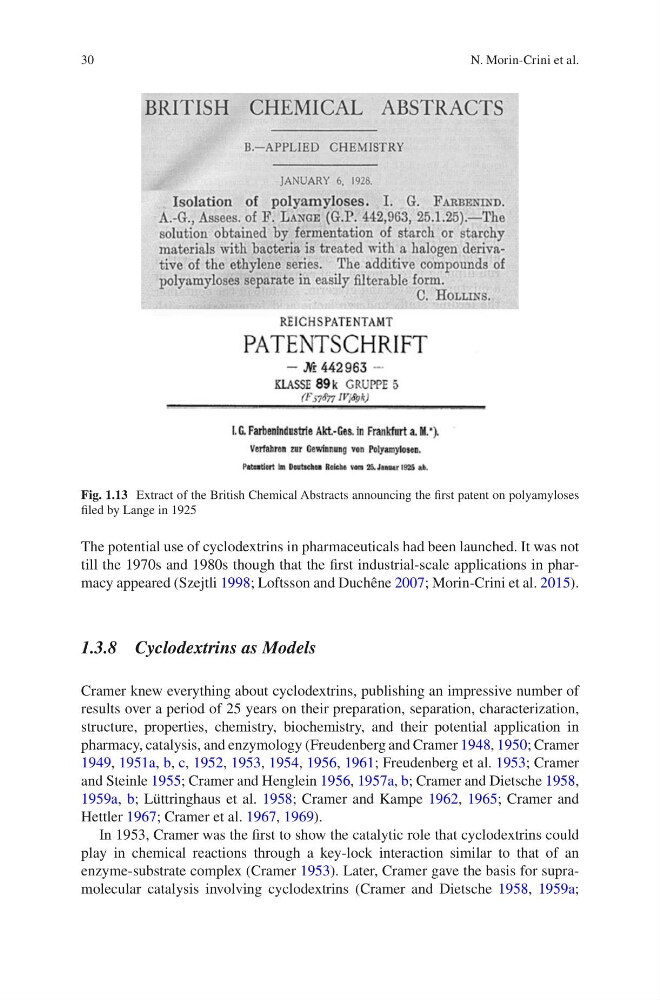
Fig. 1.13 Extract of the British Chemical Abstracts announcing the first patent on polyamyloses
filed by Lange in 1925
N. Morin-Crini et al.
The potential use of cyclodextrins in pharmaceuticals had been launched. It was not
till the 1970s and 1980s though that the first industrial-scale applications in pharmacy appeared (Szejtli 1998; Loftsson and Duchêne 2007; Morin-Crini et al. 2015).
1.3.8 Cyclodextrins as Models
Cramer knew everything about cyclodextrins, publishing an impressive number of
results over a period of 25 years on their preparation, separation, characterization,
structure, properties, chemistry, biochemistry, and their potential application in
pharmacy, catalysis, and enzymology (Freudenberg and Cramer 1948, 1950; Cramer
1949, 1951a, b, c, 1952, 1953, 1954, 1956, 1961; Freudenberg et al. 1953; Cramer
and Steinle 1955; Cramer and Henglein 1956, 1957a, b; Cramer and Dietsche 1958,
1959a, b; Lüttringhaus et al. 1958; Cramer and Kampe 1962, 1965; Cramer and
Hettler 1967; Cramer et al. 1967, 1969).
In 1953, Cramer was the first to show the catalytic role that cyclodextrins could
play in chemical reactions through a key-lock interaction similar to that of an
enzyme-substrate complex (Cramer 1953). Later, Cramer gave the basis for supramolecular catalysis involving cyclodextrins (Cramer and Dietsche 1958, 1959a;
Fig. 1.13 Extract of the British Chemical Abstracts announcing the first patent on polyamyloses
filed by Lange in 1925
N. Morin-Crini et al.