

28
D-glucosyl residues were situated close to one another and were able to unite to
form rings of five or six D-glucose units. The reactions proposed by Freudenberg to
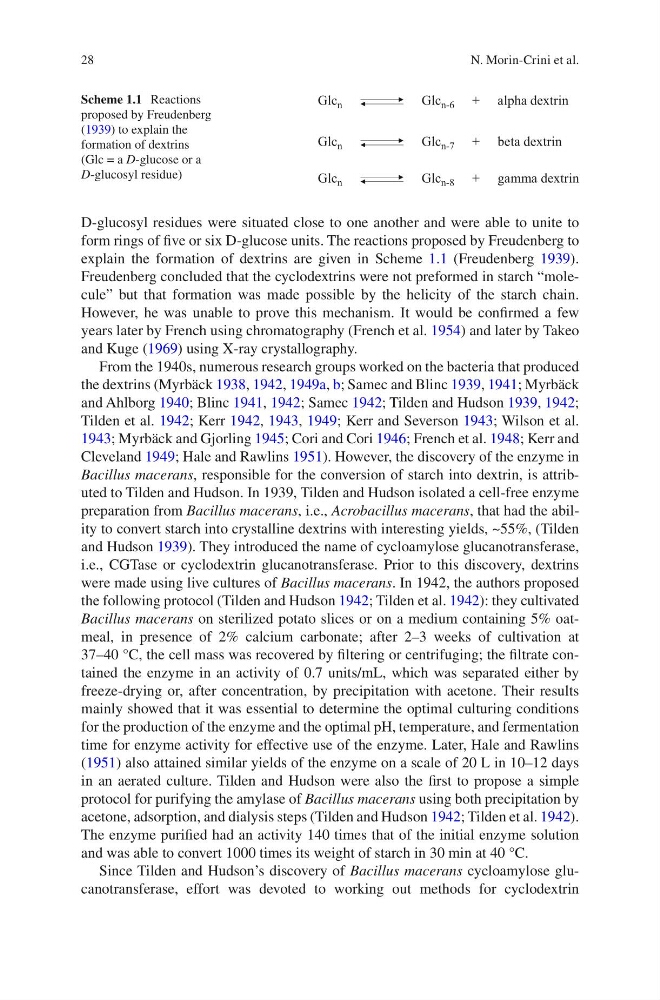
explain the formation of dextrins are given in Scheme 1.1 (Freudenberg 1939).
Freudenberg concluded that the cyclodextrins were not preformed in starch “molecule” but that formation was made possible by the helicity of the starch chain.
However, he was unable to prove this mechanism. It would be confirmed a few
years later by French using chromatography (French et al. 1954) and later by Takeo
and Kuge (1969) using X-ray crystallography.
From the 1940s, numerous research groups worked on the bacteria that produced
the dextrins (Myrbäck 1938, 1942, 1949a, b; Samec and Blinc 1939, 1941; Myrbäck
and Ahlborg 1940; Blinc 1941, 1942; Samec 1942; Tilden and Hudson 1939, 1942;
Tilden et al. 1942; Kerr 1942, 1943, 1949; Kerr and Severson 1943; Wilson et al.
1943; Myrbäck and Gjorling 1945; Cori and Cori 1946; French et al. 1948; Kerr and
Cleveland 1949; Hale and Rawlins 1951). However, the discovery of the enzyme in
Bacillus macerans, responsible for the conversion of starch into dextrin, is attributed to Tilden and Hudson. In 1939, Tilden and Hudson isolated a cell-free enzyme
preparation from Bacillus macerans, i.e., Acrobacillus macerans, that had the ability to convert starch into crystalline dextrins with interesting yields, ~55%, (Tilden
and Hudson 1939). They introduced the name of cycloamylose glucanotransferase,
i.e., CGTase or cyclodextrin glucanotransferase. Prior to this discovery, dextrins
were made using live cultures of Bacillus macerans. In 1942, the authors proposed
the following protocol (Tilden and Hudson 1942; Tilden et al. 1942): they cultivated
Bacillus macerans on sterilized potato slices or on a medium containing 5% oatmeal, in presence of 2% calcium carbonate; after 2–3 weeks of cultivation at
37–40 °C, the cell mass was recovered by filtering or centrifuging; the filtrate contained the enzyme in an activity of 0.7 units/mL, which was separated either by
freeze-drying or, after concentration, by precipitation with acetone. Their results
mainly showed that it was essential to determine the optimal culturing conditions
for the production of the enzyme and the optimal pH, temperature, and fermentation
time for enzyme activity for effective use of the enzyme. Later, Hale and Rawlins
(1951) also attained similar yields of the enzyme on a scale of 20 L in 10–12 days
in an aerated culture. Tilden and Hudson were also the first to propose a simple
protocol for purifying the amylase of Bacillus macerans using both precipitation by
acetone, adsorption, and dialysis steps (Tilden and Hudson 1942; Tilden et al. 1942).
The enzyme purified had an activity 140 times that of the initial enzyme solution
and was able to convert 1000 times its weight of starch in 30 min at 40 °C.
Since Tilden and Hudson’s discovery of Bacillus macerans cycloamylose glucanotransferase, effort was devoted to working out methods for cyclodextrin
Glc n-8 + gamma dextrin
Glc n
Glc n-7 + beta dextrin
Glc n
Glc n-6 + alpha dextrin
Glc n
Scheme 1.1 Reactions
proposed by Freudenberg
(1939) to explain the
formation of dextrins
(Glc = a D-glucose or a
D-glucosyl residue)
N. Morin-Crini et al.
D-glucosyl residues were situated close to one another and were able to unite to
form rings of five or six D-glucose units. The reactions proposed by Freudenberg to
explain the formation of dextrins are given in Scheme 1.1 (Freudenberg 1939).
Freudenberg concluded that the cyclodextrins were not preformed in starch “molecule” but that formation was made possible by the helicity of the starch chain.
However, he was unable to prove this mechanism. It would be confirmed a few
years later by French using chromatography (French et al. 1954) and later by Takeo
and Kuge (1969) using X-ray crystallography.
From the 1940s, numerous research groups worked on the bacteria that produced
the dextrins (Myrbäck 1938, 1942, 1949a, b; Samec and Blinc 1939, 1941; Myrbäck
and Ahlborg 1940; Blinc 1941, 1942; Samec 1942; Tilden and Hudson 1939, 1942;
Tilden et al. 1942; Kerr 1942, 1943, 1949; Kerr and Severson 1943; Wilson et al.
1943; Myrbäck and Gjorling 1945; Cori and Cori 1946; French et al. 1948; Kerr and
Cleveland 1949; Hale and Rawlins 1951). However, the discovery of the enzyme in
Bacillus macerans, responsible for the conversion of starch into dextrin, is attributed to Tilden and Hudson. In 1939, Tilden and Hudson isolated a cell-free enzyme
preparation from Bacillus macerans, i.e., Acrobacillus macerans, that had the ability to convert starch into crystalline dextrins with interesting yields, ~55%, (Tilden
and Hudson 1939). They introduced the name of cycloamylose glucanotransferase,
i.e., CGTase or cyclodextrin glucanotransferase. Prior to this discovery, dextrins
were made using live cultures of Bacillus macerans. In 1942, the authors proposed
the following protocol (Tilden and Hudson 1942; Tilden et al. 1942): they cultivated
Bacillus macerans on sterilized potato slices or on a medium containing 5% oatmeal, in presence of 2% calcium carbonate; after 2–3 weeks of cultivation at
37–40 °C, the cell mass was recovered by filtering or centrifuging; the filtrate contained the enzyme in an activity of 0.7 units/mL, which was separated either by
freeze-drying or, after concentration, by precipitation with acetone. Their results
mainly showed that it was essential to determine the optimal culturing conditions
for the production of the enzyme and the optimal pH, temperature, and fermentation
time for enzyme activity for effective use of the enzyme. Later, Hale and Rawlins
(1951) also attained similar yields of the enzyme on a scale of 20 L in 10–12 days
in an aerated culture. Tilden and Hudson were also the first to propose a simple
protocol for purifying the amylase of Bacillus macerans using both precipitation by
acetone, adsorption, and dialysis steps (Tilden and Hudson 1942; Tilden et al. 1942).
The enzyme purified had an activity 140 times that of the initial enzyme solution
and was able to convert 1000 times its weight of starch in 30 min at 40 °C.
Since Tilden and Hudson’s discovery of Bacillus macerans cycloamylose glucanotransferase, effort was devoted to working out methods for cyclodextrin
Glc n-8 + gamma dextrin
Glc n
Glc n-7 + beta dextrin
Glc n
Glc n-6 + alpha dextrin
Glc n
Scheme 1.1 Reactions
proposed by Freudenberg
(1939) to explain the
formation of dextrins
(Glc = a D-glucose or a
D-glucosyl residue)
N. Morin-Crini et al.