

27
pre-existing in the starch “molecule.” Similar conclusions were published by Kerr
(1942, 1943), Myrbäck (1942), and Samec (1942).
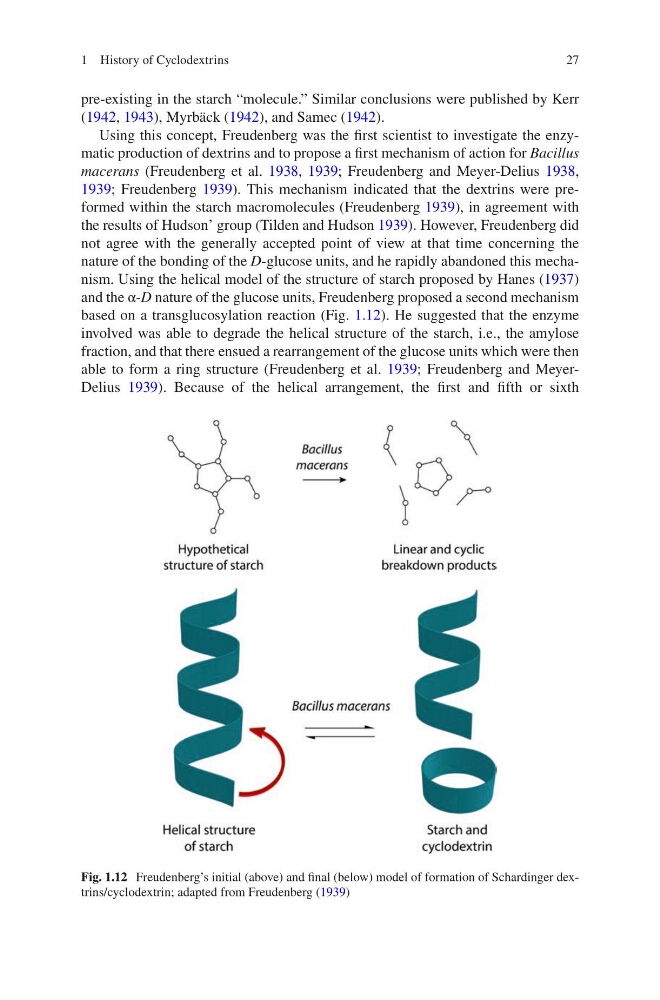
Using this concept, Freudenberg was the first scientist to investigate the enzymatic production of dextrins and to propose a first mechanism of action for Bacillus
macerans (Freudenberg et al. 1938, 1939; Freudenberg and Meyer-Delius 1938,
1939; Freudenberg 1939). This mechanism indicated that the dextrins were preformed within the starch macromolecules (Freudenberg 1939), in agreement with
the results of Hudson’ group (Tilden and Hudson 1939). However, Freudenberg did
not agree with the generally accepted point of view at that time concerning the
nature of the bonding of the D-glucose units, and he rapidly abandoned this mechanism. Using the helical model of the structure of starch proposed by Hanes (1937)
and the α-D nature of the glucose units, Freudenberg proposed a second mechanism
based on a transglucosylation reaction (Fig. 1.12). He suggested that the enzyme
involved was able to degrade the helical structure of the starch, i.e., the amylose
fraction, and that there ensued a rearrangement of the glucose units which were then
able to form a ring structure (Freudenberg et al. 1939; Freudenberg and MeyerDelius 1939). Because of the helical arrangement, the first and fifth or sixth
Fig. 1.12 Freudenberg’s initial (above) and final (below) model of formation of Schardinger dextrins/cyclodextrin; adapted from Freudenberg (1939)
1 History of Cyclodextrins
pre-existing in the starch “molecule.” Similar conclusions were published by Kerr
(1942, 1943), Myrbäck (1942), and Samec (1942).
Using this concept, Freudenberg was the first scientist to investigate the enzymatic production of dextrins and to propose a first mechanism of action for Bacillus
macerans (Freudenberg et al. 1938, 1939; Freudenberg and Meyer-Delius 1938,
1939; Freudenberg 1939). This mechanism indicated that the dextrins were preformed within the starch macromolecules (Freudenberg 1939), in agreement with
the results of Hudson’ group (Tilden and Hudson 1939). However, Freudenberg did
not agree with the generally accepted point of view at that time concerning the
nature of the bonding of the D-glucose units, and he rapidly abandoned this mechanism. Using the helical model of the structure of starch proposed by Hanes (1937)
and the α-D nature of the glucose units, Freudenberg proposed a second mechanism
based on a transglucosylation reaction (Fig. 1.12). He suggested that the enzyme
involved was able to degrade the helical structure of the starch, i.e., the amylose
fraction, and that there ensued a rearrangement of the glucose units which were then
able to form a ring structure (Freudenberg et al. 1939; Freudenberg and MeyerDelius 1939). Because of the helical arrangement, the first and fifth or sixth
Fig. 1.12 Freudenberg’s initial (above) and final (below) model of formation of Schardinger dextrins/cyclodextrin; adapted from Freudenberg (1939)
1 History of Cyclodextrins