

359
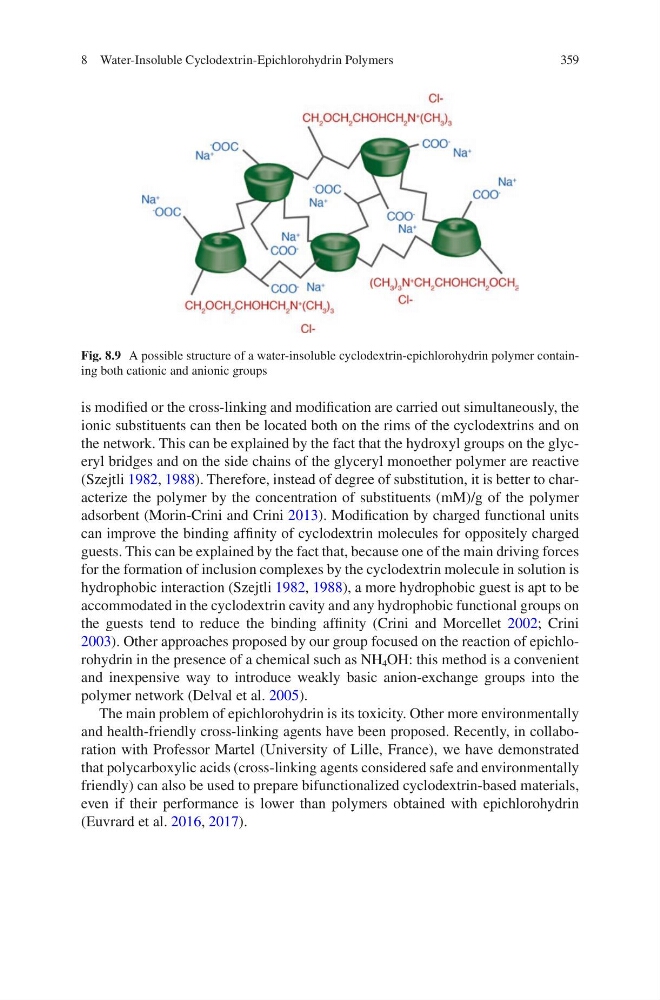
is modified or the cross-linking and modification are carried out simultaneously, the
ionic substituents can then be located both on the rims of the cyclodextrins and on
the network. This can be explained by the fact that the hydroxyl groups on the glyceryl bridges and on the side chains of the glyceryl monoether polymer are reactive
(Szejtli 1982, 1988). Therefore, instead of degree of substitution, it is better to characterize the polymer by the concentration of substituents (mM)/g of the polymer
adsorbent (Morin-Crini and Crini 2013). Modification by charged functional units
can improve the binding affinity of cyclodextrin molecules for oppositely charged
guests. This can be explained by the fact that, because one of the main driving forces
for the formation of inclusion complexes by the cyclodextrin molecule in solution is
hydrophobic interaction (Szejtli 1982, 1988), a more hydrophobic guest is apt to be
accommodated in the cyclodextrin cavity and any hydrophobic functional groups on
the guests tend to reduce the binding affinity (Crini and Morcellet 2002; Crini
2003). Other approaches proposed by our group focused on the reaction of epichlorohydrin in the presence of a chemical such as NH 4 OH: this method is a convenient
and inexpensive way to introduce weakly basic anion-exchange groups into the
polymer network (Delval et al. 2005).
The main problem of epichlorohydrin is its toxicity. Other more environmentally
and health-friendly cross-linking agents have been proposed. Recently, in collaboration with Professor Martel (University of Lille, France), we have demonstrated
that polycarboxylic acids (cross-linking agents considered safe and environmentally
friendly) can also be used to prepare bifunctionalized cyclodextrin-based materials,
even if their performance is lower than polymers obtained with epichlorohydrin
(Euvrard et al. 2016, 2017).
Fig. 8.9 A possible structure of a water-insoluble cyclodextrin-epichlorohydrin polymer containing both cationic and anionic groups
8 Water-Insoluble Cyclodextrin-Epichlorohydrin Polymers
is modified or the cross-linking and modification are carried out simultaneously, the
ionic substituents can then be located both on the rims of the cyclodextrins and on
the network. This can be explained by the fact that the hydroxyl groups on the glyceryl bridges and on the side chains of the glyceryl monoether polymer are reactive
(Szejtli 1982, 1988). Therefore, instead of degree of substitution, it is better to characterize the polymer by the concentration of substituents (mM)/g of the polymer
adsorbent (Morin-Crini and Crini 2013). Modification by charged functional units
can improve the binding affinity of cyclodextrin molecules for oppositely charged
guests. This can be explained by the fact that, because one of the main driving forces
for the formation of inclusion complexes by the cyclodextrin molecule in solution is
hydrophobic interaction (Szejtli 1982, 1988), a more hydrophobic guest is apt to be
accommodated in the cyclodextrin cavity and any hydrophobic functional groups on
the guests tend to reduce the binding affinity (Crini and Morcellet 2002; Crini
2003). Other approaches proposed by our group focused on the reaction of epichlorohydrin in the presence of a chemical such as NH 4 OH: this method is a convenient
and inexpensive way to introduce weakly basic anion-exchange groups into the
polymer network (Delval et al. 2005).
The main problem of epichlorohydrin is its toxicity. Other more environmentally
and health-friendly cross-linking agents have been proposed. Recently, in collaboration with Professor Martel (University of Lille, France), we have demonstrated
that polycarboxylic acids (cross-linking agents considered safe and environmentally
friendly) can also be used to prepare bifunctionalized cyclodextrin-based materials,
even if their performance is lower than polymers obtained with epichlorohydrin
(Euvrard et al. 2016, 2017).
Fig. 8.9 A possible structure of a water-insoluble cyclodextrin-epichlorohydrin polymer containing both cationic and anionic groups
8 Water-Insoluble Cyclodextrin-Epichlorohydrin Polymers