

358
cross-linking using conventional modification reactions such as carboxymethylation and aminoalkylation. The main aim is to modify the surface chemistry of
cross-linked materials by grafting ionic ligands (cationic and/or anionic) or neutral
ligands (amine functions). These new ligands will then also behave as active binding sites and participate in the adsorption process (Crini and Morcellet 2002; Crini
2005b). These grafting reactions, which occur in heterogeneous media, are derived
from the chemistry of polysaccharides such as cellulose. The second uses polymers
such as carboxymethylcellulose or neutral or ionic reagents such as ammonia, glycidyl trimethylammonium chloride, etc. at the same time as epichlorohydrin in the
cross-linking step of the same synthesis reactor. In this approach, the main objective
is to control the structure of the materials (porosity, specific surface area, mechanical properties, etc.) while modifying the surface chemistry of the material (Crini and
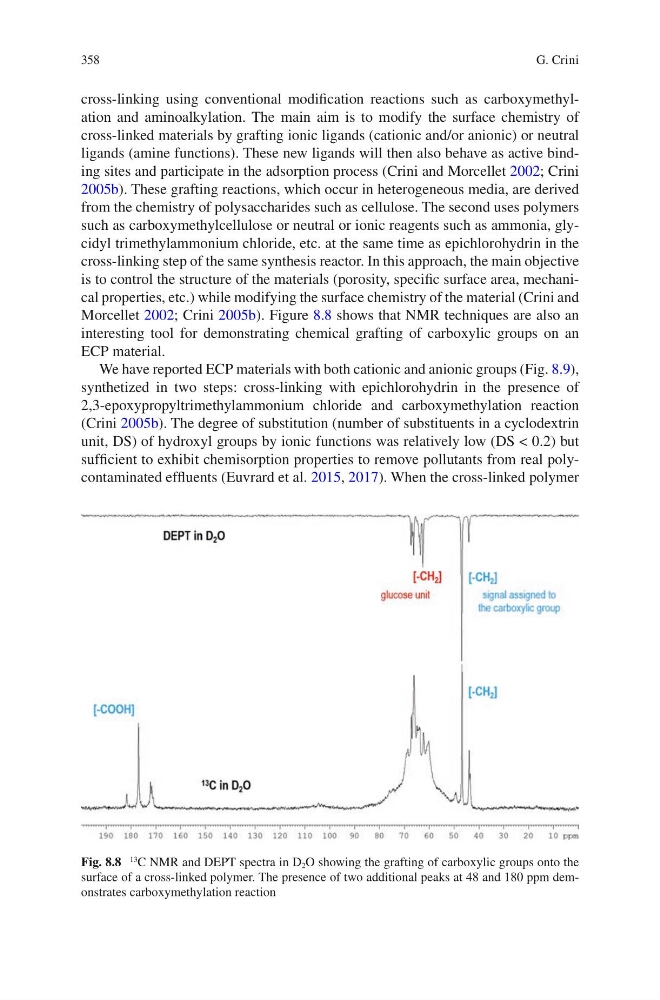
Morcellet 2002; Crini 2005b). Figure 8.8 shows that NMR techniques are also an
interesting tool for demonstrating chemical grafting of carboxylic groups on an
ECP material.
We have reported ECP materials with both cationic and anionic groups (Fig. 8.9),
synthetized in two steps: cross-linking with epichlorohydrin in the presence of
2,3-epoxypropyltrimethylammonium chloride and carboxymethylation reaction
(Crini 2005b). The degree of substitution (number of substituents in a cyclodextrin
unit, DS) of hydroxyl groups by ionic functions was relatively low (DS < 0.2) but
sufficient to exhibit chemisorption properties to remove pollutants from real polycontaminated effluents (Euvrard et al. 2015, 2017). When the cross-linked polymer
Fig. 8.8
13
C NMR and DEPT spectra in D 2 O showing the grafting of carboxylic groups onto the
surface of a cross-linked polymer. The presence of two additional peaks at 48 and 180 ppm demonstrates carboxymethylation reaction
G. Crini
cross-linking using conventional modification reactions such as carboxymethylation and aminoalkylation. The main aim is to modify the surface chemistry of
cross-linked materials by grafting ionic ligands (cationic and/or anionic) or neutral
ligands (amine functions). These new ligands will then also behave as active binding sites and participate in the adsorption process (Crini and Morcellet 2002; Crini
2005b). These grafting reactions, which occur in heterogeneous media, are derived
from the chemistry of polysaccharides such as cellulose. The second uses polymers
such as carboxymethylcellulose or neutral or ionic reagents such as ammonia, glycidyl trimethylammonium chloride, etc. at the same time as epichlorohydrin in the
cross-linking step of the same synthesis reactor. In this approach, the main objective
is to control the structure of the materials (porosity, specific surface area, mechanical properties, etc.) while modifying the surface chemistry of the material (Crini and
Morcellet 2002; Crini 2005b). Figure 8.8 shows that NMR techniques are also an
interesting tool for demonstrating chemical grafting of carboxylic groups on an
ECP material.
We have reported ECP materials with both cationic and anionic groups (Fig. 8.9),
synthetized in two steps: cross-linking with epichlorohydrin in the presence of
2,3-epoxypropyltrimethylammonium chloride and carboxymethylation reaction
(Crini 2005b). The degree of substitution (number of substituents in a cyclodextrin
unit, DS) of hydroxyl groups by ionic functions was relatively low (DS < 0.2) but
sufficient to exhibit chemisorption properties to remove pollutants from real polycontaminated effluents (Euvrard et al. 2015, 2017). When the cross-linked polymer
Fig. 8.8
13
C NMR and DEPT spectra in D 2 O showing the grafting of carboxylic groups onto the
surface of a cross-linked polymer. The presence of two additional peaks at 48 and 180 ppm demonstrates carboxymethylation reaction
G. Crini