

355
the main
1
H and
13
C signals and to demonstrate the presence of two distinct components in the materials with different mobility.
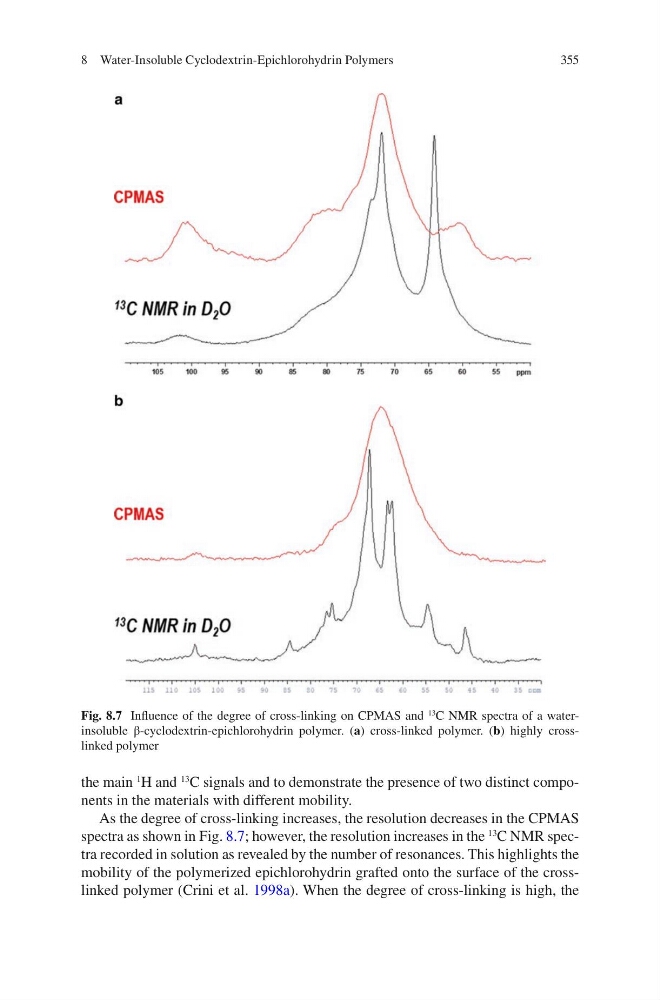
As the degree of cross-linking increases, the resolution decreases in the CPMAS
spectra as shown in Fig. 8.7; however, the resolution increases in the
13
C NMR spectra recorded in solution as revealed by the number of resonances. This highlights the
mobility of the polymerized epichlorohydrin grafted onto the surface of the crosslinked polymer (Crini et al. 1998a). When the degree of cross-linking is high, the
Fig. 8.7 Influence of the degree of cross-linking on CPMAS and
13 C NMR spectra of a waterinsoluble β-cyclodextrin-epichlorohydrin polymer. (a) cross-linked polymer. (b) highly crosslinked polymer
8 Water-Insoluble Cyclodextrin-Epichlorohydrin Polymers
the main
1
H and
13
C signals and to demonstrate the presence of two distinct components in the materials with different mobility.
As the degree of cross-linking increases, the resolution decreases in the CPMAS
spectra as shown in Fig. 8.7; however, the resolution increases in the
13
C NMR spectra recorded in solution as revealed by the number of resonances. This highlights the
mobility of the polymerized epichlorohydrin grafted onto the surface of the crosslinked polymer (Crini et al. 1998a). When the degree of cross-linking is high, the
Fig. 8.7 Influence of the degree of cross-linking on CPMAS and
13 C NMR spectra of a waterinsoluble β-cyclodextrin-epichlorohydrin polymer. (a) cross-linked polymer. (b) highly crosslinked polymer
8 Water-Insoluble Cyclodextrin-Epichlorohydrin Polymers