

284
pioneering work of Solms and Egli in 1965 can be considered as the first landmark
in the field of cyclodextrin polymers (Solms and Egli 1965). In that patent, the
authors used epichlorohydrin as the cross-linker in an alkaline bulk reaction, and,
since then, that one has been the most abundant in the literature of cyclodextrin
polymers. Also in those early years, Wiedenhof et al. (1969) improved the properties of the irregular cross-linked cyclodextrin particles that were obtained in the first
procedure and produced bead microparticles that, for instance, were suitable to be
used in chromatographic columns.
Polyurethane-type cyclodextrin networks were prepared using diisocyanates by
Buckler et al. (1969). Acid dihalides and many other potentially useful space arms, such
as dihalogenated alkenes and glutaraldehyde, were also considered in the same patent.
Various possible applications of those “anchored” cyclodextrins were in fact explored in
that patent filing: cigarette filters, extraction of juice aromas, separation of chemicals, etc.
A few years after that, in the mid-1970s, the first cyclodextrin monomers were
produced and polymerized by Furue et al. (1975). The acrylic monomers of α- and
β-cyclodextrin were obtained by reacting the respective nitrophenyl esters with the
natural cyclodextrins to yield water-soluble poly(acryloyl-β-cyclodextrin), with a
medium molecular weight (10
4
–10
5
Da). This acrylic polymer exhibited a greater
catalytic effect in the hydrolysis of p-nitrophenyl esters due to the “cooperative
effect” between two neighboring cyclodextrin moieties on a polymeric chain
(Harada et al. 1977). Other polymerizable cyclodextrin monomers were obtained in
the following years, but this second method to produce cyclodextrin polymers was
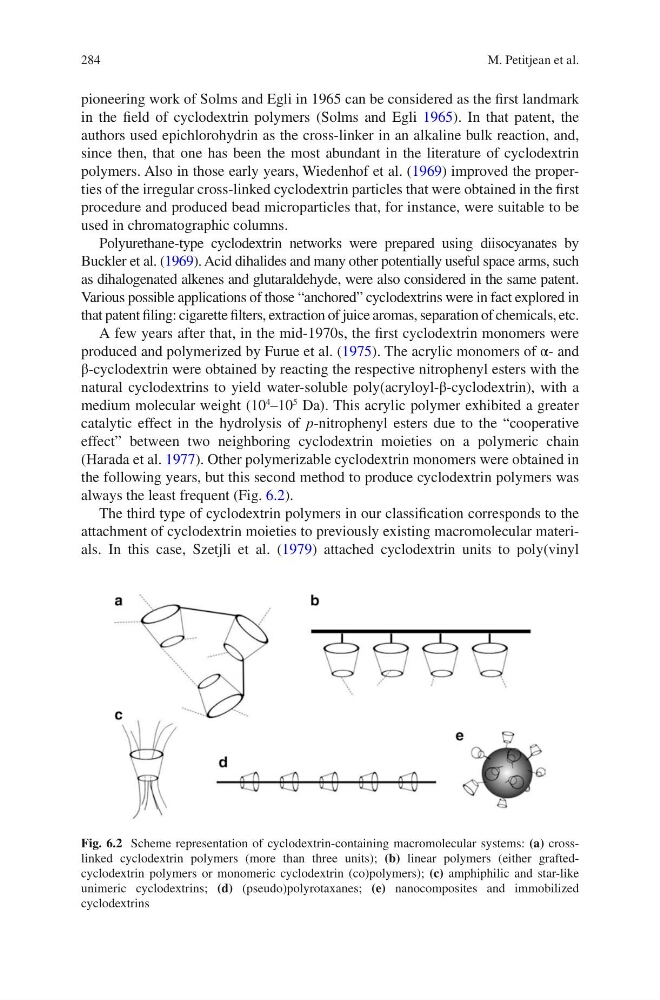
always the least frequent (Fig. 6.2).
The third type of cyclodextrin polymers in our classification corresponds to the
attachment of cyclodextrin moieties to previously existing macromolecular materials. In this case, Szetjli et al. (1979) attached cyclodextrin units to poly(vinyl
Fig. 6.2 Scheme representation of cyclodextrin-containing macromolecular systems: (a) crosslinked cyclodextrin polymers (more than three units); (b) linear polymers (either graftedcyclodextrin polymers or monomeric cyclodextrin (co)polymers); (c) amphiphilic and star-like
unimeric cyclodextrins; (d) (pseudo)polyrotaxanes; (e) nanocomposites and immobilized
cyclodextrins
M. Petitjean et al.
pioneering work of Solms and Egli in 1965 can be considered as the first landmark
in the field of cyclodextrin polymers (Solms and Egli 1965). In that patent, the
authors used epichlorohydrin as the cross-linker in an alkaline bulk reaction, and,
since then, that one has been the most abundant in the literature of cyclodextrin
polymers. Also in those early years, Wiedenhof et al. (1969) improved the properties of the irregular cross-linked cyclodextrin particles that were obtained in the first
procedure and produced bead microparticles that, for instance, were suitable to be
used in chromatographic columns.
Polyurethane-type cyclodextrin networks were prepared using diisocyanates by
Buckler et al. (1969). Acid dihalides and many other potentially useful space arms, such
as dihalogenated alkenes and glutaraldehyde, were also considered in the same patent.
Various possible applications of those “anchored” cyclodextrins were in fact explored in
that patent filing: cigarette filters, extraction of juice aromas, separation of chemicals, etc.
A few years after that, in the mid-1970s, the first cyclodextrin monomers were
produced and polymerized by Furue et al. (1975). The acrylic monomers of α- and
β-cyclodextrin were obtained by reacting the respective nitrophenyl esters with the
natural cyclodextrins to yield water-soluble poly(acryloyl-β-cyclodextrin), with a
medium molecular weight (10
4
–10
5
Da). This acrylic polymer exhibited a greater
catalytic effect in the hydrolysis of p-nitrophenyl esters due to the “cooperative
effect” between two neighboring cyclodextrin moieties on a polymeric chain
(Harada et al. 1977). Other polymerizable cyclodextrin monomers were obtained in
the following years, but this second method to produce cyclodextrin polymers was
always the least frequent (Fig. 6.2).
The third type of cyclodextrin polymers in our classification corresponds to the
attachment of cyclodextrin moieties to previously existing macromolecular materials. In this case, Szetjli et al. (1979) attached cyclodextrin units to poly(vinyl
Fig. 6.2 Scheme representation of cyclodextrin-containing macromolecular systems: (a) crosslinked cyclodextrin polymers (more than three units); (b) linear polymers (either graftedcyclodextrin polymers or monomeric cyclodextrin (co)polymers); (c) amphiphilic and star-like
unimeric cyclodextrins; (d) (pseudo)polyrotaxanes; (e) nanocomposites and immobilized
cyclodextrins
M. Petitjean et al.