

244
anion quenching reaction and showed higher activity than polyacrylic acid- stabilized
Pt nanoparticles. These results could be explained by too strong interactions between
the metal nanoparticles and the polyacrylic acid.
Meo et al. (2012) developed a novel heterogeneous catalysts based on stabilization of Ag nanoparticles as a core with poly-(6-N,N-dimethyl-propylenediamino)(6-deoxy)-β-cyclodextrin (AmCD) as a capping agent which surrounded the
nanoparticles like a shell. The synthetic procedure involved reaction of [Ag(NH 3 ) 2 ]
+
complex in the presence of a proper amount of AmCD with an excess of formaldehyde at 40 °C for 90 min. It was believed that the shell could act as a steric and
electrostatic barrier to avoid the aggregation. The obtained nanoparticles were then
used as catalysts for the reduction of nitroarenes in the presence of NaBH 4 . The
authors studied the kinetics of the reaction and the effect of the para-substituent on
the substrate and the trends of the induction period observed at the beginning of the
reaction. It was established that the presence of electron-donating groups on the
nitroarene could influence the reaction course, implying that the nanoparticle surface acted as an electrophile toward the nitro group. Nevertheless, the presence of
negatively charged or bulky groups on the nitroarene had a slightly detrimental
effect, which could emerge from the difficulty for the substrate to approach the
nanoparticle surface. The AmCD-covered catalyst surface seemed less active,
because of the intrinsic stability of the substrate-AmCD inclusion complex.
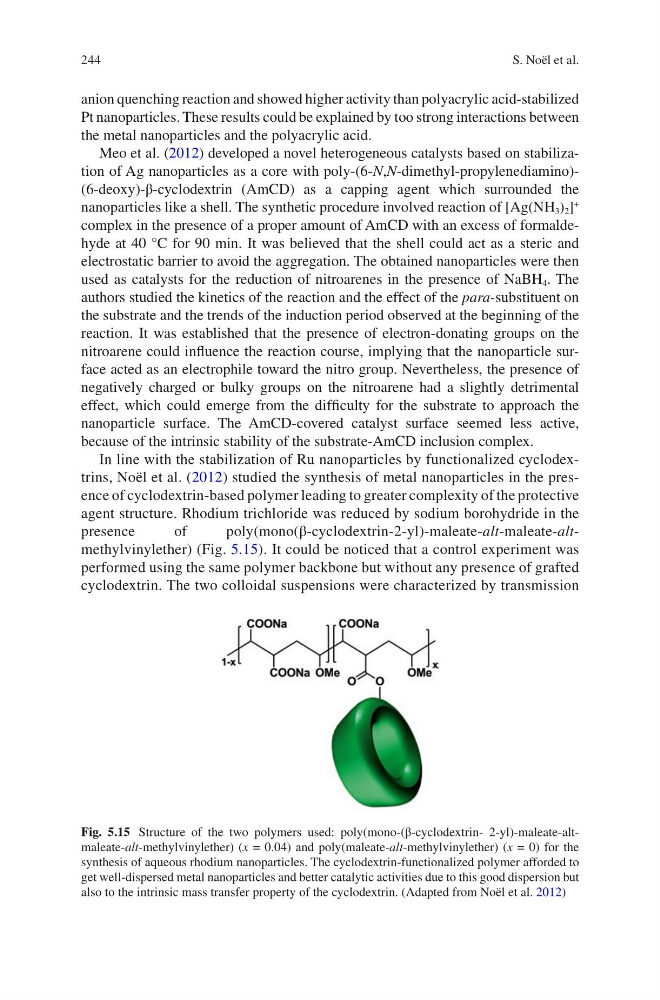
In line with the stabilization of Ru nanoparticles by functionalized cyclodextrins, Noël et al. (2012) studied the synthesis of metal nanoparticles in the presence of cyclodextrin-based polymer leading to greater complexity of the protective
agent structure. Rhodium trichloride was reduced by sodium borohydride in the
presence
of
poly(mono(β-cyclodextrin-2-yl)-maleate-alt-maleate-altmethylvinylether) (Fig. 5.15). It could be noticed that a control experiment was
performed using the same polymer backbone but without any presence of grafted
cyclodextrin. The two colloidal suspensions were characterized by transmission
Fig. 5.15 Structure of the two polymers used: poly(mono-(β-cyclodextrin- 2-yl)-maleate-altmaleate-alt-methylvinylether) (x = 0.04) and poly(maleate-alt-methylvinylether) (x = 0) for the
synthesis of aqueous rhodium nanoparticles. The cyclodextrin-functionalized polymer afforded to
get well-dispersed metal nanoparticles and better catalytic activities due to this good dispersion but
also to the intrinsic mass transfer property of the cyclodextrin. (Adapted from Noël et al. 2012)
S. Noël et al.
anion quenching reaction and showed higher activity than polyacrylic acid- stabilized
Pt nanoparticles. These results could be explained by too strong interactions between
the metal nanoparticles and the polyacrylic acid.
Meo et al. (2012) developed a novel heterogeneous catalysts based on stabilization of Ag nanoparticles as a core with poly-(6-N,N-dimethyl-propylenediamino)(6-deoxy)-β-cyclodextrin (AmCD) as a capping agent which surrounded the
nanoparticles like a shell. The synthetic procedure involved reaction of [Ag(NH 3 ) 2 ]
+
complex in the presence of a proper amount of AmCD with an excess of formaldehyde at 40 °C for 90 min. It was believed that the shell could act as a steric and
electrostatic barrier to avoid the aggregation. The obtained nanoparticles were then
used as catalysts for the reduction of nitroarenes in the presence of NaBH 4 . The
authors studied the kinetics of the reaction and the effect of the para-substituent on
the substrate and the trends of the induction period observed at the beginning of the
reaction. It was established that the presence of electron-donating groups on the
nitroarene could influence the reaction course, implying that the nanoparticle surface acted as an electrophile toward the nitro group. Nevertheless, the presence of
negatively charged or bulky groups on the nitroarene had a slightly detrimental
effect, which could emerge from the difficulty for the substrate to approach the
nanoparticle surface. The AmCD-covered catalyst surface seemed less active,
because of the intrinsic stability of the substrate-AmCD inclusion complex.
In line with the stabilization of Ru nanoparticles by functionalized cyclodextrins, Noël et al. (2012) studied the synthesis of metal nanoparticles in the presence of cyclodextrin-based polymer leading to greater complexity of the protective
agent structure. Rhodium trichloride was reduced by sodium borohydride in the
presence
of
poly(mono(β-cyclodextrin-2-yl)-maleate-alt-maleate-altmethylvinylether) (Fig. 5.15). It could be noticed that a control experiment was
performed using the same polymer backbone but without any presence of grafted
cyclodextrin. The two colloidal suspensions were characterized by transmission
Fig. 5.15 Structure of the two polymers used: poly(mono-(β-cyclodextrin- 2-yl)-maleate-altmaleate-alt-methylvinylether) (x = 0.04) and poly(maleate-alt-methylvinylether) (x = 0) for the
synthesis of aqueous rhodium nanoparticles. The cyclodextrin-functionalized polymer afforded to
get well-dispersed metal nanoparticles and better catalytic activities due to this good dispersion but
also to the intrinsic mass transfer property of the cyclodextrin. (Adapted from Noël et al. 2012)
S. Noël et al.