

10
the microorganism was able to form both acetone and ethyl alcohol. Several months
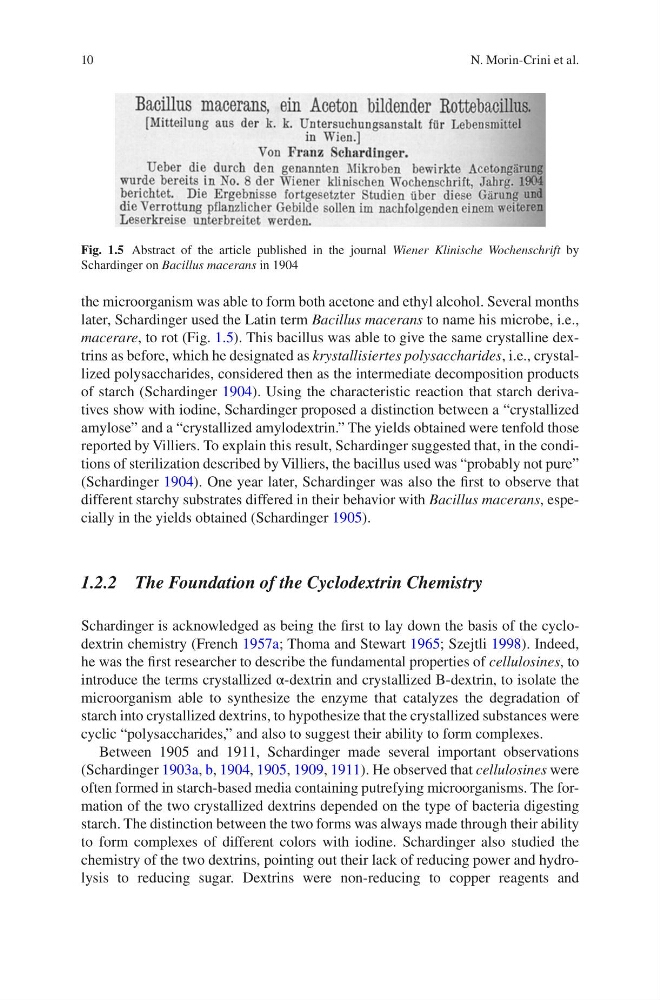
later, Schardinger used the Latin term Bacillus macerans to name his microbe, i.e.,
macerare, to rot (Fig. 1.5). This bacillus was able to give the same crystalline dextrins as before, which he designated as krystallisiertes polysaccharides, i.e., crystallized polysaccharides, considered then as the intermediate decomposition products
of starch (Schardinger 1904). Using the characteristic reaction that starch derivatives show with iodine, Schardinger proposed a distinction between a “crystallized
amylose” and a “crystallized amylodextrin.” The yields obtained were tenfold those
reported by Villiers. To explain this result, Schardinger suggested that, in the conditions of sterilization described by Villiers, the bacillus used was “probably not pure”
(Schardinger 1904). One year later, Schardinger was also the first to observe that
different starchy substrates differed in their behavior with Bacillus macerans, especially in the yields obtained (Schardinger 1905).
1.2.2 The Foundation of the Cyclodextrin Chemistry
Schardinger is acknowledged as being the first to lay down the basis of the cyclodextrin chemistry (French 1957a; Thoma and Stewart 1965; Szejtli 1998). Indeed,
he was the first researcher to describe the fundamental properties of cellulosines, to
introduce the terms crystallized α-dextrin and crystallized Β-dextrin, to isolate the
microorganism able to synthesize the enzyme that catalyzes the degradation of
starch into crystallized dextrins, to hypothesize that the crystallized substances were
cyclic “polysaccharides,” and also to suggest their ability to form complexes.
Between 1905 and 1911, Schardinger made several important observations
(Schardinger 1903a, b, 1904, 1905, 1909, 1911). He observed that cellulosines were
often formed in starch-based media containing putrefying microorganisms. The formation of the two crystallized dextrins depended on the type of bacteria digesting
starch. The distinction between the two forms was always made through their ability
to form complexes of different colors with iodine. Schardinger also studied the
chemistry of the two dextrins, pointing out their lack of reducing power and hydrolysis to reducing sugar. Dextrins were non-reducing to copper reagents and
Fig. 1.5 Abstract of the article published in the journal Wiener Klinische Wochenschrift by
Schardinger on Bacillus macerans in 1904
N. Morin-Crini et al.
the microorganism was able to form both acetone and ethyl alcohol. Several months
later, Schardinger used the Latin term Bacillus macerans to name his microbe, i.e.,
macerare, to rot (Fig. 1.5). This bacillus was able to give the same crystalline dextrins as before, which he designated as krystallisiertes polysaccharides, i.e., crystallized polysaccharides, considered then as the intermediate decomposition products
of starch (Schardinger 1904). Using the characteristic reaction that starch derivatives show with iodine, Schardinger proposed a distinction between a “crystallized
amylose” and a “crystallized amylodextrin.” The yields obtained were tenfold those
reported by Villiers. To explain this result, Schardinger suggested that, in the conditions of sterilization described by Villiers, the bacillus used was “probably not pure”
(Schardinger 1904). One year later, Schardinger was also the first to observe that
different starchy substrates differed in their behavior with Bacillus macerans, especially in the yields obtained (Schardinger 1905).
1.2.2 The Foundation of the Cyclodextrin Chemistry
Schardinger is acknowledged as being the first to lay down the basis of the cyclodextrin chemistry (French 1957a; Thoma and Stewart 1965; Szejtli 1998). Indeed,
he was the first researcher to describe the fundamental properties of cellulosines, to
introduce the terms crystallized α-dextrin and crystallized Β-dextrin, to isolate the
microorganism able to synthesize the enzyme that catalyzes the degradation of
starch into crystallized dextrins, to hypothesize that the crystallized substances were
cyclic “polysaccharides,” and also to suggest their ability to form complexes.
Between 1905 and 1911, Schardinger made several important observations
(Schardinger 1903a, b, 1904, 1905, 1909, 1911). He observed that cellulosines were
often formed in starch-based media containing putrefying microorganisms. The formation of the two crystallized dextrins depended on the type of bacteria digesting
starch. The distinction between the two forms was always made through their ability
to form complexes of different colors with iodine. Schardinger also studied the
chemistry of the two dextrins, pointing out their lack of reducing power and hydrolysis to reducing sugar. Dextrins were non-reducing to copper reagents and
Fig. 1.5 Abstract of the article published in the journal Wiener Klinische Wochenschrift by
Schardinger on Bacillus macerans in 1904
N. Morin-Crini et al.