

9
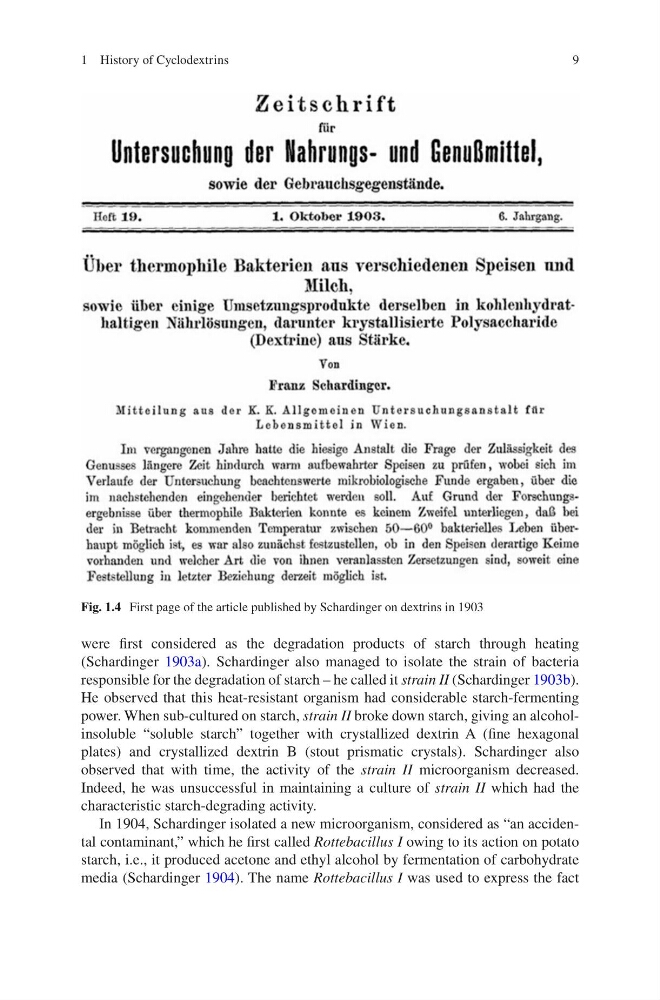
were first considered as the degradation products of starch through heating
(Schardinger 1903a). Schardinger also managed to isolate the strain of bacteria
responsible for the degradation of starch – he called it strain II (Schardinger 1903b).
He observed that this heat-resistant organism had considerable starch-fermenting
power. When sub-cultured on starch, strain II broke down starch, giving an alcoholinsoluble “soluble starch” together with crystallized dextrin A (fine hexagonal
plates) and crystallized dextrin B (stout prismatic crystals). Schardinger also
observed that with time, the activity of the strain II microorganism decreased.
Indeed, he was unsuccessful in maintaining a culture of strain II which had the
characteristic starch-degrading activity.
In 1904, Schardinger isolated a new microorganism, considered as “an accidental contaminant,” which he first called Rottebacillus I owing to its action on potato
starch, i.e., it produced acetone and ethyl alcohol by fermentation of carbohydrate
media (Schardinger 1904). The name Rottebacillus I was used to express the fact
Fig. 1.4 First page of the article published by Schardinger on dextrins in 1903
1 History of Cyclodextrins
were first considered as the degradation products of starch through heating
(Schardinger 1903a). Schardinger also managed to isolate the strain of bacteria
responsible for the degradation of starch – he called it strain II (Schardinger 1903b).
He observed that this heat-resistant organism had considerable starch-fermenting
power. When sub-cultured on starch, strain II broke down starch, giving an alcoholinsoluble “soluble starch” together with crystallized dextrin A (fine hexagonal
plates) and crystallized dextrin B (stout prismatic crystals). Schardinger also
observed that with time, the activity of the strain II microorganism decreased.
Indeed, he was unsuccessful in maintaining a culture of strain II which had the
characteristic starch-degrading activity.
In 1904, Schardinger isolated a new microorganism, considered as “an accidental contaminant,” which he first called Rottebacillus I owing to its action on potato
starch, i.e., it produced acetone and ethyl alcohol by fermentation of carbohydrate
media (Schardinger 1904). The name Rottebacillus I was used to express the fact
Fig. 1.4 First page of the article published by Schardinger on dextrins in 1903
1 History of Cyclodextrins