

205
overall cyclodextrin quantities. The first quantitative gas chromatographic method
applied for simultaneous analysis of various cyclodextrins was based on a derivatization of cyclodextrins to their corresponding dimethyl silyl derivatives, followed by
separation on a porous layer open tubular column (Armbruster and Mukhtar 1968;
Armbruster 1970).
In cooperation with a group at Eötvös Loránd University Faculty of Sciences
(Budapest), a liquid chromatographic method was developed for the separation of
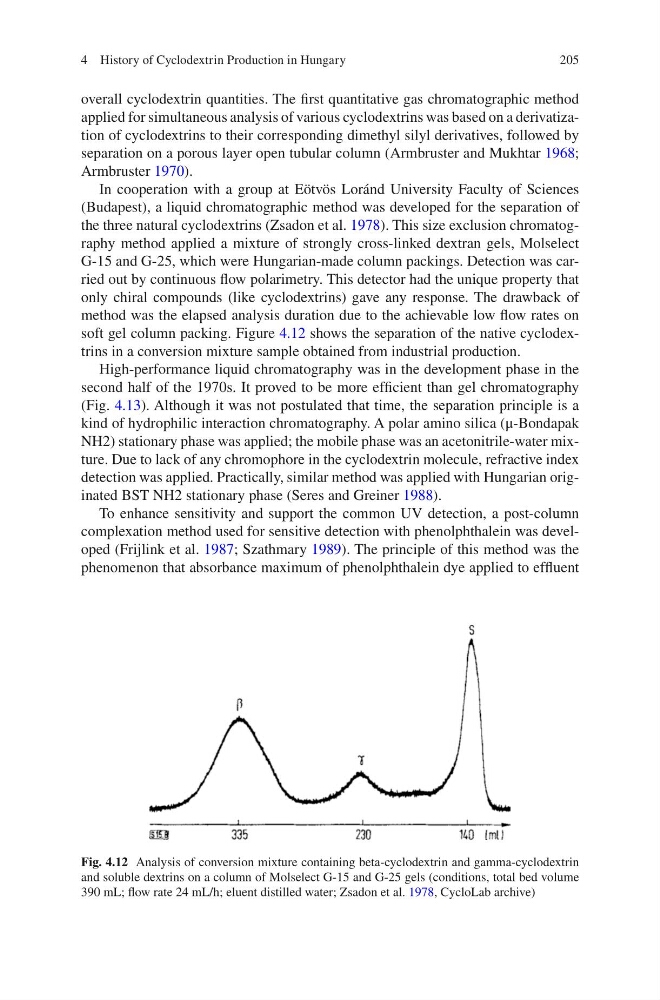
the three natural cyclodextrins (Zsadon et al. 1978). This size exclusion chromatography method applied a mixture of strongly cross-linked dextran gels, Molselect
G-15 and G-25, which were Hungarian-made column packings. Detection was carried out by continuous flow polarimetry. This detector had the unique property that
only chiral compounds (like cyclodextrins) gave any response. The drawback of
method was the elapsed analysis duration due to the achievable low flow rates on
soft gel column packing. Figure 4.12 shows the separation of the native cyclodextrins in a conversion mixture sample obtained from industrial production.
High-performance liquid chromatography was in the development phase in the
second half of the 1970s. It proved to be more efficient than gel chromatography
(Fig. 4.13). Although it was not postulated that time, the separation principle is a
kind of hydrophilic interaction chromatography. A polar amino silica (μ-Bondapak
NH2) stationary phase was applied; the mobile phase was an acetonitrile-water mixture. Due to lack of any chromophore in the cyclodextrin molecule, refractive index
detection was applied. Practically, similar method was applied with Hungarian originated BST NH2 stationary phase (Seres and Greiner 1988).
To enhance sensitivity and support the common UV detection, a post-column
complexation method used for sensitive detection with phenolphthalein was developed (Frijlink et al. 1987; Szathmary 1989). The principle of this method was the
phenomenon that absorbance maximum of phenolphthalein dye applied to effluent
Fig. 4.12 Analysis of conversion mixture containing beta-cyclodextrin and gamma-cyclodextrin
and soluble dextrins on a column of Molselect G-15 and G-25 gels (conditions, total bed volume
390 mL; flow rate 24 mL/h; eluent distilled water; Zsadon et al. 1978, CycloLab archive)
4 History of Cyclodextrin Production in Hungary
overall cyclodextrin quantities. The first quantitative gas chromatographic method
applied for simultaneous analysis of various cyclodextrins was based on a derivatization of cyclodextrins to their corresponding dimethyl silyl derivatives, followed by
separation on a porous layer open tubular column (Armbruster and Mukhtar 1968;
Armbruster 1970).
In cooperation with a group at Eötvös Loránd University Faculty of Sciences
(Budapest), a liquid chromatographic method was developed for the separation of
the three natural cyclodextrins (Zsadon et al. 1978). This size exclusion chromatography method applied a mixture of strongly cross-linked dextran gels, Molselect
G-15 and G-25, which were Hungarian-made column packings. Detection was carried out by continuous flow polarimetry. This detector had the unique property that
only chiral compounds (like cyclodextrins) gave any response. The drawback of
method was the elapsed analysis duration due to the achievable low flow rates on
soft gel column packing. Figure 4.12 shows the separation of the native cyclodextrins in a conversion mixture sample obtained from industrial production.
High-performance liquid chromatography was in the development phase in the
second half of the 1970s. It proved to be more efficient than gel chromatography
(Fig. 4.13). Although it was not postulated that time, the separation principle is a
kind of hydrophilic interaction chromatography. A polar amino silica (μ-Bondapak
NH2) stationary phase was applied; the mobile phase was an acetonitrile-water mixture. Due to lack of any chromophore in the cyclodextrin molecule, refractive index
detection was applied. Practically, similar method was applied with Hungarian originated BST NH2 stationary phase (Seres and Greiner 1988).
To enhance sensitivity and support the common UV detection, a post-column
complexation method used for sensitive detection with phenolphthalein was developed (Frijlink et al. 1987; Szathmary 1989). The principle of this method was the
phenomenon that absorbance maximum of phenolphthalein dye applied to effluent
Fig. 4.12 Analysis of conversion mixture containing beta-cyclodextrin and gamma-cyclodextrin
and soluble dextrins on a column of Molselect G-15 and G-25 gels (conditions, total bed volume
390 mL; flow rate 24 mL/h; eluent distilled water; Zsadon et al. 1978, CycloLab archive)
4 History of Cyclodextrin Production in Hungary