

203
In the scaling up of the manufacturing technology, a lot of efforts were made to
establish a unified process, which is good for production of all the three cyclodextrins in the same batch. The produced alpha-cyclodextrin, beta-cyclodextrin, and
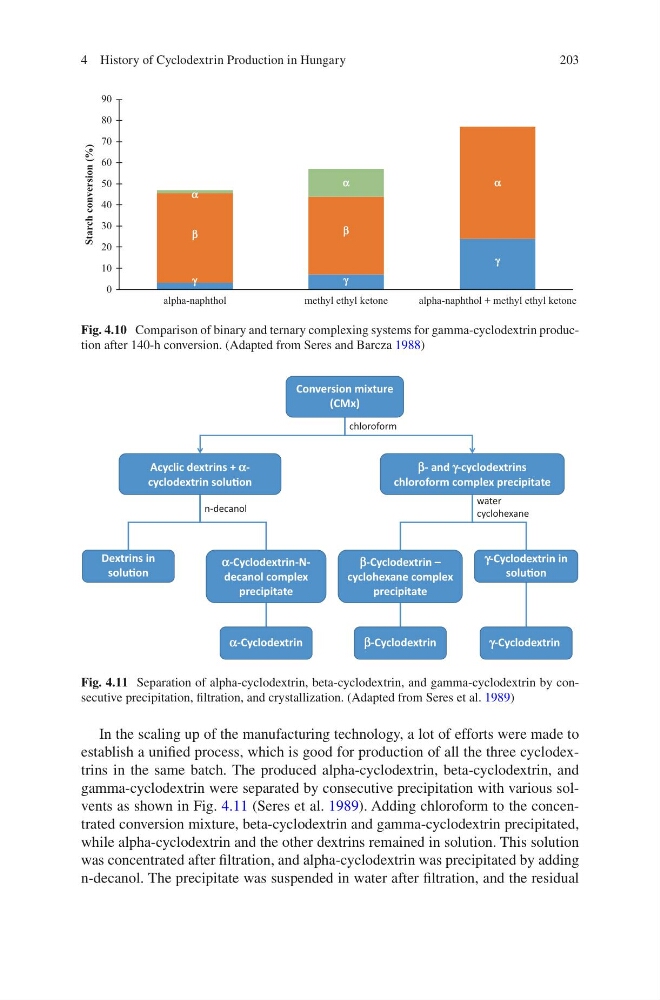
gamma-cyclodextrin were separated by consecutive precipitation with various solvents as shown in Fig. 4.11 (Seres et al. 1989). Adding chloroform to the concentrated conversion mixture, beta-cyclodextrin and gamma-cyclodextrin precipitated,
while alpha-cyclodextrin and the other dextrins remained in solution. This solution
was concentrated after filtration, and alpha-cyclodextrin was precipitated by adding
n-decanol. The precipitate was suspended in water after filtration, and the residual
0
10
20
30
40
50
60
70
80
90
alpha-naphthol
methyl ethyl ketone
alpha-naphthol + methyl ethyl ketone
Starch conversion (%)
a
b
g
a
b
a
g
g
Fig. 4.10 Comparison of binary and ternary complexing systems for gamma-cyclodextrin production after 140-h conversion. (Adapted from Seres and Barcza 1988)
Conversion mixture
(CMx)
a-Cyclodextrin-Na-Cyclodextrin
b- and g-cyclodextrins
b-Cyclodextrin –
b-Cyclodextrin
g-Cyclodextrin in
soluƟon
g-Cyclodextrin
cyclodextrin soluƟon
chloroform complex precipitate
cyclohexane complex
precipitate
decanol complex
precipitate
Dextrins in
soluƟon
chloroform
n-decanol
water
cyclohexane
Fig. 4.11 Separation of alpha-cyclodextrin, beta-cyclodextrin, and gamma-cyclodextrin by consecutive precipitation, filtration, and crystallization. (Adapted from Seres et al. 1989)
4 History of Cyclodextrin Production in Hungary
In the scaling up of the manufacturing technology, a lot of efforts were made to
establish a unified process, which is good for production of all the three cyclodextrins in the same batch. The produced alpha-cyclodextrin, beta-cyclodextrin, and
gamma-cyclodextrin were separated by consecutive precipitation with various solvents as shown in Fig. 4.11 (Seres et al. 1989). Adding chloroform to the concentrated conversion mixture, beta-cyclodextrin and gamma-cyclodextrin precipitated,
while alpha-cyclodextrin and the other dextrins remained in solution. This solution
was concentrated after filtration, and alpha-cyclodextrin was precipitated by adding
n-decanol. The precipitate was suspended in water after filtration, and the residual
0
10
20
30
40
50
60
70
80
90
alpha-naphthol
methyl ethyl ketone
alpha-naphthol + methyl ethyl ketone
Starch conversion (%)
a
b
g
a
b
a
g
g
Fig. 4.10 Comparison of binary and ternary complexing systems for gamma-cyclodextrin production after 140-h conversion. (Adapted from Seres and Barcza 1988)
Conversion mixture
(CMx)
a-Cyclodextrin-Na-Cyclodextrin
b- and g-cyclodextrins
b-Cyclodextrin –
b-Cyclodextrin
g-Cyclodextrin in
soluƟon
g-Cyclodextrin
cyclodextrin soluƟon
chloroform complex precipitate
cyclohexane complex
precipitate
decanol complex
precipitate
Dextrins in
soluƟon
chloroform
n-decanol
water
cyclohexane
Fig. 4.11 Separation of alpha-cyclodextrin, beta-cyclodextrin, and gamma-cyclodextrin by consecutive precipitation, filtration, and crystallization. (Adapted from Seres et al. 1989)
4 History of Cyclodextrin Production in Hungary