

202
with 1-naphthol and methyl ethyl ketone, resulted in 11 kg of pure gammacyclodextrin in 1982.
The invention of Chinoin researchers was based on ternary complex formation
and on the solubility-based separation of cyclodextrin complexes in different solvents, applied for patenting in 1983 and granted in 1988 (Seres et al. 1988). At first,
the production of alpha-cyclodextrin was enhanced by using a proper complexforming agent, for example, a strong ionic detergent, sodium dodecyl sulfate/methyl
ethyl ketone, or a long-chain aliphatic alcohol and ketone. As the conversion was
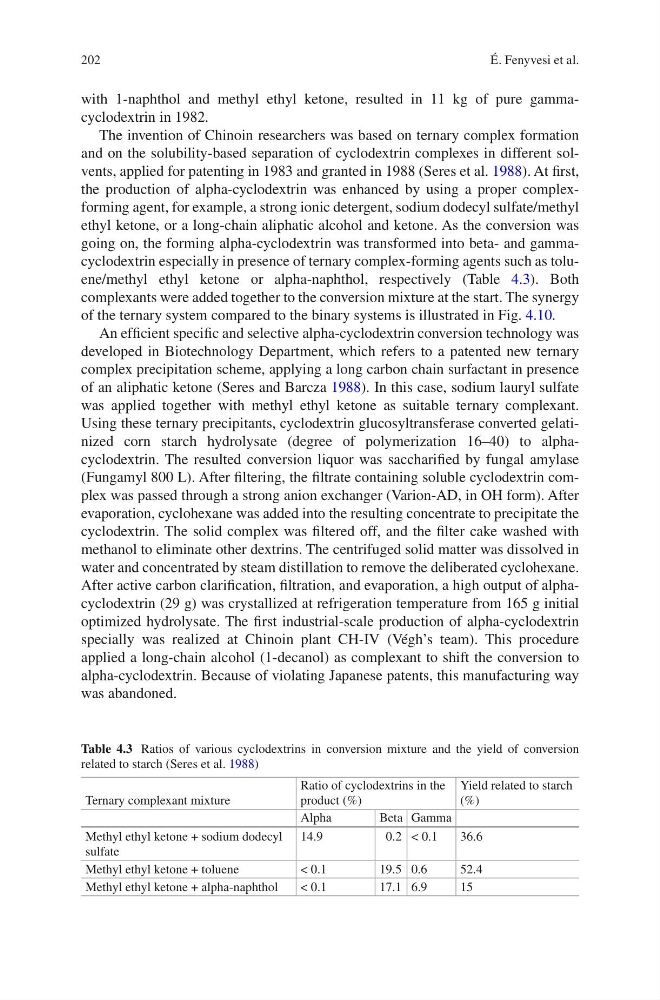
going on, the forming alpha-cyclodextrin was transformed into beta- and gammacyclodextrin especially in presence of ternary complex-forming agents such as toluene/methyl ethyl ketone or alpha-naphthol, respectively (Table 4.3). Both
complexants were added together to the conversion mixture at the start. The synergy
of the ternary system compared to the binary systems is illustrated in Fig. 4.10.
An efficient specific and selective alpha-cyclodextrin conversion technology was
developed in Biotechnology Department, which refers to a patented new ternary
complex precipitation scheme, applying a long carbon chain surfactant in presence
of an aliphatic ketone (Seres and Barcza 1988). In this case, sodium lauryl sulfate
was applied together with methyl ethyl ketone as suitable ternary complexant.
Using these ternary precipitants, cyclodextrin glucosyltransferase converted gelatinized corn starch hydrolysate (degree of polymerization 16–40) to alphacyclodextrin. The resulted conversion liquor was saccharified by fungal amylase
(Fungamyl 800 L). After filtering, the filtrate containing soluble cyclodextrin complex was passed through a strong anion exchanger (Varion-AD, in OH form). After
evaporation, cyclohexane was added into the resulting concentrate to precipitate the
cyclodextrin. The solid complex was filtered off, and the filter cake washed with
methanol to eliminate other dextrins. The centrifuged solid matter was dissolved in
water and concentrated by steam distillation to remove the deliberated cyclohexane.
After active carbon clarification, filtration, and evaporation, a high output of alphacyclodextrin (29 g) was crystallized at refrigeration temperature from 165 g initial
optimized hydrolysate. The first industrial-scale production of alpha-cyclodextrin
specially was realized at Chinoin plant CH-IV (Végh’s team). This procedure
applied a long-chain alcohol (1-decanol) as complexant to shift the conversion to
alpha-cyclodextrin. Because of violating Japanese patents, this manufacturing way
was abandoned.
Table 4.3 Ratios of various cyclodextrins in conversion mixture and the yield of conversion
related to starch (Seres et al. 1988)
Ternary complexant mixture
Ratio of cyclodextrins in the
product (%)
Yield related to starch
(%)
Alpha
Beta Gamma
Methyl ethyl ketone + sodium dodecyl
sulfate
14.9
0.2 < 0.1
36.6
Methyl ethyl ketone + toluene
< 0.1
19.5 0.6
52.4
Methyl ethyl ketone + alpha-naphthol
< 0.1
17.1 6.9
15
É. Fenyvesi et al.
with 1-naphthol and methyl ethyl ketone, resulted in 11 kg of pure gammacyclodextrin in 1982.
The invention of Chinoin researchers was based on ternary complex formation
and on the solubility-based separation of cyclodextrin complexes in different solvents, applied for patenting in 1983 and granted in 1988 (Seres et al. 1988). At first,
the production of alpha-cyclodextrin was enhanced by using a proper complexforming agent, for example, a strong ionic detergent, sodium dodecyl sulfate/methyl
ethyl ketone, or a long-chain aliphatic alcohol and ketone. As the conversion was
going on, the forming alpha-cyclodextrin was transformed into beta- and gammacyclodextrin especially in presence of ternary complex-forming agents such as toluene/methyl ethyl ketone or alpha-naphthol, respectively (Table 4.3). Both
complexants were added together to the conversion mixture at the start. The synergy
of the ternary system compared to the binary systems is illustrated in Fig. 4.10.
An efficient specific and selective alpha-cyclodextrin conversion technology was
developed in Biotechnology Department, which refers to a patented new ternary
complex precipitation scheme, applying a long carbon chain surfactant in presence
of an aliphatic ketone (Seres and Barcza 1988). In this case, sodium lauryl sulfate
was applied together with methyl ethyl ketone as suitable ternary complexant.
Using these ternary precipitants, cyclodextrin glucosyltransferase converted gelatinized corn starch hydrolysate (degree of polymerization 16–40) to alphacyclodextrin. The resulted conversion liquor was saccharified by fungal amylase
(Fungamyl 800 L). After filtering, the filtrate containing soluble cyclodextrin complex was passed through a strong anion exchanger (Varion-AD, in OH form). After
evaporation, cyclohexane was added into the resulting concentrate to precipitate the
cyclodextrin. The solid complex was filtered off, and the filter cake washed with
methanol to eliminate other dextrins. The centrifuged solid matter was dissolved in
water and concentrated by steam distillation to remove the deliberated cyclohexane.
After active carbon clarification, filtration, and evaporation, a high output of alphacyclodextrin (29 g) was crystallized at refrigeration temperature from 165 g initial
optimized hydrolysate. The first industrial-scale production of alpha-cyclodextrin
specially was realized at Chinoin plant CH-IV (Végh’s team). This procedure
applied a long-chain alcohol (1-decanol) as complexant to shift the conversion to
alpha-cyclodextrin. Because of violating Japanese patents, this manufacturing way
was abandoned.
Table 4.3 Ratios of various cyclodextrins in conversion mixture and the yield of conversion
related to starch (Seres et al. 1988)
Ternary complexant mixture
Ratio of cyclodextrins in the
product (%)
Yield related to starch
(%)
Alpha
Beta Gamma
Methyl ethyl ketone + sodium dodecyl
sulfate
14.9
0.2 < 0.1
36.6
Methyl ethyl ketone + toluene
< 0.1
19.5 0.6
52.4
Methyl ethyl ketone + alpha-naphthol
< 0.1
17.1 6.9
15
É. Fenyvesi et al.