

187
The research started with selecting the proper bacteria expressing the desired
enzyme able to produce cyclodextrins with highest activity and productivity. Various
B. macerans, B. circulans, B. stearothermophilus, and B. polymyxa strains were
screened for the best cyclodextrin glucosyltransferase, which converts starch into
the preferable beta-cyclodextrin in the maximal ratio. The following parameters had
to be optimized: (i) cultivating circumstances of an industrial strain; (ii) ingredients
of culture medium; (iii) screening of various amino acid nitrogen sources; and (iv)
fermentation parameters such as determination of optimal pH, cultivation temperature, and oxygen uptake.
Hundreds of experiments were carried out to find optimal conditions for cultivation of these bacteria. Mutagenic stimulation by either UV or X-ray irradiation was
also intensively applied. It was crucial also to select an optimal cultivation medium.
Finally, selection among various carbon sources led to a recognition that oat bran
was the best nutrient for culturing. The main steps in laboratory development of
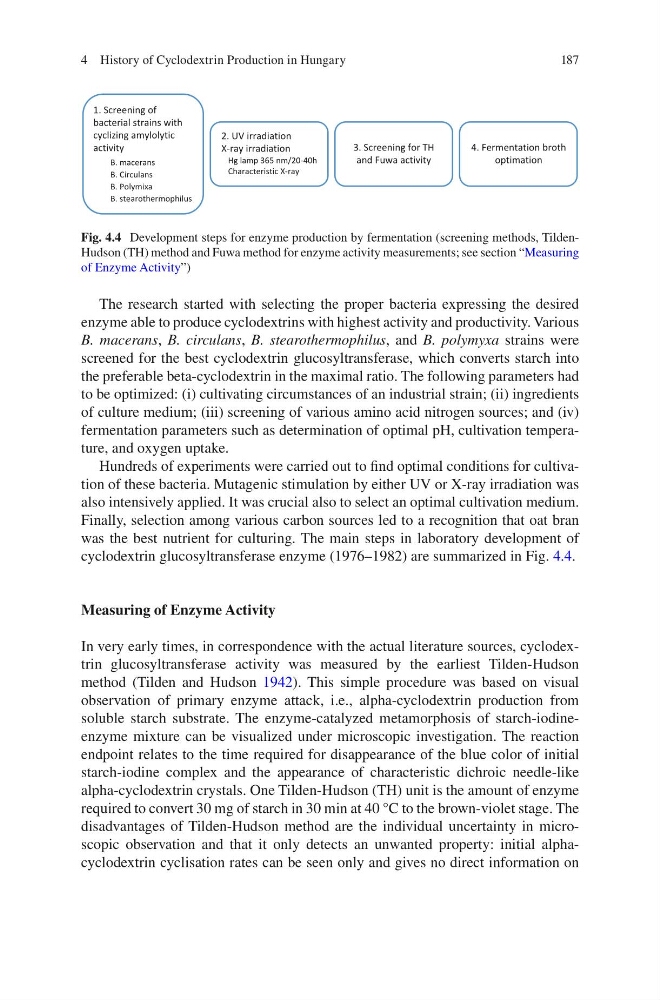
cyclodextrin glucosyltransferase enzyme (1976–1982) are summarized in Fig. 4.4.
Measuring of Enzyme Activity
In very early times, in correspondence with the actual literature sources, cyclodextrin glucosyltransferase activity was measured by the earliest Tilden-Hudson
method (Tilden and Hudson 1942). This simple procedure was based on visual
observation of primary enzyme attack, i.e., alpha-cyclodextrin production from
soluble starch substrate. The enzyme-catalyzed metamorphosis of starch-iodineenzyme mixture can be visualized under microscopic investigation. The reaction
endpoint relates to the time required for disappearance of the blue color of initial
starch-iodine complex and the appearance of characteristic dichroic needle-like
alpha-cyclodextrin crystals. One Tilden-Hudson (TH) unit is the amount of enzyme
required to convert 30 mg of starch in 30 min at 40 °C to the brown-violet stage. The
disadvantages of Tilden-Hudson method are the individual uncertainty in microscopic observation and that it only detects an unwanted property: initial alphacyclodextrin cyclisation rates can be seen only and gives no direct information on
1. Screening of
bacterial strains with
cyclizing amylolytic
activity
B. macerans
B. Circulans
B. Polymixa
B. stearothermophilus
3. Screening for TH
and Fuwa activity
2. UV irradiation
X-ray irradiation
Hg lamp 365 nm/20-40h
Characteristic X-ray
4. Fermentation broth
optimation
Fig. 4.4 Development steps for enzyme production by fermentation (screening methods, TildenHudson (TH) method and Fuwa method for enzyme activity measurements; see section “Measuring
of Enzyme Activity”)
4 History of Cyclodextrin Production in Hungary
The research started with selecting the proper bacteria expressing the desired
enzyme able to produce cyclodextrins with highest activity and productivity. Various
B. macerans, B. circulans, B. stearothermophilus, and B. polymyxa strains were
screened for the best cyclodextrin glucosyltransferase, which converts starch into
the preferable beta-cyclodextrin in the maximal ratio. The following parameters had
to be optimized: (i) cultivating circumstances of an industrial strain; (ii) ingredients
of culture medium; (iii) screening of various amino acid nitrogen sources; and (iv)
fermentation parameters such as determination of optimal pH, cultivation temperature, and oxygen uptake.
Hundreds of experiments were carried out to find optimal conditions for cultivation of these bacteria. Mutagenic stimulation by either UV or X-ray irradiation was
also intensively applied. It was crucial also to select an optimal cultivation medium.
Finally, selection among various carbon sources led to a recognition that oat bran
was the best nutrient for culturing. The main steps in laboratory development of
cyclodextrin glucosyltransferase enzyme (1976–1982) are summarized in Fig. 4.4.
Measuring of Enzyme Activity
In very early times, in correspondence with the actual literature sources, cyclodextrin glucosyltransferase activity was measured by the earliest Tilden-Hudson
method (Tilden and Hudson 1942). This simple procedure was based on visual
observation of primary enzyme attack, i.e., alpha-cyclodextrin production from
soluble starch substrate. The enzyme-catalyzed metamorphosis of starch-iodineenzyme mixture can be visualized under microscopic investigation. The reaction
endpoint relates to the time required for disappearance of the blue color of initial
starch-iodine complex and the appearance of characteristic dichroic needle-like
alpha-cyclodextrin crystals. One Tilden-Hudson (TH) unit is the amount of enzyme
required to convert 30 mg of starch in 30 min at 40 °C to the brown-violet stage. The
disadvantages of Tilden-Hudson method are the individual uncertainty in microscopic observation and that it only detects an unwanted property: initial alphacyclodextrin cyclisation rates can be seen only and gives no direct information on
1. Screening of
bacterial strains with
cyclizing amylolytic
activity
B. macerans
B. Circulans
B. Polymixa
B. stearothermophilus
3. Screening for TH
and Fuwa activity
2. UV irradiation
X-ray irradiation
Hg lamp 365 nm/20-40h
Characteristic X-ray
4. Fermentation broth
optimation
Fig. 4.4 Development steps for enzyme production by fermentation (screening methods, TildenHudson (TH) method and Fuwa method for enzyme activity measurements; see section “Measuring
of Enzyme Activity”)
4 History of Cyclodextrin Production in Hungary