

167
hydrogen exchange. All these results, presented for the first time at a conference
invited to the 10th Congress of the Italian Chemical Society (Padova, Italy, June
1968), were “relevant” according to Professor Szejtli, since most of the reactions in
which cyclodextrins were involved were carried out in solution, mostly in water
(Szejtli 1982, 1988).
Another interesting fact was that the hydrogen bonds in β-cyclodextrin were also
stronger than in α-cyclodextrin (Casu 1966; Casu et al. 1968a, b). On raising the
temperature, the hydroxyl signals shifted to higher fields, which was indicative of a
weakening of the hydrogen bonds. At the same time, the signals for the anomeric
protons remained practically unchanged. These results were in accordance with the
presence of intramolecular hydrogen bonding in cyclodextrins previously proposed
by Hybl et al. (1965), on the basis of X-ray crystallography data. Two years later,
Cramer’s group also published similar results using optical rotator dispersion spectroscopy (Cramer and Hettler 1967; Cramer et al. 1967). Later, Takeo and Kuge
(1969), investigating the NMR spectra of β-cyclodextrin and γ-cyclodextrin
(DMSO-d 6 at 25 °C and 80 °C), showed that hydrogen bonds were stronger in
γ-cyclodextrin than in β-cyclodextrin, in agreement with Casu’s results.
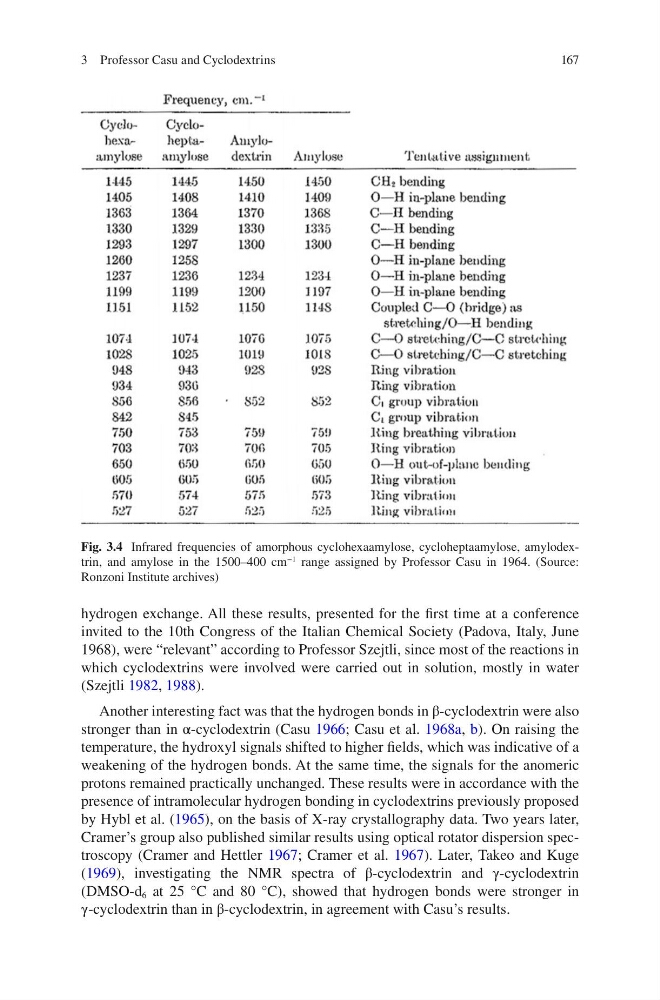
Fig. 3.4 Infrared frequencies of amorphous cyclohexaamylose, cycloheptaamylose, amylodextrin, and amylose in the 1500–400 cm
−1 range assigned by Professor Casu in 1964. (Source:
Ronzoni Institute archives)
3 Professor Casu and Cyclodextrins
hydrogen exchange. All these results, presented for the first time at a conference
invited to the 10th Congress of the Italian Chemical Society (Padova, Italy, June
1968), were “relevant” according to Professor Szejtli, since most of the reactions in
which cyclodextrins were involved were carried out in solution, mostly in water
(Szejtli 1982, 1988).
Another interesting fact was that the hydrogen bonds in β-cyclodextrin were also
stronger than in α-cyclodextrin (Casu 1966; Casu et al. 1968a, b). On raising the
temperature, the hydroxyl signals shifted to higher fields, which was indicative of a
weakening of the hydrogen bonds. At the same time, the signals for the anomeric
protons remained practically unchanged. These results were in accordance with the
presence of intramolecular hydrogen bonding in cyclodextrins previously proposed
by Hybl et al. (1965), on the basis of X-ray crystallography data. Two years later,
Cramer’s group also published similar results using optical rotator dispersion spectroscopy (Cramer and Hettler 1967; Cramer et al. 1967). Later, Takeo and Kuge
(1969), investigating the NMR spectra of β-cyclodextrin and γ-cyclodextrin
(DMSO-d 6 at 25 °C and 80 °C), showed that hydrogen bonds were stronger in
γ-cyclodextrin than in β-cyclodextrin, in agreement with Casu’s results.
Fig. 3.4 Infrared frequencies of amorphous cyclohexaamylose, cycloheptaamylose, amylodextrin, and amylose in the 1500–400 cm
−1 range assigned by Professor Casu in 1964. (Source:
Ronzoni Institute archives)
3 Professor Casu and Cyclodextrins