

129
Later, Professor Szejtli suggested practical applications of cyclodextrincomplexed flavors (Szejtli 1982b) such as in households, in the catering trade, in
dietetics and hospitals, and in the tinned food and meat industry (Fig. 2.20). In this
paper, Professor Szejtli pointed out the fact that Japan was the only country where
the application of cyclodextrin in food products was not limited (Szejtli 1982b).
Coffee flavors were also stabilized by complexation with β-cyclodextrin as reported
by Szente and Szejtli et al. (1986). In contact with water, the complex-bound flavor
substances were released immediately. In a previous work (Lindner et al. 1981),
flavor-β-cyclodextrin complexes were used in sausages, e.g., 1 g complex was
equivalent to 130–150 g and 3–100 g of onion and cumin, respectively.
2.5.2 Cyclodextrin in Cosmetics and Toiletry
The two first reviews on the potential applications of cyclodextrins in cosmetics and
toiletry were published in 1982 (Szejtli 1982b, c). These applications were presented at the 33rd Starch Convention of the Arbeitsgemeinschaft Getreideforschung
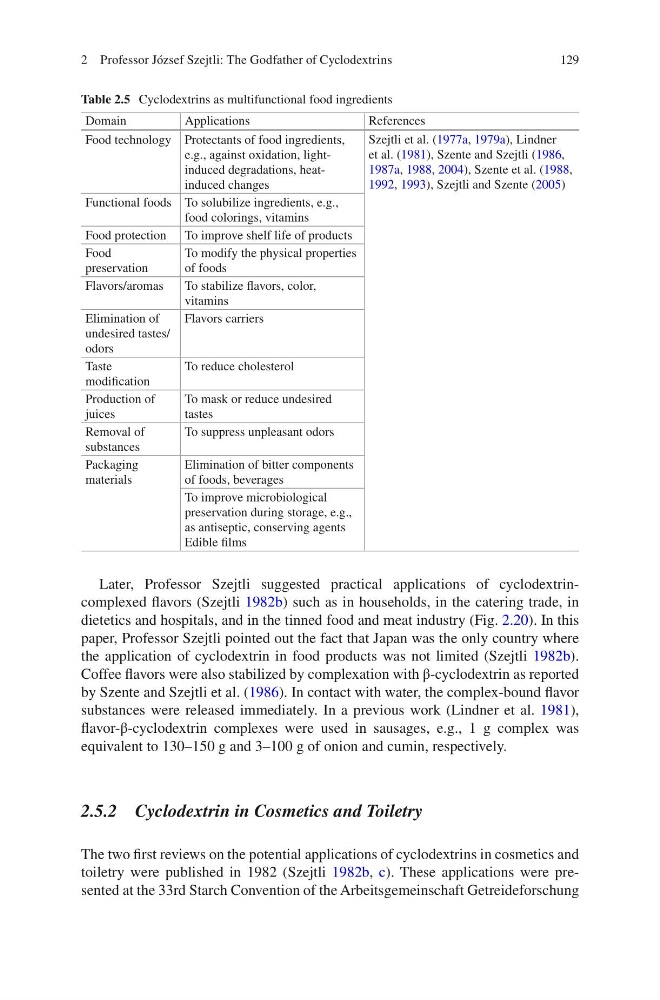
Table 2.5 Cyclodextrins as multifunctional food ingredients
Domain
Applications
References
Food technology Protectants of food ingredients,
e.g., against oxidation, lightinduced degradations, heatinduced changes
Szejtli et al. (1977a, 1979a), Lindner
et al. (1981), Szente and Szejtli (1986,
1987a, 1988, 2004), Szente et al. (1988,
1992, 1993), Szejtli and Szente (2005)
Functional foods To solubilize ingredients, e.g.,
food colorings, vitamins
Food protection To improve shelf life of products
Food
preservation
To modify the physical properties
of foods
Flavors/aromas
To stabilize flavors, color,
vitamins
Elimination of
undesired tastes/
odors
Flavors carriers
Taste
modification
To reduce cholesterol
Production of
juices
To mask or reduce undesired
tastes
Removal of
substances
To suppress unpleasant odors
Packaging
materials
Elimination of bitter components
of foods, beverages
To improve microbiological
preservation during storage, e.g.,
as antiseptic, conserving agents
Edible films
2 Professor József Szejtli: The Godfather of Cyclodextrins
Later, Professor Szejtli suggested practical applications of cyclodextrincomplexed flavors (Szejtli 1982b) such as in households, in the catering trade, in
dietetics and hospitals, and in the tinned food and meat industry (Fig. 2.20). In this
paper, Professor Szejtli pointed out the fact that Japan was the only country where
the application of cyclodextrin in food products was not limited (Szejtli 1982b).
Coffee flavors were also stabilized by complexation with β-cyclodextrin as reported
by Szente and Szejtli et al. (1986). In contact with water, the complex-bound flavor
substances were released immediately. In a previous work (Lindner et al. 1981),
flavor-β-cyclodextrin complexes were used in sausages, e.g., 1 g complex was
equivalent to 130–150 g and 3–100 g of onion and cumin, respectively.
2.5.2 Cyclodextrin in Cosmetics and Toiletry
The two first reviews on the potential applications of cyclodextrins in cosmetics and
toiletry were published in 1982 (Szejtli 1982b, c). These applications were presented at the 33rd Starch Convention of the Arbeitsgemeinschaft Getreideforschung
Table 2.5 Cyclodextrins as multifunctional food ingredients
Domain
Applications
References
Food technology Protectants of food ingredients,
e.g., against oxidation, lightinduced degradations, heatinduced changes
Szejtli et al. (1977a, 1979a), Lindner
et al. (1981), Szente and Szejtli (1986,
1987a, 1988, 2004), Szente et al. (1988,
1992, 1993), Szejtli and Szente (2005)
Functional foods To solubilize ingredients, e.g.,
food colorings, vitamins
Food protection To improve shelf life of products
Food
preservation
To modify the physical properties
of foods
Flavors/aromas
To stabilize flavors, color,
vitamins
Elimination of
undesired tastes/
odors
Flavors carriers
Taste
modification
To reduce cholesterol
Production of
juices
To mask or reduce undesired
tastes
Removal of
substances
To suppress unpleasant odors
Packaging
materials
Elimination of bitter components
of foods, beverages
To improve microbiological
preservation during storage, e.g.,
as antiseptic, conserving agents
Edible films
2 Professor József Szejtli: The Godfather of Cyclodextrins