

127
Cyclodextrins can be modified by substituting one or more hydrogen atom of the
primary and/or secondary hydroxyls, e.g., esters, ethers, or glycosyl-cyclodextrins,
by substituting one or more primary and/or secondary hydroxyls, e.g., halogeno and
aminocyclodextrins, by eliminating the hydrogen atom of the C5-CH 2 OH group, or
splitting one or more C2-C3 bonds by periodate oxidation. The substitution of
highly reactive hydroxyl groups with either polar or apolar moieties permitted the
disruption of intermolecular hydrogen bonds, and this produced cyclodextrin derivatives with anomalous increased solubility. The problems of selectivity and strategies for selective modification of hydroxyl groups have also been discussed by
Professor Szejtli (Szejtli 1982a, 1984a, 1988a, 1998; Szente and Szejtli 1999).
The aim of such derivatizations may be (i) to improve the solubility of the native
cyclodextrins, (ii) to improve the association between the cyclodextrin and its guest,
(iii) to reduce its reactivity, (iv) to bind specific functional groups, and/or (v) to create new molecular of macromolecular structures, e.g., for chromatographic purposes.
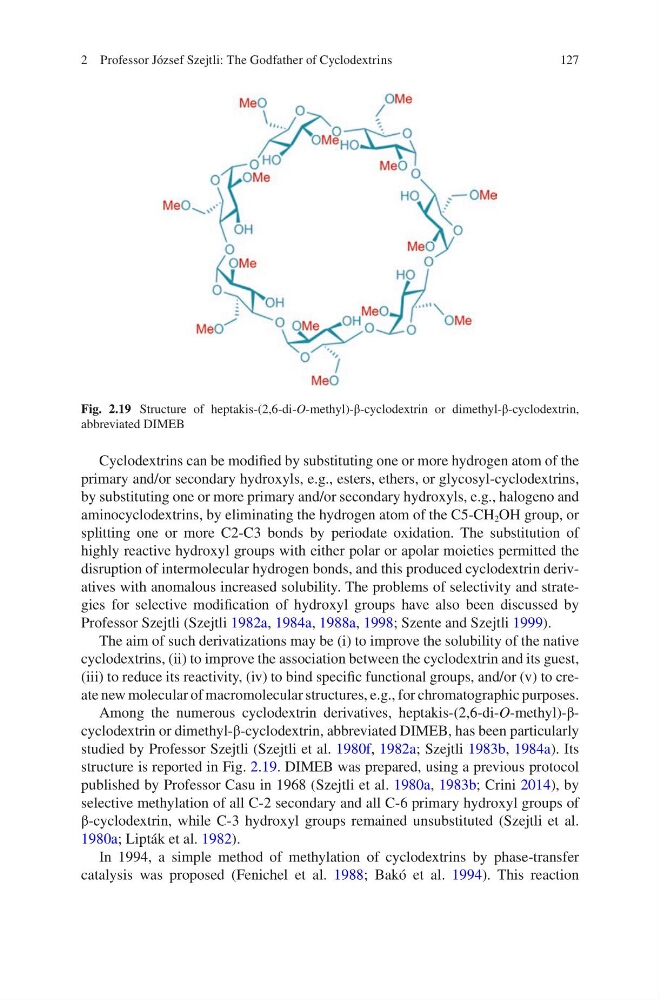
Among the numerous cyclodextrin derivatives, heptakis-(2,6-di-O-methyl)-βcyclodextrin or dimethyl-β-cyclodextrin, abbreviated DIMEB, has been particularly
studied by Professor Szejtli (Szejtli et al. 1980f, 1982a; Szejtli 1983b, 1984a). Its
structure is reported in Fig. 2.19. DIMEB was prepared, using a previous protocol
published by Professor Casu in 1968 (Szejtli et al. 1980a, 1983b; Crini 2014), by
selective methylation of all C-2 secondary and all C-6 primary hydroxyl groups of
β-cyclodextrin, while C-3 hydroxyl groups remained unsubstituted (Szejtli et al.
1980a; Lipták et al. 1982).
In 1994, a simple method of methylation of cyclodextrins by phase-transfer
catalysis was proposed (Fenichel et al. 1988; Bakó et al. 1994). This reaction
Fig. 2.19 Structure of heptakis-(2,6-di-O-methyl)-β-cyclodextrin or dimethyl-β-cyclodextrin,
abbreviated DIMEB
2 Professor József Szejtli: The Godfather of Cyclodextrins
Cyclodextrins can be modified by substituting one or more hydrogen atom of the
primary and/or secondary hydroxyls, e.g., esters, ethers, or glycosyl-cyclodextrins,
by substituting one or more primary and/or secondary hydroxyls, e.g., halogeno and
aminocyclodextrins, by eliminating the hydrogen atom of the C5-CH 2 OH group, or
splitting one or more C2-C3 bonds by periodate oxidation. The substitution of
highly reactive hydroxyl groups with either polar or apolar moieties permitted the
disruption of intermolecular hydrogen bonds, and this produced cyclodextrin derivatives with anomalous increased solubility. The problems of selectivity and strategies for selective modification of hydroxyl groups have also been discussed by
Professor Szejtli (Szejtli 1982a, 1984a, 1988a, 1998; Szente and Szejtli 1999).
The aim of such derivatizations may be (i) to improve the solubility of the native
cyclodextrins, (ii) to improve the association between the cyclodextrin and its guest,
(iii) to reduce its reactivity, (iv) to bind specific functional groups, and/or (v) to create new molecular of macromolecular structures, e.g., for chromatographic purposes.
Among the numerous cyclodextrin derivatives, heptakis-(2,6-di-O-methyl)-βcyclodextrin or dimethyl-β-cyclodextrin, abbreviated DIMEB, has been particularly
studied by Professor Szejtli (Szejtli et al. 1980f, 1982a; Szejtli 1983b, 1984a). Its
structure is reported in Fig. 2.19. DIMEB was prepared, using a previous protocol
published by Professor Casu in 1968 (Szejtli et al. 1980a, 1983b; Crini 2014), by
selective methylation of all C-2 secondary and all C-6 primary hydroxyl groups of
β-cyclodextrin, while C-3 hydroxyl groups remained unsubstituted (Szejtli et al.
1980a; Lipták et al. 1982).
In 1994, a simple method of methylation of cyclodextrins by phase-transfer
catalysis was proposed (Fenichel et al. 1988; Bakó et al. 1994). This reaction
Fig. 2.19 Structure of heptakis-(2,6-di-O-methyl)-β-cyclodextrin or dimethyl-β-cyclodextrin,
abbreviated DIMEB
2 Professor József Szejtli: The Godfather of Cyclodextrins