

123
In the 1980s, Professor Szejtli pointed out the fact the preparation of cyclodextrin inclusion complexes was simple. Their preparation and characterization were
detailed in his two books (Szejtli 1982a, 1988a). Professor Szejtli wrote: “No universal method exists for the preparation of cyclodextrin complexes; the method has
to be tailor made for the guest and for the requirements: whether small-scale laboratory preparation or large-scale industrial production” (Szejtli 1982a).
The complexation was performed in homogeneous solution, or in suspension,
under pressure, or by simple mixing of the components. The most common procedure was to shake an aqueous solution of cyclodextrin (cold or warm, neutral or
acidic) with the guest substance or its solution (Szejtli 1987a). Water can be removed
by freeze-drying or spray drying. Other methods such as kneading, slurry complexation, filtration, or heating method were also used in the formation of cyclodextrin
complexes (Szejtli 1995).
To prove the formation of an inclusion complex, various methods were used,
e.g., circular dichroism (Szejtli 1978, 1983b), spectroscopy optical rotatory dispersion (Szejtli 1978), powder X-ray diffraction (Szejtli 1977b, 1978), polarography
(Daruhazi et al. 1982, Szejtli 1982a), thin-layer chromatography (Szejtli 1978,
1982b), gas chromatography (Szejtli 1982c), UV-visible spectroscopy (Szejtli et al.
1978b), nuclear magnetic resonance spectroscopy (Szejtli 1983b), infrared spectroscopy (Szejtli et al. 1978b), thermoanalysis (Szejtli 1978), mass spectrometry
(Szejtli 1977a, b), and differential scanning calorimetry (Novák et al. 1993).
For instance, mass spectrometric investigations proved that from a mixture of
(O,O-dimethyl O-(2,2-dichlorovinyl)-phosphate with β-cyclodextrin, this insecticide was completely evaporated between 50 and 120 °C, i.e., before the beginning
of the decomposition of cyclodextrin. In the mass spectrum of the insecticidecyclodextrin complex, the peaks characteristics of (O,O-dimethyl O-(2,2dichlorovinyl)-phosphate appeared only above 200 °C, simultaneously with the
degradation products of β-cyclodextrin, demonstrating that the insecticide was
bound in the complex.
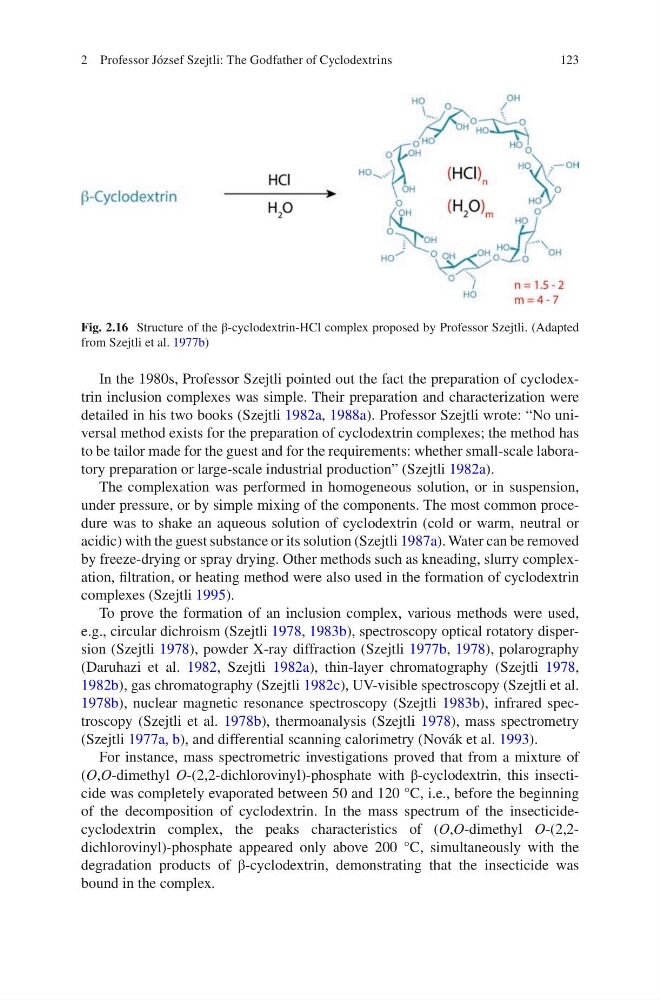
Fig. 2.16 Structure of the β-cyclodextrin-HCl complex proposed by Professor Szejtli. (Adapted
from Szejtli et al. 1977b)
2 Professor József Szejtli: The Godfather of Cyclodextrins
In the 1980s, Professor Szejtli pointed out the fact the preparation of cyclodextrin inclusion complexes was simple. Their preparation and characterization were
detailed in his two books (Szejtli 1982a, 1988a). Professor Szejtli wrote: “No universal method exists for the preparation of cyclodextrin complexes; the method has
to be tailor made for the guest and for the requirements: whether small-scale laboratory preparation or large-scale industrial production” (Szejtli 1982a).
The complexation was performed in homogeneous solution, or in suspension,
under pressure, or by simple mixing of the components. The most common procedure was to shake an aqueous solution of cyclodextrin (cold or warm, neutral or
acidic) with the guest substance or its solution (Szejtli 1987a). Water can be removed
by freeze-drying or spray drying. Other methods such as kneading, slurry complexation, filtration, or heating method were also used in the formation of cyclodextrin
complexes (Szejtli 1995).
To prove the formation of an inclusion complex, various methods were used,
e.g., circular dichroism (Szejtli 1978, 1983b), spectroscopy optical rotatory dispersion (Szejtli 1978), powder X-ray diffraction (Szejtli 1977b, 1978), polarography
(Daruhazi et al. 1982, Szejtli 1982a), thin-layer chromatography (Szejtli 1978,
1982b), gas chromatography (Szejtli 1982c), UV-visible spectroscopy (Szejtli et al.
1978b), nuclear magnetic resonance spectroscopy (Szejtli 1983b), infrared spectroscopy (Szejtli et al. 1978b), thermoanalysis (Szejtli 1978), mass spectrometry
(Szejtli 1977a, b), and differential scanning calorimetry (Novák et al. 1993).
For instance, mass spectrometric investigations proved that from a mixture of
(O,O-dimethyl O-(2,2-dichlorovinyl)-phosphate with β-cyclodextrin, this insecticide was completely evaporated between 50 and 120 °C, i.e., before the beginning
of the decomposition of cyclodextrin. In the mass spectrum of the insecticidecyclodextrin complex, the peaks characteristics of (O,O-dimethyl O-(2,2dichlorovinyl)-phosphate appeared only above 200 °C, simultaneously with the
degradation products of β-cyclodextrin, demonstrating that the insecticide was
bound in the complex.
Fig. 2.16 Structure of the β-cyclodextrin-HCl complex proposed by Professor Szejtli. (Adapted
from Szejtli et al. 1977b)
2 Professor József Szejtli: The Godfather of Cyclodextrins