

37
What Makes a Task Safety Critical?
personnel performing them, referred to as organizational barrier elements, are provided with the competence, procedures and other workplace aids required to execute
such actions in a reliable manner. In a design phase, focus will be on ensuring satisfactory level of quality on more technical factors influencing human performance,
such as alarm system, use of automation and various human–machine interfaces.
A PROCESS FOR MAPPING AND ASSESSMENT
OF OPERATIONAL BARRIER ELEMENTS
The approach to implement management of operational barrier elements, in which
determination of task criticality was required, consists of five main steps. This stepwise process was partly based on the guidance provided by the Health and Safety
Executive ( 1999) and the Energy Institute ( EI) ( 2011). However, significant modifications were made to accommodate the framework, definitions and practices of barrier
management, in particular those suggested by the NSA ( Øie et al., 2014) and PSA
( 2017). The approach is briefly summarized to provide the reader with some additional understanding of the context ( i.e. process) in which ranking of task criticality
was performed.
Step 1. Identification. The first step is to identify safety critical task which could
be categorized as operational barrier elements. This consists of reviewing various
documents such as reports about risk analysis and safety studies, system and operational philosophies, procedures and manuals, incident and maintenance records, and
more. Feedback about experience from operational personnel is another valuable
source of information.
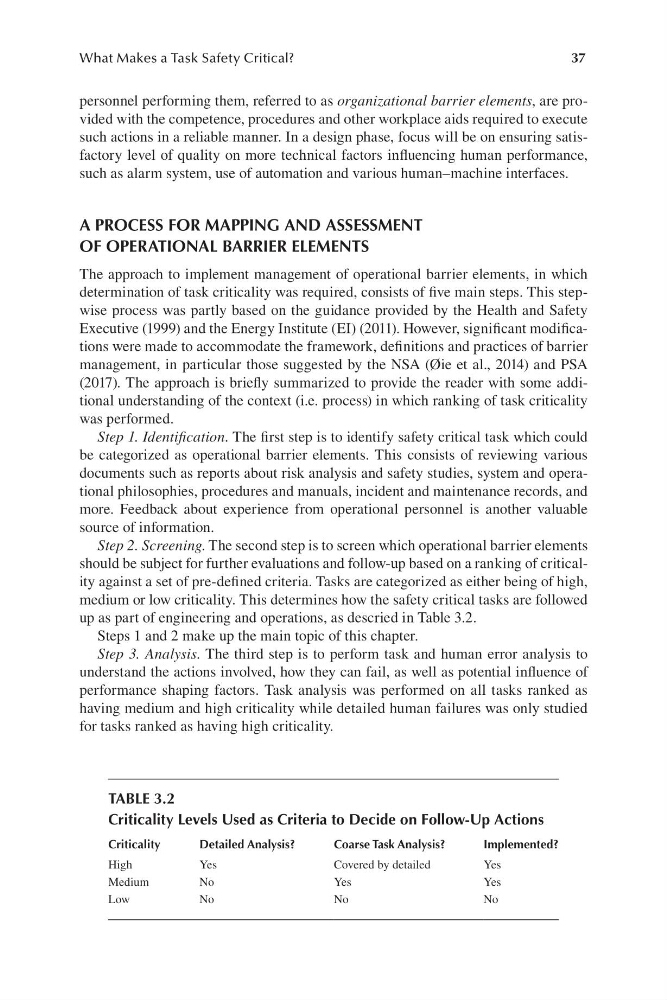
Step 2. Screening. The second step is to screen which operational barrier elements
should be subject for further evaluations and follow-up based on a ranking of criticality against a set of pre-defined criteria. Tasks are categorized as either being of high,
medium or low criticality. This determines how the safety critical tasks are followed
up as part of engineering and operations, as descried in Table 3.2.
Steps 1 and 2 make up the main topic of this chapter.
Step 3. Analysis. The third step is to perform task and human error analysis to
understand the actions involved, how they can fail, as well as potential influence of
performance shaping factors. Task analysis was performed on all tasks ranked as
having medium and high criticality while detailed human failures was only studied
for tasks ranked as having high criticality.
TABLE 3.2
Criticality Levels Used as Criteria to Decide on Follow-Up Actions
Criticality
Detailed Analysis?
Coarse Task Analysis?
Implemented?
High
Yes
Covered by detailed
Yes
Medium
No
Yes
Yes
Low
No
No
No
What Makes a Task Safety Critical?
personnel performing them, referred to as organizational barrier elements, are provided with the competence, procedures and other workplace aids required to execute
such actions in a reliable manner. In a design phase, focus will be on ensuring satisfactory level of quality on more technical factors influencing human performance,
such as alarm system, use of automation and various human–machine interfaces.
A PROCESS FOR MAPPING AND ASSESSMENT
OF OPERATIONAL BARRIER ELEMENTS
The approach to implement management of operational barrier elements, in which
determination of task criticality was required, consists of five main steps. This stepwise process was partly based on the guidance provided by the Health and Safety
Executive ( 1999) and the Energy Institute ( EI) ( 2011). However, significant modifications were made to accommodate the framework, definitions and practices of barrier
management, in particular those suggested by the NSA ( Øie et al., 2014) and PSA
( 2017). The approach is briefly summarized to provide the reader with some additional understanding of the context ( i.e. process) in which ranking of task criticality
was performed.
Step 1. Identification. The first step is to identify safety critical task which could
be categorized as operational barrier elements. This consists of reviewing various
documents such as reports about risk analysis and safety studies, system and operational philosophies, procedures and manuals, incident and maintenance records, and
more. Feedback about experience from operational personnel is another valuable
source of information.
Step 2. Screening. The second step is to screen which operational barrier elements
should be subject for further evaluations and follow-up based on a ranking of criticality against a set of pre-defined criteria. Tasks are categorized as either being of high,
medium or low criticality. This determines how the safety critical tasks are followed
up as part of engineering and operations, as descried in Table 3.2.
Steps 1 and 2 make up the main topic of this chapter.
Step 3. Analysis. The third step is to perform task and human error analysis to
understand the actions involved, how they can fail, as well as potential influence of
performance shaping factors. Task analysis was performed on all tasks ranked as
having medium and high criticality while detailed human failures was only studied
for tasks ranked as having high criticality.
TABLE 3.2
Criticality Levels Used as Criteria to Decide on Follow-Up Actions
Criticality
Detailed Analysis?
Coarse Task Analysis?
Implemented?
High
Yes
Covered by detailed
Yes
Medium
No
Yes
Yes
Low
No
No
No