

15
Human Factors in Accident Investigation
HUMAN FACTORS AND ‘ SENSE-MAKING’
IN ACCIDENT INVESTIGATION
Kilskar et al. ( 2019) concluded that the term sense-making is often underspecified
in the literature, although when it is used, the focus appears to be on operational
safety, in the main, and on those involved at the time. This is in contrast to HF,
which is a mature discipline applied throughout the system lifecycle ( see Ministry
of Defence 2015, for example). From the perspective of HF, then, questions about
sense-making can be asked at any of the stages of the CADMID cycle ( Conception,
Design, Assessment, Manufacture, In-Use, Decommission).
In order to makes sense of safety occurrences, investigators should distinguish
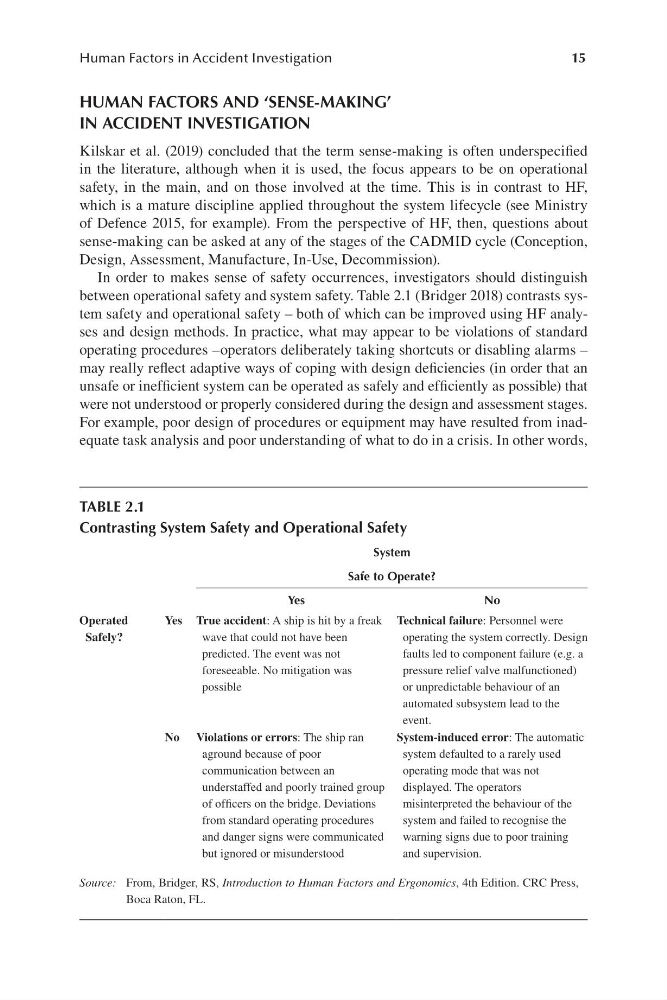
between operational safety and system safety. Table 2.1 ( Bridger 2018) contrasts system safety and operational safety – both of which can be improved using HF analyses and design methods. In practice, what may appear to be violations of standard
operating procedures –operators deliberately taking shortcuts or disabling alarms –
may really reflect adaptive ways of coping with design deficiencies ( in order that an
unsafe or inefficient system can be operated as safely and efficiently as possible) that
were not understood or properly considered during the design and assessment stages.
For example, poor design of procedures or equipment may have resulted from inadequate task analysis and poor understanding of what to do in a crisis. In other words,
TABLE 2.1
Contrasting System Safety and Operational Safety
System
Safe to Operate?
Yes
No
Operated
Yes True accident: A ship is hit by a freak Technical failure: Personnel were
Safely?
wave that could not have been
operating the system correctly. Design
predicted. The event was not
faults led to component failure ( e.g. a
foreseeable. No mitigation was
pressure relief valve malfunctioned)
possible
or unpredictable behaviour of an
automated subsystem lead to the
event.
No Violations or errors: The ship ran
System-induced error: The automatic
aground because of poor
system defaulted to a rarely used
communication between an
operating mode that was not
understaffed and poorly trained group displayed. The operators
of officers on the bridge. Deviations
misinterpreted the behaviour of the
from standard operating procedures
system and failed to recognise the
and danger signs were communicated
warning signs due to poor training
but ignored or misunderstood
and supervision.
Source: From, Bridger, RS, Introduction to Human Factors and Ergonomics, 4th Edition. CRC Press,
Boca Raton, FL.
Human Factors in Accident Investigation
HUMAN FACTORS AND ‘ SENSE-MAKING’
IN ACCIDENT INVESTIGATION
Kilskar et al. ( 2019) concluded that the term sense-making is often underspecified
in the literature, although when it is used, the focus appears to be on operational
safety, in the main, and on those involved at the time. This is in contrast to HF,
which is a mature discipline applied throughout the system lifecycle ( see Ministry
of Defence 2015, for example). From the perspective of HF, then, questions about
sense-making can be asked at any of the stages of the CADMID cycle ( Conception,
Design, Assessment, Manufacture, In-Use, Decommission).
In order to makes sense of safety occurrences, investigators should distinguish
between operational safety and system safety. Table 2.1 ( Bridger 2018) contrasts system safety and operational safety – both of which can be improved using HF analyses and design methods. In practice, what may appear to be violations of standard
operating procedures –operators deliberately taking shortcuts or disabling alarms –
may really reflect adaptive ways of coping with design deficiencies ( in order that an
unsafe or inefficient system can be operated as safely and efficiently as possible) that
were not understood or properly considered during the design and assessment stages.
For example, poor design of procedures or equipment may have resulted from inadequate task analysis and poor understanding of what to do in a crisis. In other words,
TABLE 2.1
Contrasting System Safety and Operational Safety
System
Safe to Operate?
Yes
No
Operated
Yes True accident: A ship is hit by a freak Technical failure: Personnel were
Safely?
wave that could not have been
operating the system correctly. Design
predicted. The event was not
faults led to component failure ( e.g. a
foreseeable. No mitigation was
pressure relief valve malfunctioned)
possible
or unpredictable behaviour of an
automated subsystem lead to the
event.
No Violations or errors: The ship ran
System-induced error: The automatic
aground because of poor
system defaulted to a rarely used
communication between an
operating mode that was not
understaffed and poorly trained group displayed. The operators
of officers on the bridge. Deviations
misinterpreted the behaviour of the
from standard operating procedures
system and failed to recognise the
and danger signs were communicated
warning signs due to poor training
but ignored or misunderstood
and supervision.
Source: From, Bridger, RS, Introduction to Human Factors and Ergonomics, 4th Edition. CRC Press,
Boca Raton, FL.